

BitViraj Technologies - Your Gateway to
Tomorrow's Innovations
Why 2026 Is Being Called the Year of Quantum Error Correction
By Bitviraj Technology
Why 2026 Is Being Called the Year of Quantum Error Correction
Introduction
Quantum computing has spent the better part of the last decade promising a future where machines can solve problems that would take today's most powerful supercomputers thousands of years. From drug discovery and climate modeling to financial optimization and cybersecurity, the potential applications seem limitless. Yet despite billions of dollars in investment and impressive hardware advancements, one challenge has consistently stood in the way of practical quantum computing: errors.
In 2026, that challenge is finally beginning to look solvable.
Researchers, technology giants, and quantum startups around the world have made remarkable progress in Quantum Error Correction (QEC), leading many experts to call 2026 the "Year of Quantum Error Correction." While previous years focused on increasing qubit counts and demonstrating quantum advantage, the conversation has now shifted toward building reliable quantum computers that can perform meaningful calculations without collapsing under the weight of their own errors.
But why is Quantum Error Correction such a big deal, and why are industry leaders suddenly so excited about it?
Let's explore.
The Quantum Computing Problem Nobody Could Ignore
To understand Quantum Error Correction, we first need to understand why quantum computers are so fragile.
Unlike classical computers, which store information as bits represented by 0s and 1s, quantum computers use qubits. A qubit can exist in multiple states simultaneously through a phenomenon known as superposition. Combined with quantum entanglement, this gives quantum computers extraordinary computational power.
However, there is a catch.
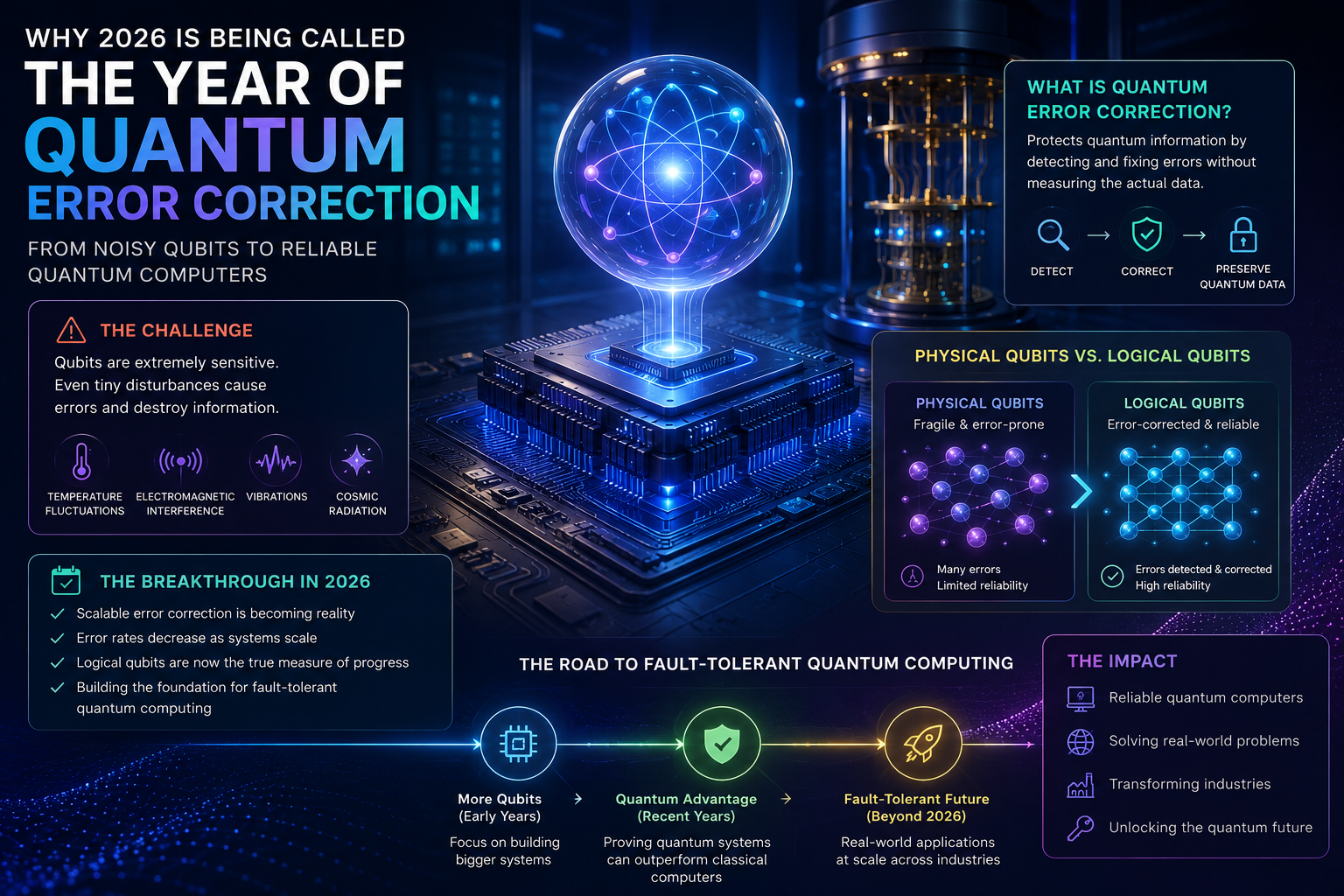
Qubits are incredibly sensitive to their environment. Even the smallest disturbance—temperature fluctuations, electromagnetic interference, vibrations, or cosmic radiation—can introduce errors into calculations.
This phenomenon, known as decoherence, causes quantum information to degrade rapidly. As the number of qubits increases, so does the likelihood of errors, making large-scale quantum computation extremely difficult.
For years, researchers could build more qubits, but they struggled to keep those qubits stable long enough to solve useful problems.
That's where Quantum Error Correction comes in.
What Is Quantum Error Correction?
Quantum Error Correction is a set of techniques designed to detect and correct errors in quantum systems without destroying the quantum information being processed.
At first glance, this sounds impossible.
Measuring a qubit directly typically collapses its quantum state, eliminating the very information researchers want to preserve. Quantum Error Correction solves this problem by encoding information across multiple physical qubits instead of storing it in just one.
Rather than monitoring the actual data qubit, researchers measure carefully designed error syndromes that reveal whether an error has occurred without exposing the underlying quantum information.
Think of it like backing up an important file across multiple storage devices. If one device fails, the original information can still be reconstructed.
The same principle applies in quantum computing, except the mathematics and engineering are significantly more complex.
Physical Qubits vs. Logical Qubits
One of the most important concepts in Quantum Error Correction is the distinction between physical qubits and logical qubits.
Physical Qubits
Physical qubits are the actual hardware components found inside a quantum computer. Depending on the architecture, they may be superconducting circuits, trapped ions, neutral atoms, or photons. While these qubits perform computations, they are inherently noisy and prone to errors.
Logical Qubits
Logical qubits are error-corrected qubits created by combining multiple physical qubits into a more reliable computational unit. Instead of relying on a single fragile qubit, a logical qubit distributes information across many physical qubits, allowing the system to detect and correct errors automatically.
This is why many experts argue that logical qubits matter far more than physical qubit counts.
For years, quantum companies competed by announcing machines with larger and larger numbers of physical qubits. However, a quantum processor with 1,000 unstable qubits may be less useful than one with a smaller number of highly reliable logical qubits.
In 2026, the industry's focus has clearly shifted from quantity to quality.
Why 2026 Is Different
Quantum Error Correction is not a new idea. Researchers have been working on it for decades.
What makes 2026 different is that several major breakthroughs have demonstrated that scalable error correction is becoming practical rather than theoretical.
For the first time, researchers are consistently showing that increasing the size of error-corrected systems can reduce error rates instead of increasing them.
This may sound like a small achievement, but it represents one of the most important milestones in quantum computing history.
Simply put, scientists are proving that quantum computers can become more reliable as they grow larger.
That changes everything.
IBM's Push Toward Fault-Tolerant Quantum Computing
IBM has been one of the strongest advocates for practical Quantum Error Correction.
Over the past few years, the company has shifted its strategy away from simply building larger processors and toward developing fault-tolerant quantum systems capable of running complex algorithms.
IBM's roadmap emphasizes logical qubit performance as a key measurement of progress. The company believes that meaningful commercial quantum applications will emerge only when error-corrected logical qubits can operate reliably at scale.
Researchers at IBM have demonstrated improved error suppression techniques and continue developing architectures specifically designed to support fault-tolerant computing.
For many industry observers, IBM's progress has reinforced the idea that Quantum Error Correction is no longer an academic exercise but a commercial necessity.
Google's Continued Breakthroughs
Google has also played a significant role in advancing Quantum Error Correction.
After previously demonstrating quantum supremacy, Google's research teams shifted their attention toward reducing error rates in quantum processors.
Recent studies have shown that larger error-corrected quantum systems can outperform smaller ones, validating a key prediction of Quantum Error Correction theory.
This achievement is important because it demonstrates that error correction can scale effectively, one of the biggest uncertainties facing the industry.
Google's work has strengthened confidence that fault-tolerant quantum computing is achievable within the coming decade.
Quantinuum's Focus on High-Fidelity Logical Qubits
Quantinuum has emerged as one of the most respected players in the quantum industry due to its emphasis on reliability and precision.
Rather than focusing exclusively on qubit counts, the company has prioritized creating highly stable logical qubits capable of maintaining quantum information for longer periods.
Using trapped-ion technology, Quantinuum has reported impressive logical qubit performance and some of the highest fidelity rates in the industry.
These advancements have demonstrated that different hardware approaches can successfully support Quantum Error Correction, broadening the possibilities for future quantum architectures.
The Industry-Wide Shift in Success Metrics
Perhaps the most significant change in 2026 is how the industry measures success.
A few years ago, headlines were dominated by announcements such as:
- "Company X launches a 500-qubit processor."
- "Company Y reaches 1,000 physical qubits."
Today, investors, researchers, and enterprise customers are asking different questions:
- How many logical qubits does the system support?
- What is the error rate?
- Can the system perform useful computations reliably?
- Is the architecture fault tolerant?
This shift reflects a growing maturity within the quantum ecosystem.
The industry now understands that practical quantum computing will not be achieved through larger machines alone. Reliability must come first.
What Quantum Error Correction Means for Businesses
For enterprises watching the quantum space, Quantum Error Correction could be the development that finally transforms quantum computing from a research project into a business tool.
Reliable quantum systems could unlock applications in:
Drug Discovery
Researchers could accurately simulate complex molecules and chemical reactions, dramatically reducing pharmaceutical development timelines.
Financial Services
Banks and investment firms could tackle optimization problems involving massive datasets and market variables.
Materials Science
Scientists could discover new materials for batteries, semiconductors, and sustainable energy solutions.
Artificial Intelligence
Future quantum-enhanced machine learning systems may improve optimization and accelerate specific AI workloads.
While widespread commercial adoption may still be several years away, Quantum Error Correction is the foundation that makes these possibilities realistic.
Challenges Still Ahead
Despite the excitement, significant hurdles remain.
Creating a single fault-tolerant logical qubit often requires dozens, hundreds, or even thousands of physical qubits, depending on the error correction method used.
Researchers must continue improving:
- Hardware quality
- Error detection efficiency
- Quantum control systems
- Manufacturing scalability
- Software optimization
The road to large-scale fault-tolerant quantum computing is still long.
However, for the first time, the industry can see a credible path forward.
The Beginning of a New Quantum Era
History may ultimately remember 2026 as the year quantum computing stopped chasing bigger numbers and started building reliable machines.
Quantum Error Correction has shifted from being a theoretical requirement to becoming the central focus of the entire industry. Companies such as IBM, Google, Quantinuum, and numerous research institutions are proving that error-corrected quantum systems can work—and that they can scale.
The importance of this transition cannot be overstated.
Just as error correction enabled the rise of modern digital communications, cloud computing, and data storage, Quantum Error Correction may become the technology that unlocks the true potential of quantum computing.
The race is no longer about who has the most qubits.
It's about who can make those qubits reliable.
And that is why 2026 is being called the Year of Quantum Error Correction.
About Bitviraj Technology
At Bitviraj Technology, we explore emerging technologies that are shaping the future of business and innovation. From artificial intelligence and cloud computing to cybersecurity and quantum technologies, our goal is to help organizations understand the trends that will define the next generation of digital transformation.
Case Studies
Empowering Digital
Evolution



Blogs
Empowering Digital
Evolution
BitViraj Technologies - Your Gateway to
Tomorrow's Innovations



Embark on a DigitalJourney


The next-generation digital technology company Bitviraj has the potential to empower and reinvent business in the current fast-paced market.


Our Service
- Website Development
- Application Development
- Blockchain Development
- Gaming and Metaverse