

BitViraj Technologies - Your Gateway to
Tomorrow's Innovations
Quantum Computing vs AI: Competition or Collaboration?
Artificial intelligence and quantum computing are two of the most transformative technologies of the modern era. AI has already changed the way businesses operate, how people interact with technology, and how organizations analyze information. From generative AI and autonomous systems to advanced data analytics, artificial intelligence has moved rapidly from research laboratories into everyday applications.
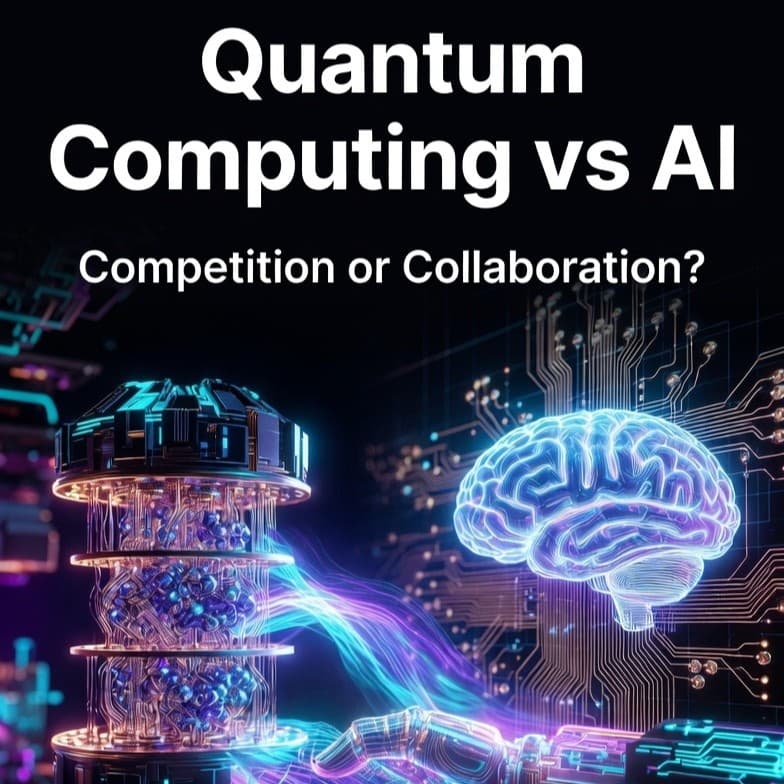
Quantum Computing vs AI
Competition or Collaboration?
Introduction
Artificial intelligence and quantum computing are two of the most transformative technologies of the modern era.
AI has already changed the way businesses operate, how people interact with technology, and how organizations analyze information. From generative AI and autonomous systems to advanced data analytics, artificial intelligence has moved rapidly from research laboratories into everyday applications.
Quantum computing, meanwhile, represents a new approach to computation based on the principles of quantum mechanics. Although still developing, quantum technology promises to solve certain complex problems that are beyond the capabilities of classical computers.
As both technologies continue to advance, an important question has emerged:
Will quantum computing compete with artificial intelligence, or will the two technologies work together to create something far more powerful?
The answer is increasingly clear.
Rather than replacing each other, AI and quantum computing are likely to become partners.
The future may not be a battle between quantum computers and AI systems. Instead, it may be a collaboration where each technology strengthens the other.
The Rise of Two Revolutionary Technologies
To understand the relationship between AI and quantum computing, it is important to understand their different strengths.
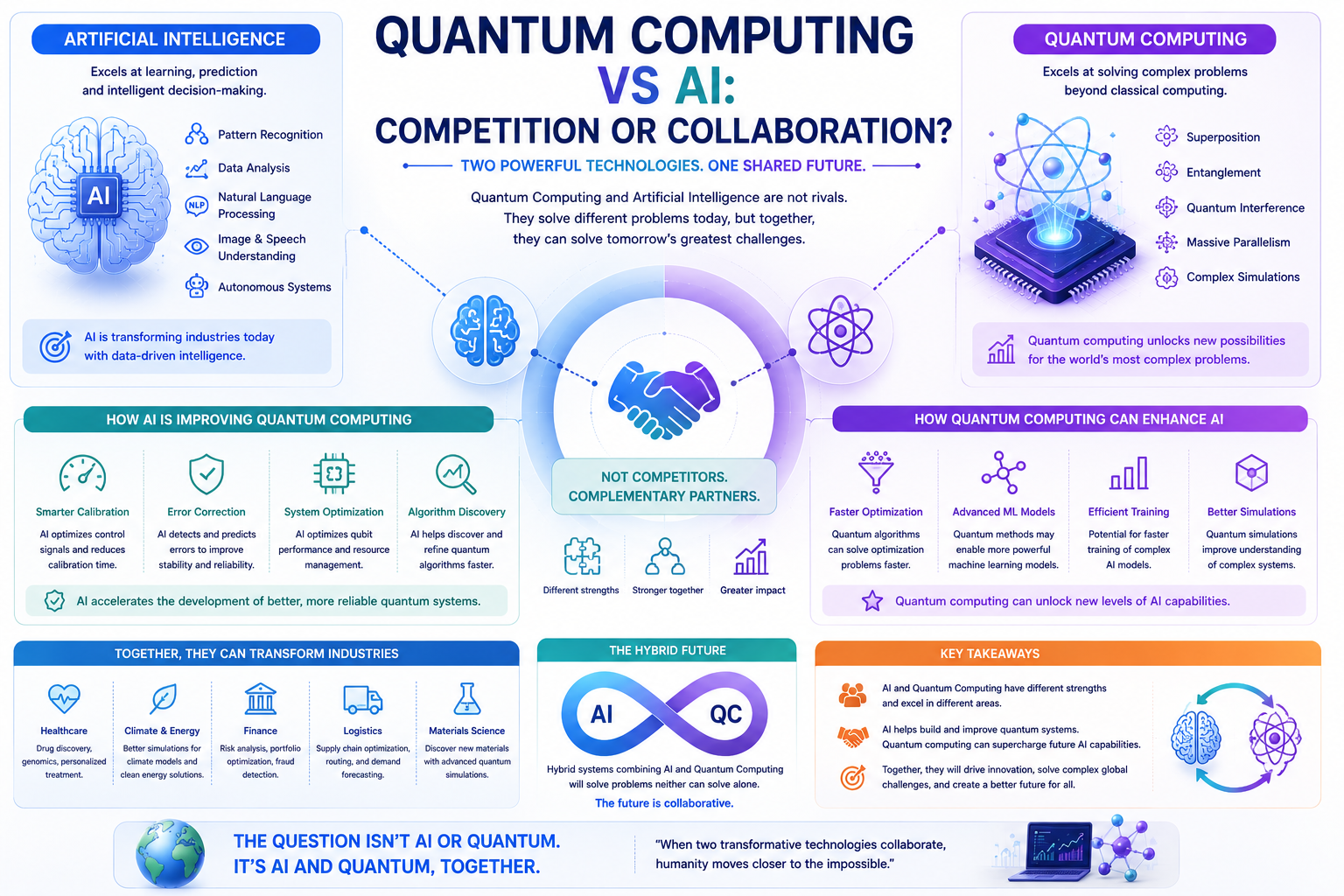
Artificial intelligence excels at recognizing patterns, learning from data, making predictions, and automating complex decision-making.
Modern AI systems are powered by classical computing infrastructure, including:
- CPUs
- GPUs
- Cloud computing platforms
- Specialized AI accelerators
Quantum computing takes a different approach.
Instead of processing information using traditional bits, quantum computers use quantum bits, or qubits, which operate according to quantum mechanical principles such as:
- Superposition
- Entanglement
- Quantum interference
Quantum computers are not designed to replace classical computers. Instead, they are expected to provide advantages for specific categories of problems involving optimization, simulation, and complex mathematical calculations.
The intersection between these two technologies creates a fascinating opportunity.
Can Quantum Computers Accelerate AI?
One of the biggest questions in the technology industry is whether quantum computers can make artificial intelligence more powerful.
The potential exists, but the reality is more complex.
Today's AI models require enormous amounts of computing power. Training advanced models can involve billions of parameters and require massive data center infrastructure.
Quantum computing could eventually help accelerate certain parts of the AI pipeline.
Potential applications include:
- Faster optimization
- Improved machine learning algorithms
- Advanced pattern recognition
- Better sampling methods
- More efficient model training
However, quantum computers are not expected to replace GPUs or classical AI infrastructure anytime soon.
Instead, future AI systems will likely use a hybrid approach where quantum processors handle specific tasks while classical systems manage the rest.
Quantum Machine Learning: The Future Intersection of AI and Quantum Computing
One of the most exciting research areas connecting these fields is Quantum Machine Learning (QML).
Quantum Machine Learning explores how quantum algorithms can improve machine learning processes and how AI techniques can help develop better quantum systems.
Researchers are investigating whether quantum methods could improve:
- Data classification
- Optimization problems
- Pattern detection
- Feature extraction
- Complex simulations
The idea behind QML is not simply 'faster AI.'
The goal is to discover new computational approaches that become possible only when quantum mechanics and machine learning work together.
Although QML is still in its early stages, it has attracted significant interest from universities, technology companies, and research organizations worldwide.
How AI Is Already Improving Quantum Hardware
Interestingly, the relationship between AI and quantum computing is not one-sided.
While researchers explore how quantum computers can improve AI, AI is already helping scientists build better quantum computers.
Quantum hardware is extremely difficult to operate.
Qubits are sensitive to environmental changes, noise, and imperfections. Maintaining stable quantum systems requires constant monitoring, calibration, and optimization.
This is where artificial intelligence is becoming increasingly valuable.
AI-Powered Quantum Calibration
Quantum processors require precise control systems to operate correctly.
Small errors in:
- Temperature
- Electrical signals
- Laser control
- Microwave pulses
can affect quantum calculations.
AI algorithms can analyze large amounts of operational data and automatically adjust system parameters.
Machine learning techniques can help:
- Detect hardware problems
- Optimize control signals
- Reduce calibration time
- Improve qubit performance
This allows quantum researchers to manage increasingly complex systems.
AI and Quantum Error Correction
Quantum error correction is one of the biggest challenges facing the industry.
Unlike classical computers, quantum systems cannot simply copy information to create backups. Researchers must use advanced techniques to detect and correct errors without destroying quantum states.
AI can assist by identifying error patterns and optimizing correction strategies.
Machine learning models may help:
- Predict quantum errors
- Improve error detection
- Optimize quantum circuits
- Increase system reliability
As quantum computers grow larger, AI-driven error management could become essential.
AI for Quantum Algorithm Discovery
Developing quantum algorithms requires deep mathematical expertise.
AI systems are increasingly being explored as tools for discovering and improving quantum algorithms.
Machine learning models can analyze:
- Quantum circuits
- Optimization strategies
- Algorithm performance
- Hardware limitations
This could accelerate the process of finding better ways to use quantum computers.
In the future, AI may become an important partner for quantum researchers.
Could Quantum Computing Transform Artificial Intelligence?
While AI is currently far ahead in commercial adoption, quantum computing could eventually introduce new possibilities.
Some potential areas of impact include:
Advanced Optimization
Many AI systems depend on optimization problems. Training machine learning models involves finding the best parameters from enormous possibilities. Quantum optimization algorithms may eventually improve certain training processes.
Better Scientific AI Models
AI is increasingly used in areas such as drug discovery, climate modeling, materials science, and physics research. Quantum computers could enhance these applications by providing more accurate simulations and calculations.
Improved Data Analysis
Quantum systems may eventually help analyze complex datasets where relationships are difficult to identify using classical methods. This could benefit industries including healthcare, finance, manufacturing, and cybersecurity.
The Reality Check: Current Limitations
Despite the excitement, it is important to separate future possibilities from current capabilities.
Today, quantum computing faces several limitations:
Hardware Challenges
Current quantum computers have limited qubit numbers, high error rates, and short coherence times. Large-scale fault-tolerant quantum computing remains under development.
Data Challenges
Modern AI depends heavily on massive datasets. Quantum systems are not automatically better at processing large amounts of classical data. Efficient methods for transferring information between classical and quantum systems are still being researched.
Algorithm Development
Many proposed quantum AI applications require new algorithms that have not yet reached practical maturity. The field is promising, but significant scientific work remains.
The Future of Quantum AI
Between 2026 and 2030, the relationship between AI and quantum computing is expected to become increasingly important.
Several trends are likely to shape the future:
Hybrid AI-Quantum Systems
Most early applications will probably combine classical AI systems with quantum processors. Rather than replacing existing technology, quantum computers will act as specialized accelerators.
Automated Quantum Development
AI tools may help researchers design quantum circuits, improve hardware performance, and discover new algorithms.
Industry-Specific Applications
The strongest early use cases may emerge in areas such as pharmaceutical research, financial modeling, energy optimization, advanced materials, and scientific simulation.
Quantum-Powered AI Research
As quantum hardware improves, researchers will continue exploring whether quantum approaches can unlock entirely new AI capabilities.
Competition or Collaboration?
The idea that quantum computing and AI are competing technologies is misleading.
They solve different problems.
AI helps machines learn, reason, and make predictions.
Quantum computing provides a new computational framework for solving specific complex problems.
The future will likely involve both technologies working together.
A useful comparison is the relationship between CPUs and GPUs.
GPUs did not replace CPUs.
Instead, they became powerful accelerators that transformed computing.
Quantum processors may follow a similar path.
They may become specialized tools that enhance AI systems rather than replace them.
The Business Impact of Quantum AI
For businesses, the convergence of AI and quantum computing represents a major opportunity.
Organizations that understand both technologies early may gain advantages in:
- Research and development
- Data analysis
- Optimization
- Product innovation
- Scientific discovery
However, companies should approach quantum AI strategically.
The goal should not be adopting quantum technology simply because it is emerging.
The focus should be identifying specific business problems where quantum approaches could eventually provide value.
Final Thoughts
Quantum computing and artificial intelligence are often presented as competing technologies fighting for the future of computing.
The reality is far more interesting.
They are likely to become partners.
AI is already helping researchers build better quantum computers through improved calibration, optimization, and error correction. At the same time, quantum computing may eventually provide new tools that enhance artificial intelligence itself.
The next generation of computing may not belong to quantum or AI alone.
It may belong to the combination of both.
As these technologies continue to evolve, the biggest breakthroughs may come not from one replacing the other—but from what happens when they work together.
About Bitviraj Technology
Bitviraj Technology explores the technologies shaping the future of business and innovation, including artificial intelligence, quantum computing, cybersecurity, cloud computing, and digital transformation. Through industry insights and technology analysis, we help organizations understand the trends that will define tomorrow's digital world.
Case Studies
Empowering Digital
Evolution



Blogs
Empowering Digital
Evolution
BitViraj Technologies - Your Gateway to
Tomorrow's Innovations


Embark on a DigitalJourney


The next-generation digital technology company Bitviraj has the potential to empower and reinvent business in the current fast-paced market.


Our Service
- Website Development
- Application Development
- Blockchain Development
- Gaming and Metaverse