

BitViraj Technologies - Your Gateway to
Tomorrow's Innovations
Tokenization of Luxury Private Jets: Framework, Technical Architecture, and Emerging Projects (2026)
The tokenization of luxury private jets represents one of the most compelling applications of Real World Asset (RWA) tokenization. By converting ownership rights or revenue streams from physical aviation assets into digital tokens on blockchain networks, this model enables fractional ownership, liquidity, and global investment access in an asset class that has historically been limited to ultra-high-net-worth individuals and institutional investors.

By Bitviraj Technology
April 5, 2024
Tokenization of Luxury Private Jets
Framework, Technical Architecture, and Emerging Projects (2026)
Tokenization of Luxury Private Jets: Framework, Technical Architecture, and Emerging Projects (2026)
Introduction
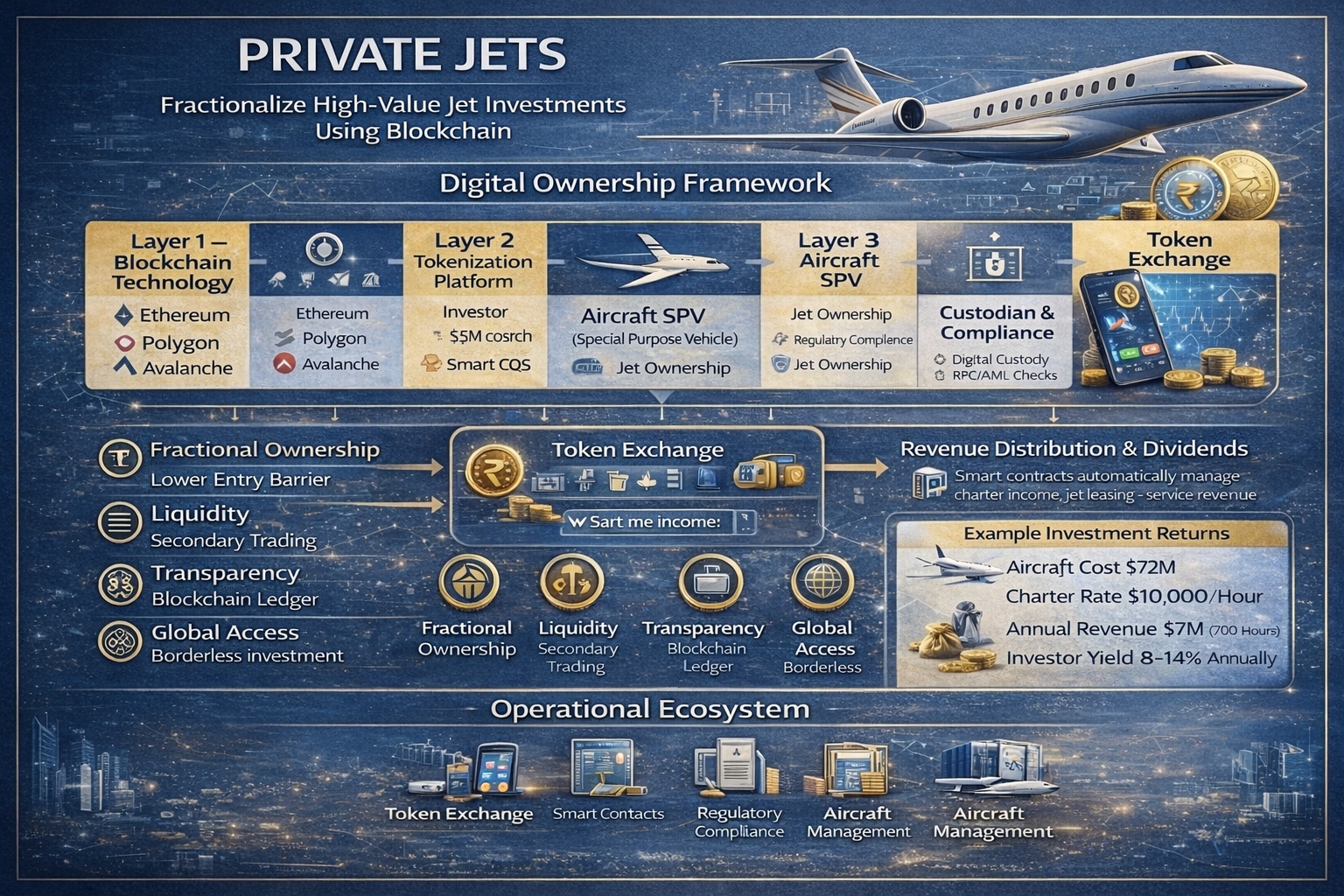
The tokenization of luxury private jets represents one of the most compelling applications of Real World Asset (RWA) tokenization. By converting ownership rights or revenue streams from physical aviation assets into digital tokens on blockchain networks, this model enables fractional ownership, liquidity, and global investment access in an asset class that has historically been limited to ultra-high-net-worth individuals and institutional investors.
Private jets are traditionally high-value, illiquid assets, with acquisition costs ranging from $15 million to $75 million, depending on the aircraft model (e.g., Gulfstream, Bombardier Global, Dassault Falcon). Operating costs, maintenance, and management complexities further restrict ownership to a small group of buyers.
Tokenization fundamentally changes this paradigm by allowing investors to own fractional economic interests in aircraft, while blockchain technology provides transparent ownership records, automated revenue distribution, and regulatory compliance frameworks.
As of 2026, several aviation companies, fintech platforms, and blockchain infrastructure providers are actively building tokenized aviation ecosystems.
This article provides a complete framework, technical architecture, and overview of live projects shaping the future of private jet tokenization.
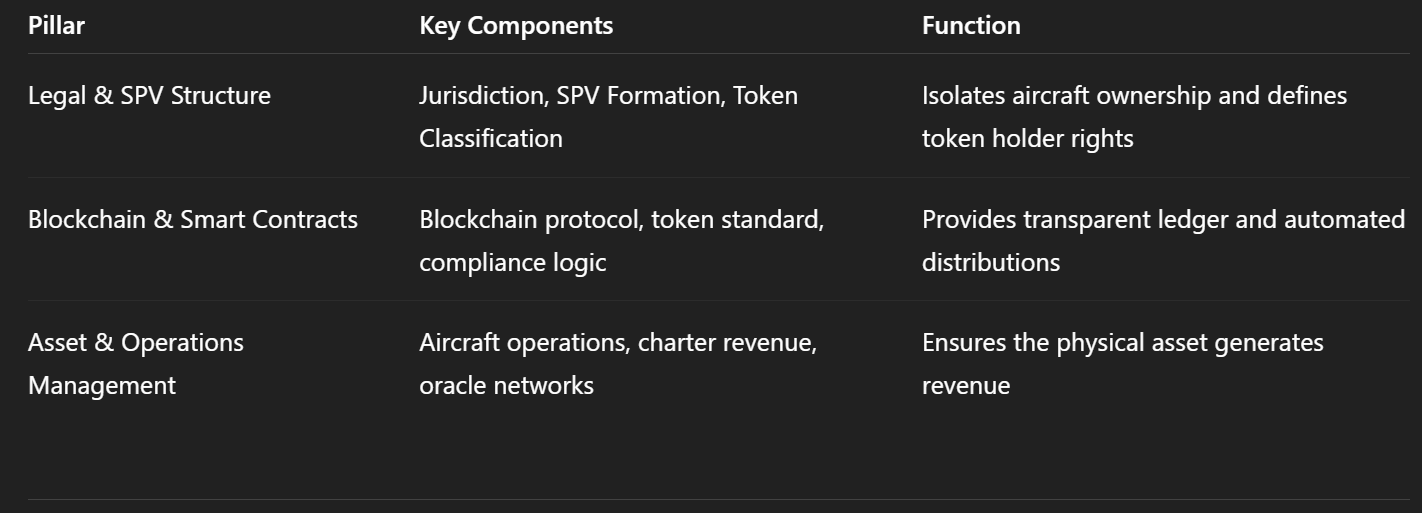
The Three Pillars of Private Jet Tokenization
A robust tokenization ecosystem for aviation assets is built upon three fundamental pillars:
1. Legal Structuring
SPV frameworks, regulatory compliance, and investor protection
2. Blockchain Infrastructure
Smart contracts, token standards, and automated distribution
3. Asset & Operations Management
Aircraft operations, maintenance, and charter management
These pillars ensure that digital tokens represent legally enforceable economic rights tied to real-world aviation assets.
1. Legal Structure: The Foundation of Aviation Tokenization
Tokenization of real-world assets requires strong legal frameworks to ensure investor protection and regulatory compliance.
The standard structure used in aviation tokenization is the Special Purpose Vehicle (SPV) model.
Special Purpose Vehicle (SPV)
An SPV is a dedicated legal entity created specifically to hold the aircraft asset.
Typical jurisdictions include:
British Virgin Islands
Cayman Islands
Delaware (USA)
Singapore
Dubai International Financial Centre (DIFC)
The SPV owns the aircraft, while tokens represent economic shares in the SPV.
This structure provides:
- Legal isolation of the aircraft
- Protection from operating company liabilities
- Clear investor ownership rights
Rather than giving investors direct ownership of the aircraft, tokens generally represent:
- revenue participation rights
- profit sharing
- asset-backed securities
This approach ensures compliance with securities regulations.
Regulatory Compliance
Because tokenized aircraft shares represent financial rights, they are typically classified as security tokens.
Compliance mechanisms include:
KYC (Know Your Customer)
AML (Anti-Money Laundering)
Accredited investor verification
Transfer restrictions
Regulatory frameworks commonly referenced include:
- U.S. Securities Act
- EU MiCA / securities frameworks
- Dubai VARA compliance
- Singapore MAS guidelines
2. Blockchain Infrastructure and Smart Contracts
Blockchain technology forms the digital infrastructure layer of the tokenization ecosystem.
It provides:
- immutable ownership records
- automated financial distribution
- programmable governance mechanisms
Blockchain Protocol Selection
Most tokenization projects select high-security blockchains with established ecosystems.
Common choices include:
Ethereum
Polygon
Arbitrum
Avalanche
Hyperledger Besu
Layer-2 networks such as Arbitrum or Polygon are often preferred because they provide:
- lower transaction fees
- faster settlement
- enterprise scalability
Token Standards
Token standards define how digital assets function.
ERC-20
Simple fungible token standard used for representing financial value.
Advantages:
- widely supported
- exchange compatible
Limitations:
- limited compliance features
ERC-3643 (Security Token Standard)
ERC-3643 is designed specifically for regulated digital securities.
Key features include:
- identity verification
- transfer restrictions
- compliance enforcement
- investor whitelisting
This makes it ideal for tokenized aviation assets where only verified investors may participate.
Smart Contract Logic
Smart contracts automate financial operations and investor rights.
Typical smart contracts include:
- Token Issuance Contract - Handles the minting of aircraft ownership tokens.
- Revenue Distribution Contract - Automates revenue payments to investors.
- Governance Contract - Allows token holders to vote on decisions such as:
- aircraft acquisition
- charter operator selection
- revenue allocation
Revenue Distribution: The Waterfall Model
One of the most important components of aviation tokenization is the financial distribution model.
Smart contracts typically implement a waterfall structure.
Revenue generated from aircraft operations is distributed in the following order:
- Operating costs (fuel, crew, maintenance)
- Aircraft management fees
- Insurance and leasing obligations
- Investor profit distribution
After operational expenses are deducted, remaining profits are distributed proportionally to token holders.
Payments are often executed using stablecoins such as USDC or USDT to avoid volatility.
3. Asset and Operations Management
The digital tokenization system must remain closely connected to real-world aircraft operations.
Without effective operational management, tokenized assets cannot generate investor returns.
Aircraft Operations
A licensed aircraft operator is responsible for:
- charter bookings
- aircraft maintenance
- crew management
- regulatory compliance
Operators may include aviation companies or specialized charter management firms.
Examples include:
NetJets
VistaJet
Flexjet
regional charter operators
Oracle Networks
Oracles provide real-world data feeds to blockchain systems.
In aviation tokenization, oracles may supply data such as:
- flight hours
- aircraft location
- maintenance status
- charter revenue
Oracle providers may include:
- Chainlink
- enterprise aviation data feeds
- IoT-enabled aircraft telemetry systems
These ensure that blockchain records reflect real operational performance.
Technical Architecture of a Tokenized Private Jet
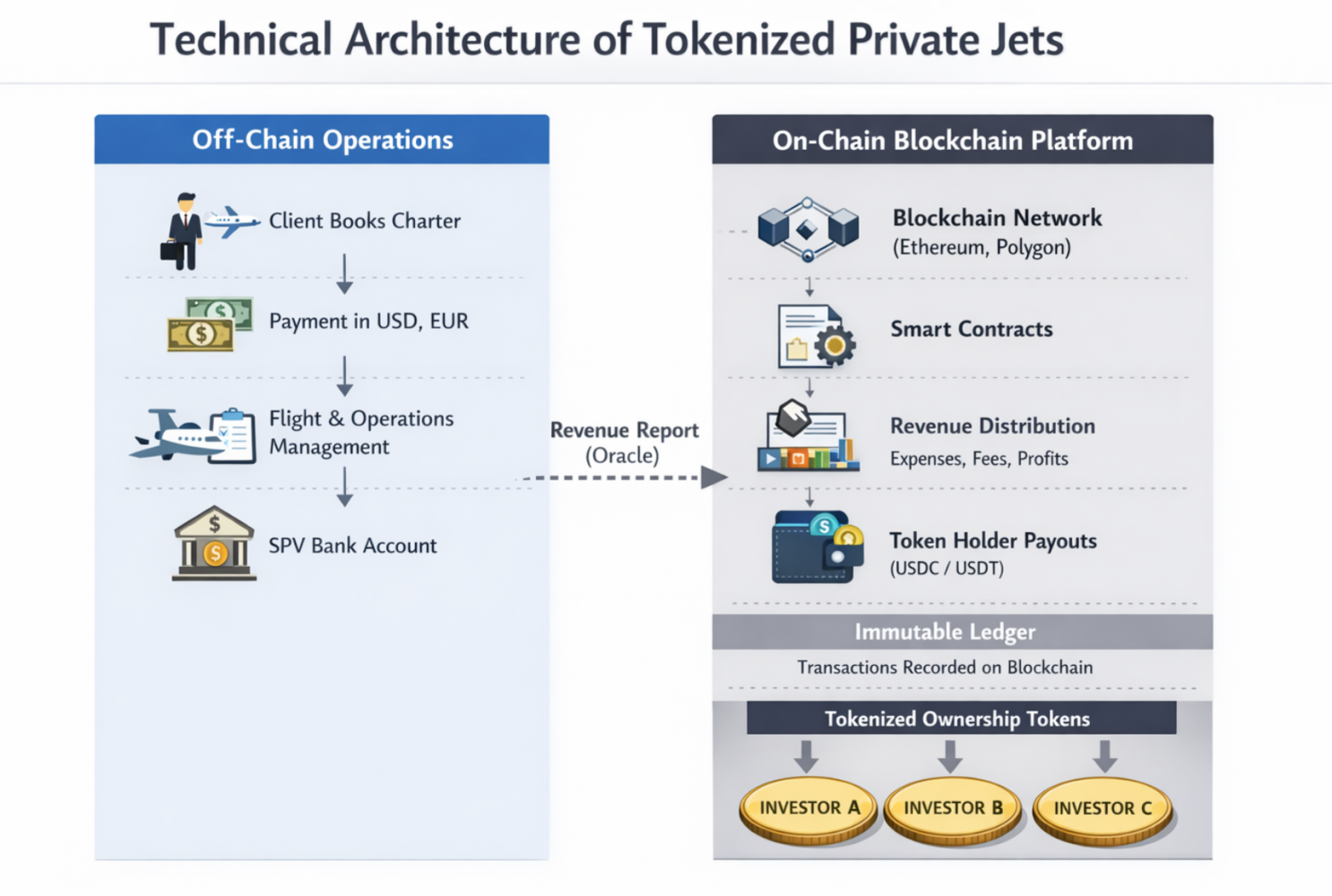
The complete system connects off-chain aviation operations with on-chain financial infrastructure.
1
Step 1: Charter Booking
A charter client books a flight through a broker or platform. The client pays the operator in fiat currency (USD or EUR).
2
Step 2: Operational Execution
The aircraft operator manages the flight, pays crew and fuel costs, and handles logistics. Net revenue is transferred to the SPV bank account.
3
Step 3: Oracle Reporting
The revenue information is reported to the blockchain via an oracle system. This triggers the smart contract distribution mechanism.
4
Step 4: On-Chain Distribution
The smart contract calculates each investor's share based on token ownership. Payments are distributed automatically to token holders.
Example: Investor A owns 5% of tokens, Investor B owns 1% of tokens. Revenue distribution occurs automatically based on token balance.
5
Step 5: Transparent Ledger
All transactions are recorded on the blockchain. Benefits include transparent accounting, immutable financial records, and investor confidence.
Live Projects Tokenizing Aviation Assets
Several companies are actively building tokenized aviation ecosystems.
AriyaX (AXPT)
AriyaX is a Dubai-based aviation company developing a tokenization platform for ultra-long-range private jets.
The project uses:
- SPV structure in the British Virgin Islands
- Stobox tokenization infrastructure
- blockchain-based revenue distribution
The platform allows investors to participate in charter and leasing income generated by private jets.
Website: ariyax.com
DiamondLake Minerals & FlyJetr
DiamondLake Minerals has partnered with FlyJetr to launch a hybrid aviation tokenization platform.
Their initiative focuses on acquiring large business jets such as Gulfstream G450 aircraft and offering a new tokenized ownership structure.
Key features include:
- hybrid security + utility tokens
- aviation asset-backed investments
- digital ownership registry
ETHZilla Corporation
ETHZilla represents a highly regulated aviation tokenization project.
The Eurus Aero Token I focuses on tokenizing revenue from commercial jet engines rather than entire aircraft.
Key characteristics:
- tokenized leasing revenue
- Ethereum Layer-2 infrastructure
- Nasdaq-listed parent company
This demonstrates growing institutional acceptance of aviation tokenization models.
PrivateCharterX
PrivateCharterX integrates blockchain into the charter booking ecosystem.
Features include:
- blockchain-based booking records
- NFT membership access
- carbon credit verification
The platform aims to transform luxury aviation travel infrastructure rather than just ownership models.
AVINOC
AVINOC is one of the earliest blockchain aviation projects, launched in 2017.
Its ecosystem includes:
- VOO token
- decentralized booking marketplace
- aviation payment infrastructure
The project enables transparent private jet booking and payments using blockchain technology.
Skyshare
Skyshare represents a Web3 MVP platform focused on fractional jet ownership.
Technology stack includes:
- ReactJS frontend
- Supabase database
- NFT minting infrastructure
The platform allows aircraft owners to tokenize their jets and enable shared charter bookings.
Benefits of Private Jet Tokenization
Fractional Ownership
Investors can participate with significantly smaller capital commitments.
Example: Instead of purchasing a $50M aircraft, investors may own fractions starting from $50,000–$100,000.
Liquidity
Traditional aviation ownership is extremely illiquid. Tokenization enables trading through secondary marketplaces.
Transparency
Blockchain ensures transparent revenue distribution, immutable ownership records, and auditable transactions.
Global Investment Access
Investors worldwide can access aviation assets without direct aircraft management responsibilities.
Challenges and Regulatory Considerations
Regulatory Complexity
Aircraft ownership and securities laws vary across jurisdictions.
Operational Risk
Aircraft must maintain high utilization rates to generate returns.
Market Liquidity
Secondary trading infrastructure is still developing.
Compliance Costs
KYC, AML, and securities regulations increase operational complexity.
The Future of Tokenized Aviation
The tokenization of private jets represents a significant evolution in real-world asset finance.
As blockchain adoption increases, we may see:
tokenized aircraft fleets
aviation-focused digital exchanges
tokenized aircraft leasing markets
integration with carbon credit markets
Combined with institutional RWA infrastructure, aviation tokenization could become a multi-billion-dollar investment sector.
Conclusion
The tokenization of luxury private jets is rapidly moving from concept to real-world implementation.
By combining:
- robust legal frameworks
- blockchain-powered financial infrastructure
- professional aviation asset management
this model enables a new asset class that is liquid, transparent, and globally accessible.
The success of these platforms will depend on maintaining the right balance between digital innovation and real-world aviation operations.
As RWA tokenization continues to expand, aviation assets may become one of the most exciting high-value sectors in blockchain finance.
Case Studies
Empowering Digital
Evolution



Blogs
Empowering Digital
Evolution
BitViraj Technologies - Your Gateway to
Tomorrow's Innovations



Embark on a DigitalJourney


The next-generation digital technology company Bitviraj has the potential to empower and reinvent business in the current fast-paced market.


Our Service
- Website Development
- Application Development
- Blockchain Development
- Gaming and Metaverse