

BitViraj Technologies - Your Gateway to
Tomorrow's Innovations
By Bitviraj Technology
April 10, 2024
Black Gold, Digital Ledger
The Comprehensive Guide to Oil Barrel Tokenization
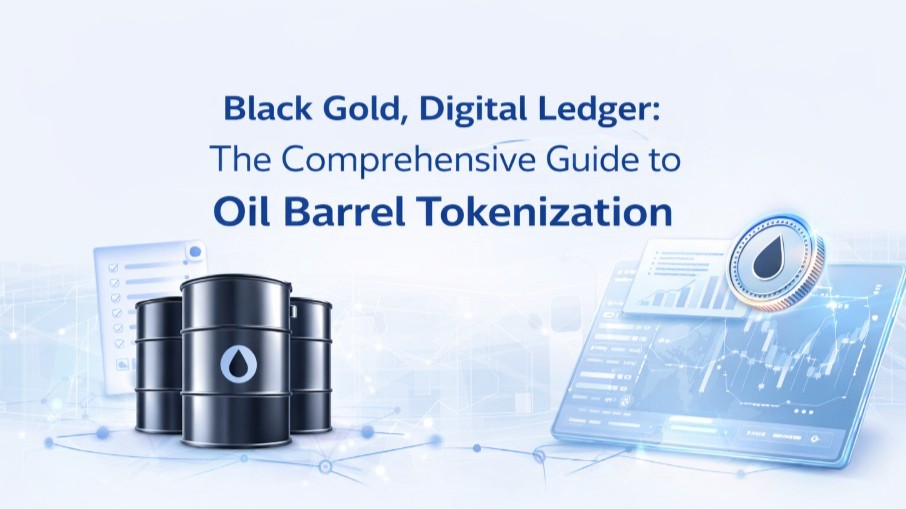
Black Gold, Digital Ledger: The Comprehensive Guide to Oil Barrel Tokenization
Executive Summary
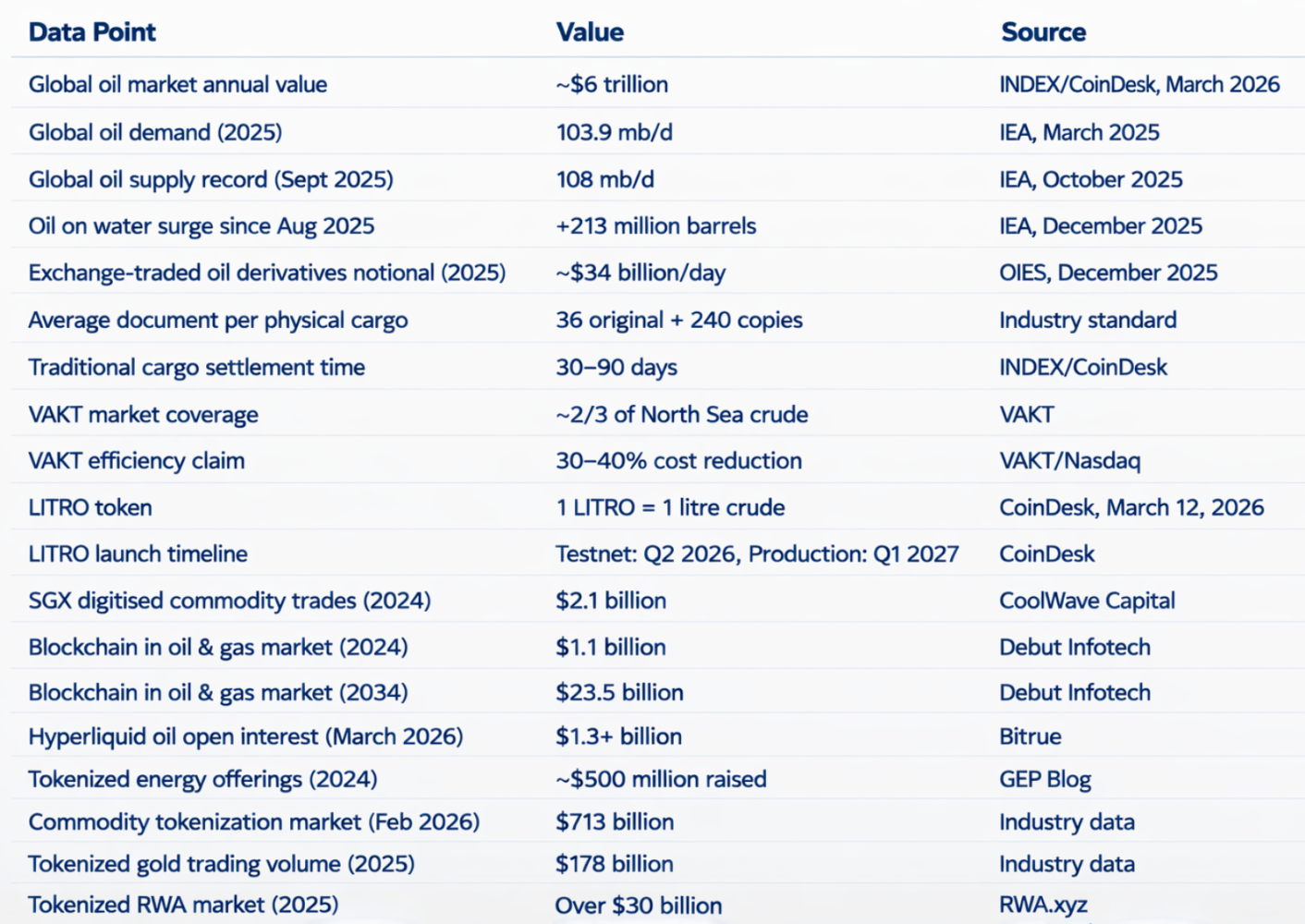
The global oil market—valued at approximately $6 trillion annually, consuming 103.9 million barrels per day, and supporting exchange-traded derivatives volumes exceeding $34 billion per day—remains paradoxically anchored to paper-heavy, multi-intermediary settlement processes. A single physical cargo trade generates an average of 36 original documents and 240 copies, exchanged between 27 different parties, with settlement taking 30 to 90 days.
Tokenization—the representation of physical oil barrels, production rights, or cargo ownership as programmable digital tokens on a blockchain—offers a radical infrastructure upgrade for one of the world's most systemically important markets. This comprehensive report provides a data-grounded analysis of oil barrel tokenization, examining its technical architecture, live projects, regulatory landscape, and critical role in mitigating geopolitical risk.
Key Findings:
- The global oil blockchain market is projected to reach $23.5 billion by 2034 from $1.1 billion in 2024 (CAGR 37%+)
- VAKT, backed by BP, Shell, Total, Chevron, and Saudi Aramco, handles approximately two-thirds of North Sea crude oil post-trade settlement on blockchain, live since 2018
- INDEX/LITRO is launching the most ambitious pure tokenization project: 1 LITRO token = 1 litre of verified physical crude on Arbitrum, with commercial launch scheduled for January 2027
- Tokenization can directly counter the geopolitical war premium in oil prices by enabling faster insurance re-routing, collateral-backed financing, and transparent cargo provenance verification
- The broader tokenized real-world asset (RWA) market exceeded $30 billion in 2025, with commodities becoming a major growth sector
Part 1: The Global Oil Market — Scale, Structure & Inefficiencies
1.1 Market Scale — Government & Agency Data
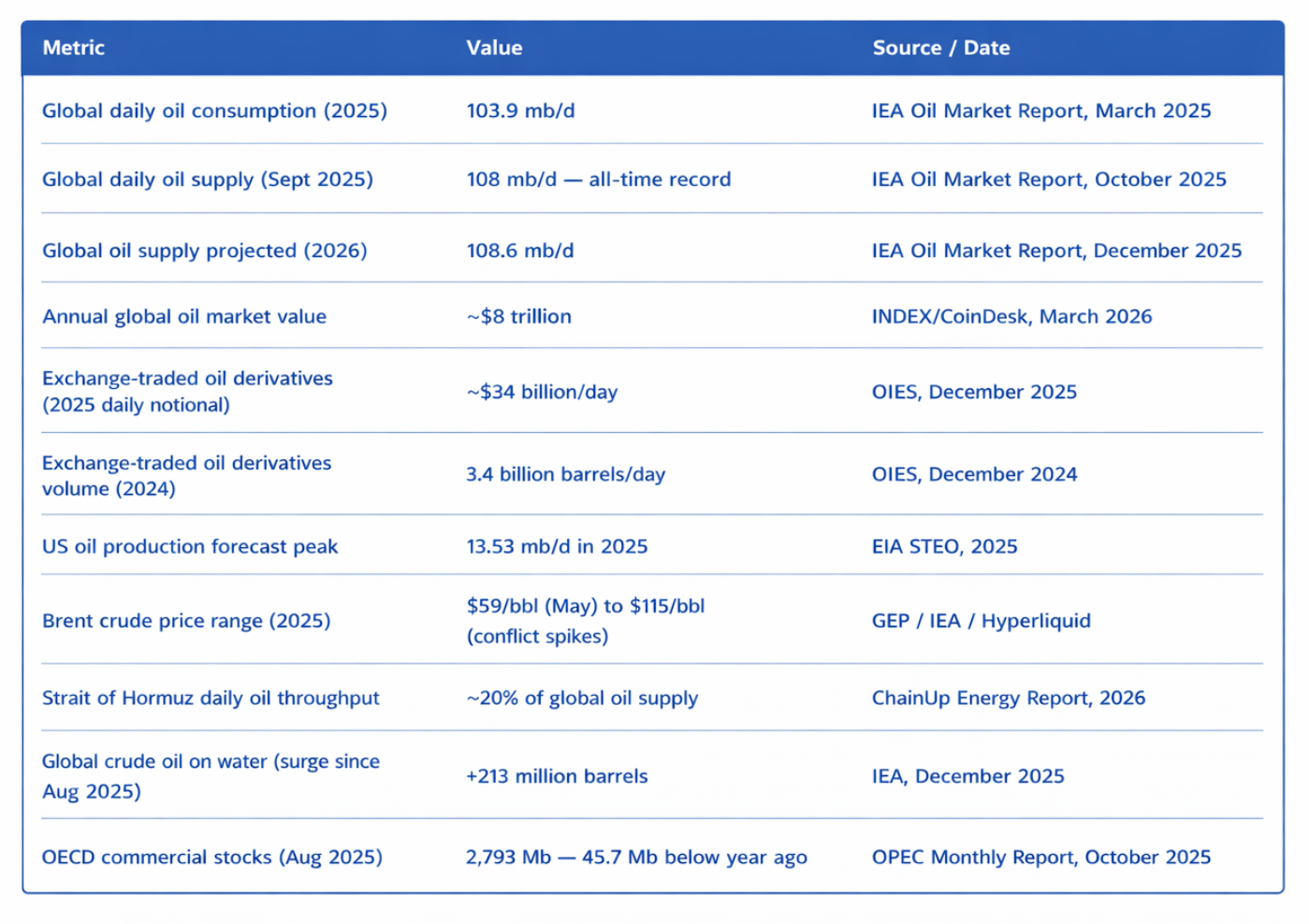
Oil is the world's single most traded physical commodity by value. The following data comes from the International Energy Agency (IEA), OPEC, and the Oxford Institute for Energy Studies (OIES):
1.2 Structural Inefficiencies in Traditional Oil Trading
Despite its massive scale, oil trading infrastructure is severely antiquated. A single Very Large Crude Carrier (VLCC) carrying 2 million barrels generates a documentation storm involving buyers, sellers, brokers, inspection firms, terminal operators, port authorities, insurance companies, letter-of-credit banks, shipping companies, and regulators.
The Documentation Problem:
- 36 original documents per physical cargo trade (on average)
- 240 copies exchanged between 27 different parties per trade
- Settlement delays: 30 to 90 days for physical oil cargo settlement
- $billions in capital locked in paper-based Letters of Credit
- Fraud risk: Double-financing of the same cargo is a documented problem (notably the 2020 Hin Leong Singapore scandal involving billions in fraudulent oil trades)
- Opacity: Ownership of oil in transit is legally ambiguous—tankers carrying oil whose legal ownership has been transferred but settlement not completed represent trillions in 'grey zone' capital
1.3 Why Oil Is the Perfect Candidate for Tokenization
Oil's characteristics make it uniquely suited to tokenization:
Fungible: A barrel of WTI crude of a given grade is interchangeable with any other barrel of equivalent specification
Standardized: OPEC, ICE, and CME define precise grade specifications for WTI, Brent, Dubai, Oman
Globally traded: On ICE London, CME New York, INE Shanghai, and dozens of bilateral OTC markets
Verifiably stored: Held in vast quantities in tanks, tankers, and pipelines with established audit protocols
These properties allow a precise 1:1 digital representation to be created, audited, and maintained on a blockchain ledger.
Part 2: What Is Oil Barrel Tokenization?
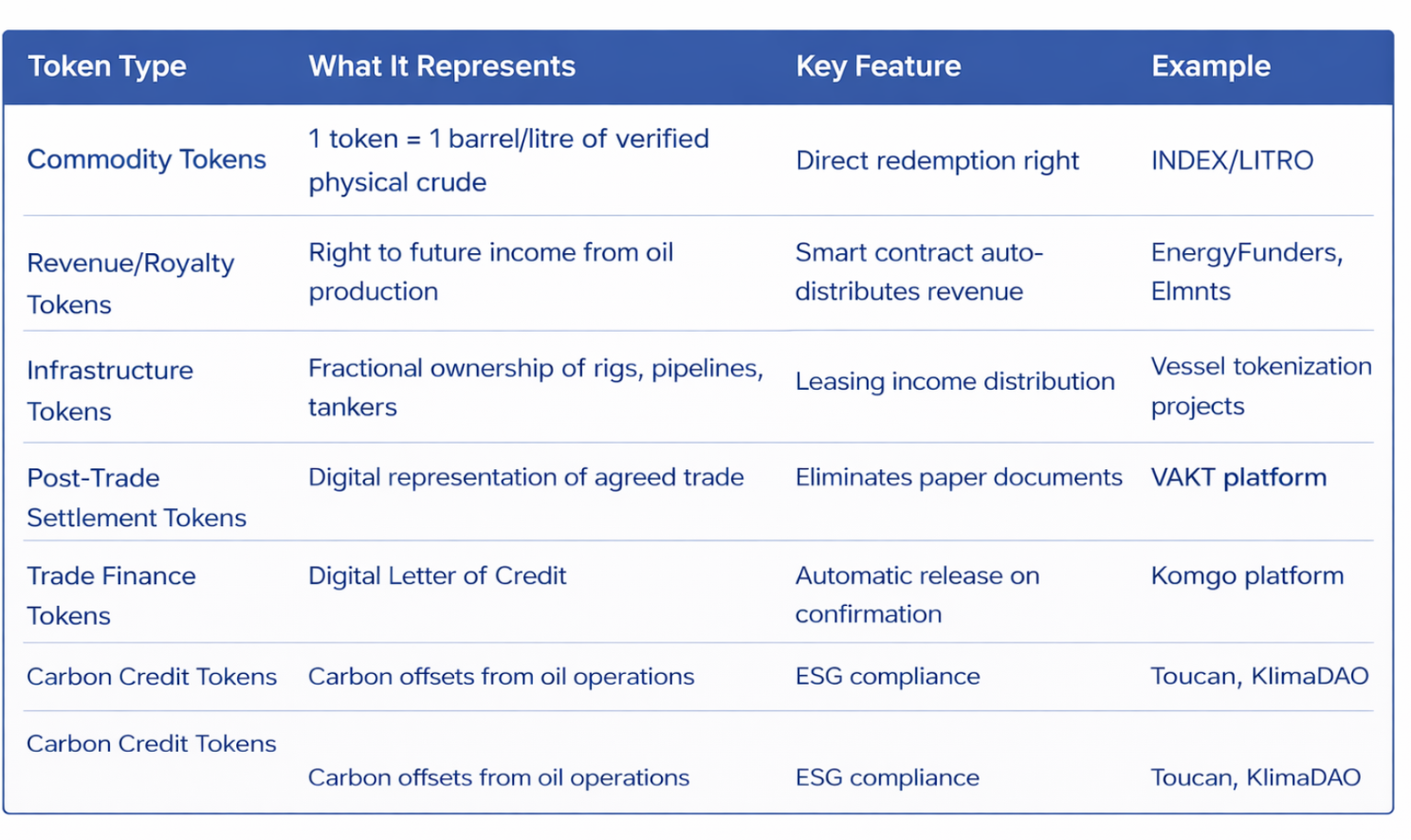
2.1 Definition and Token Types
Oil barrel tokenization is the process of creating a digital token on a blockchain that represents a legally enforceable, redeemable ownership claim on a specific quantity of physical crude oil held in audited, verified storage.
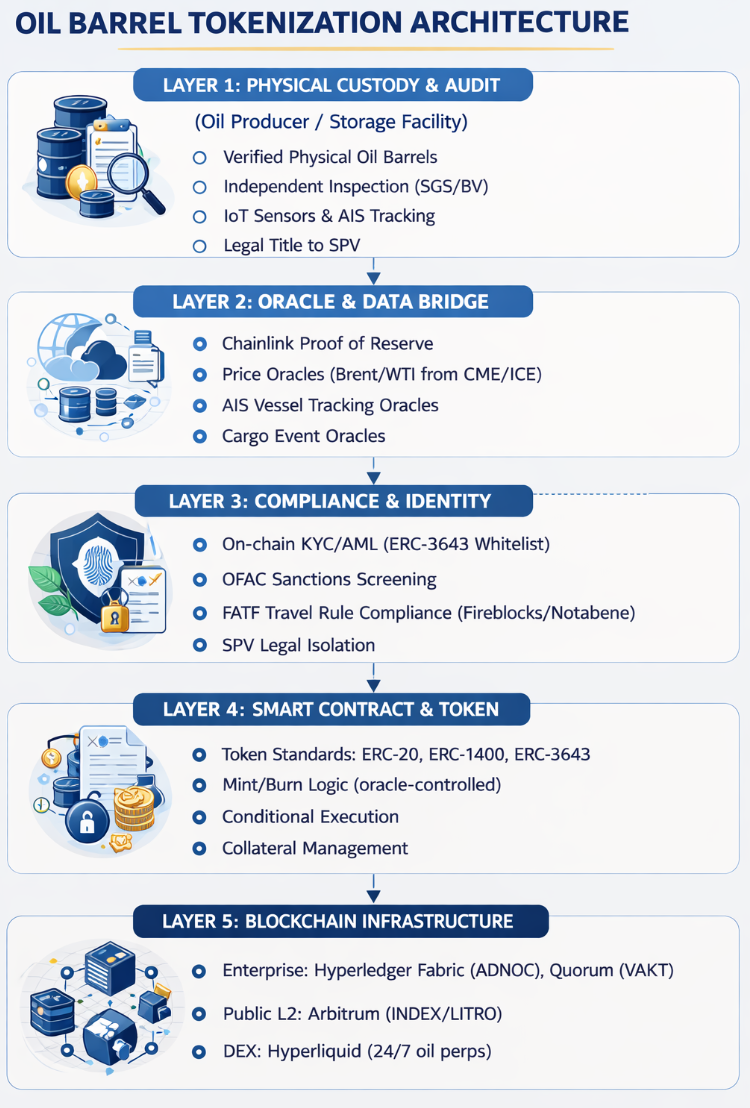
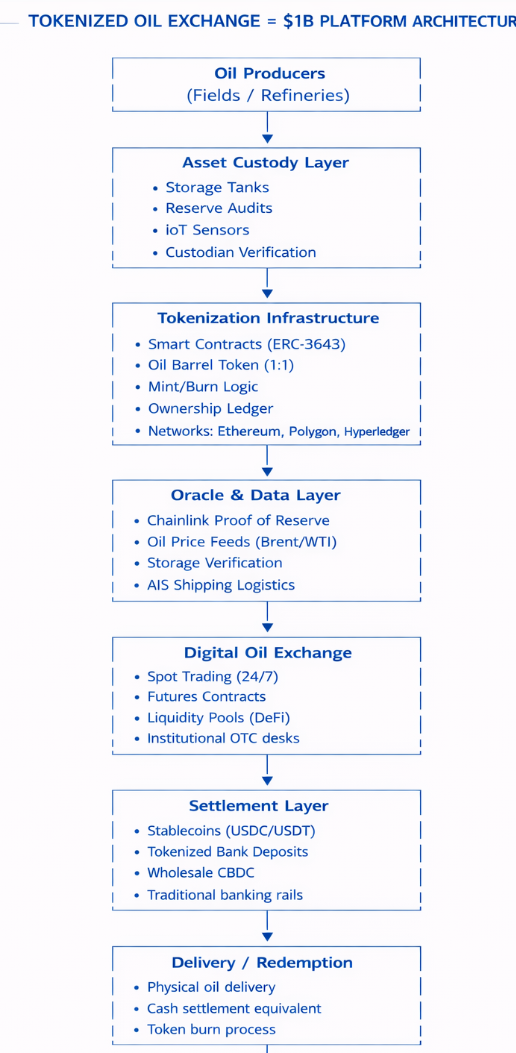
2.2 The Five-Layer Technical Architecture
A typical oil tokenization system operates across five interconnected layers:
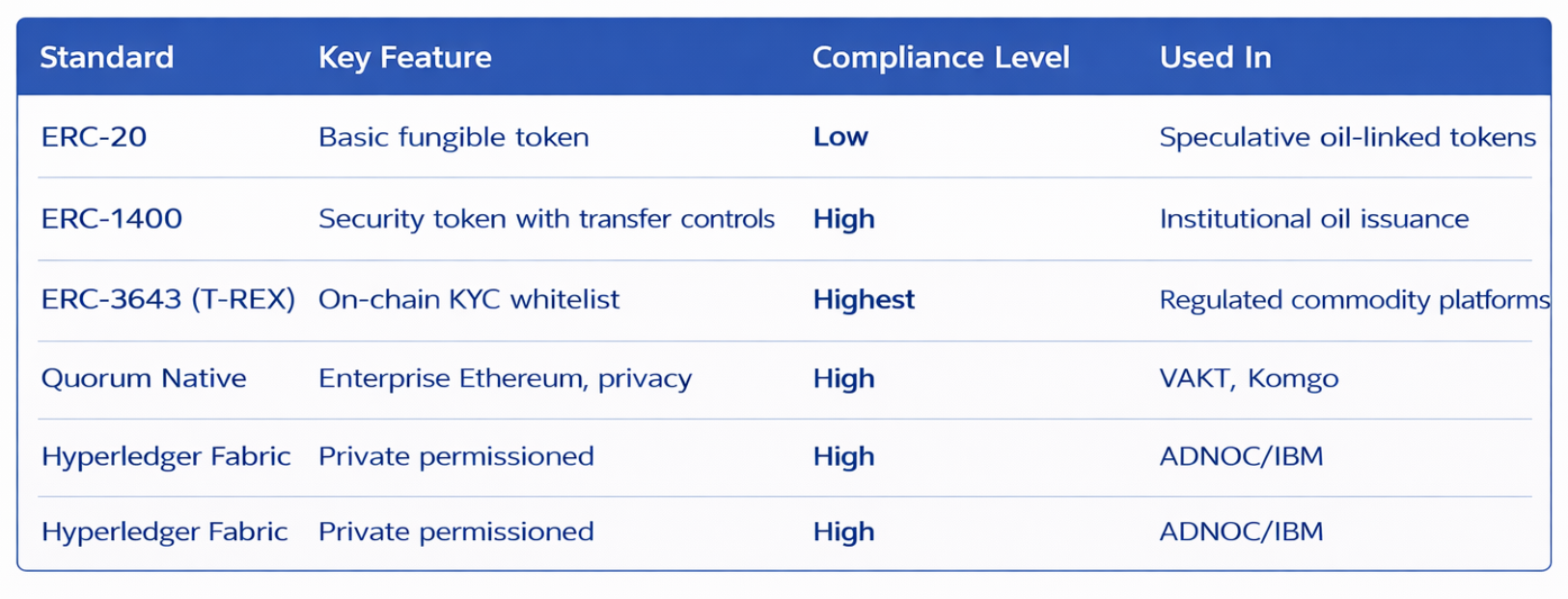
2.3 Token Standards for Oil
2.4 The Custody Chain — Critical Infrastructure
The custody chain is the most complex and critical component:
- Storage facility certification: ISO 28000, OIML standards—operators like Vopak, Oiltanking, Vitol
- Inspection regime: Pre-tokenization inspection and monthly re-inspection by SGS, Bureau Veritas, Intertek
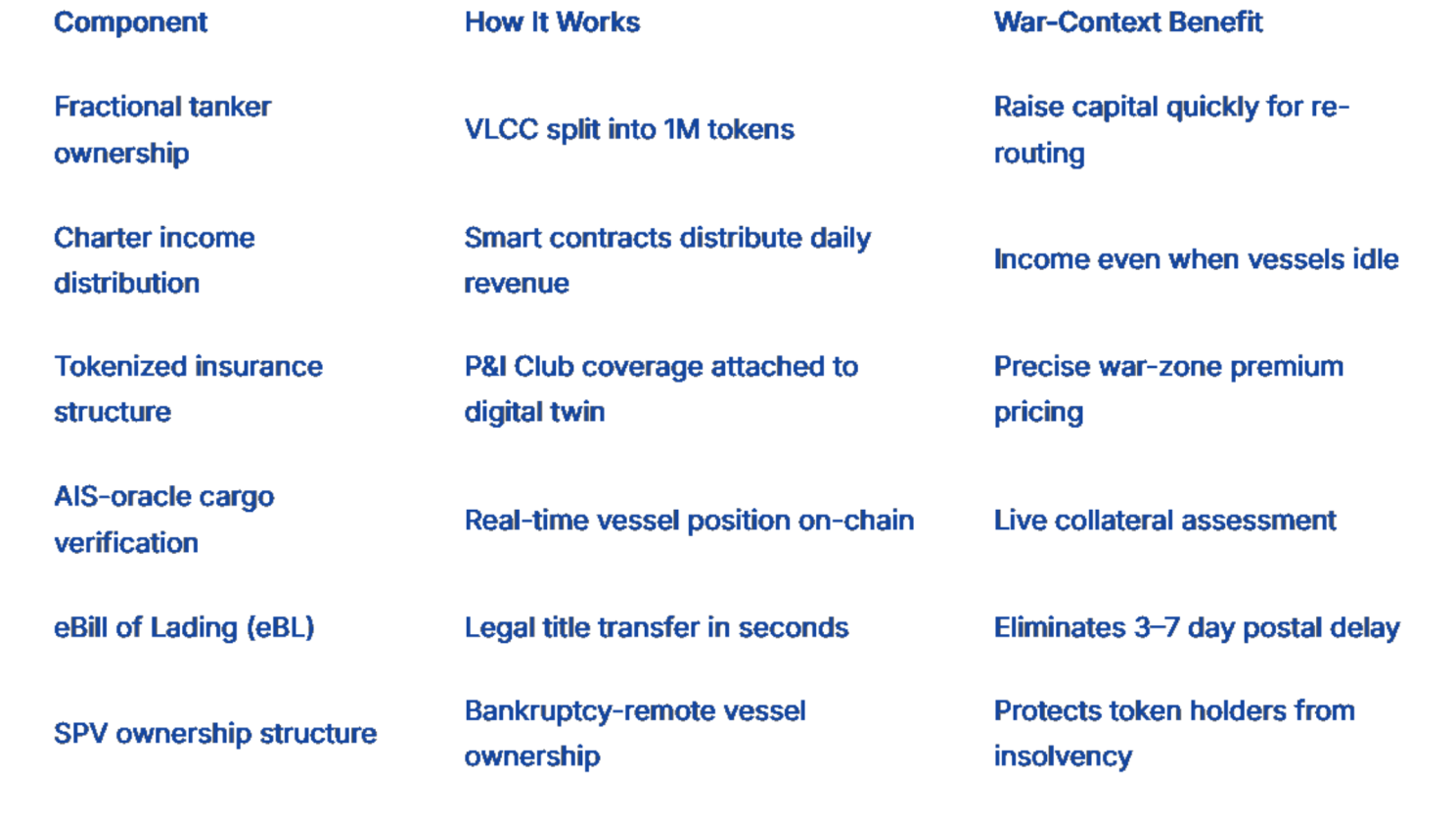
- Legal title transfer: Deed of Assignment or Warehouse Receipt to SPV; electronic Bills of Lading (eBL) under MLETR
- Continuous verification: Chainlink Proof of Reserve queries custody databases to verify supply matches tokens
Part 3: Live Projects, PoCs & Upcoming Launches
3.1 VAKT — The World's First Live Blockchain Oil Post-Trade Platform
The most operationally mature blockchain project in the oil industry.
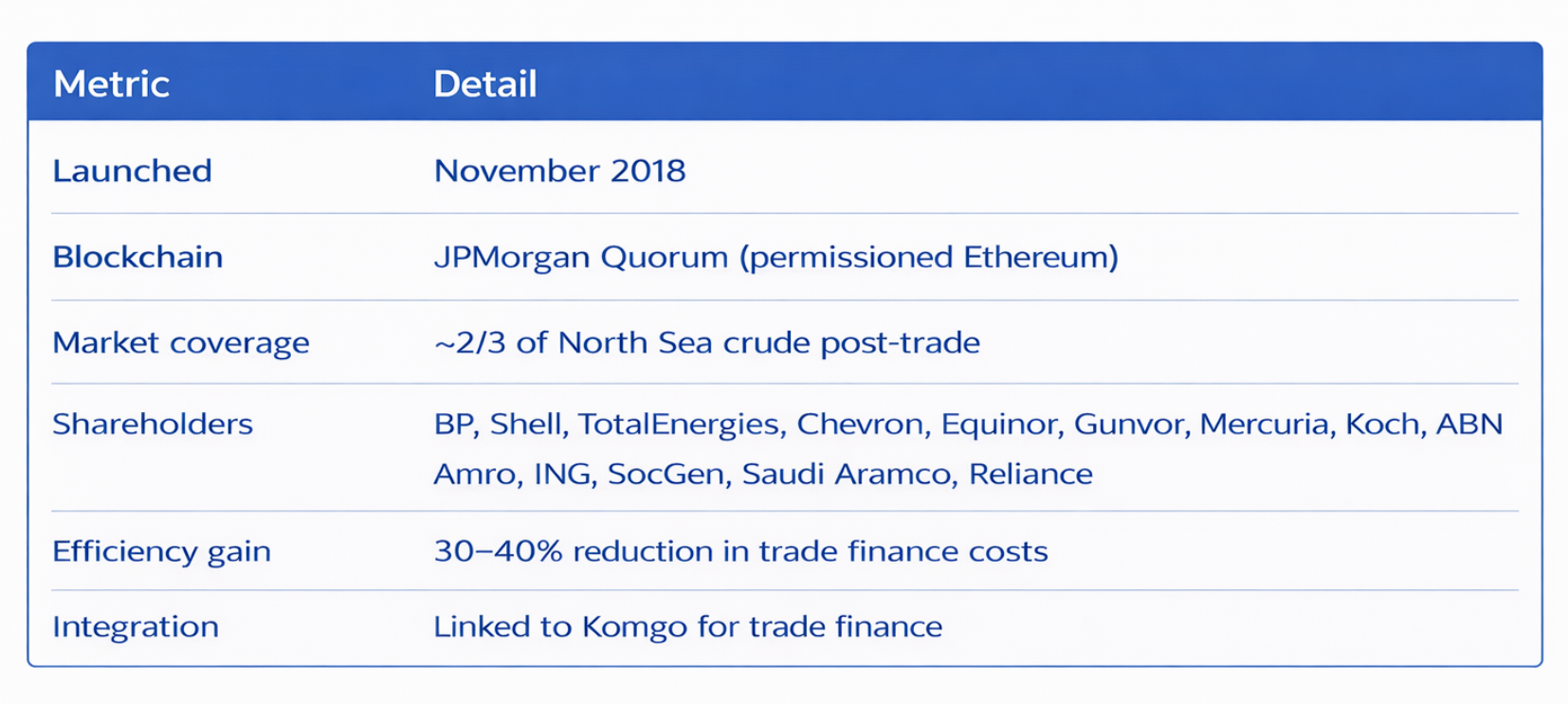
Saudi Aramco's Hans Middelthon: "VAKT has demonstrated that their platform has the potential to digitize what is currently a very manual process and be truly transformative."
3.2 INDEX / LITRO — Tokenized Physical Crude Oil
The most ambitious pure commodity tokenization project.
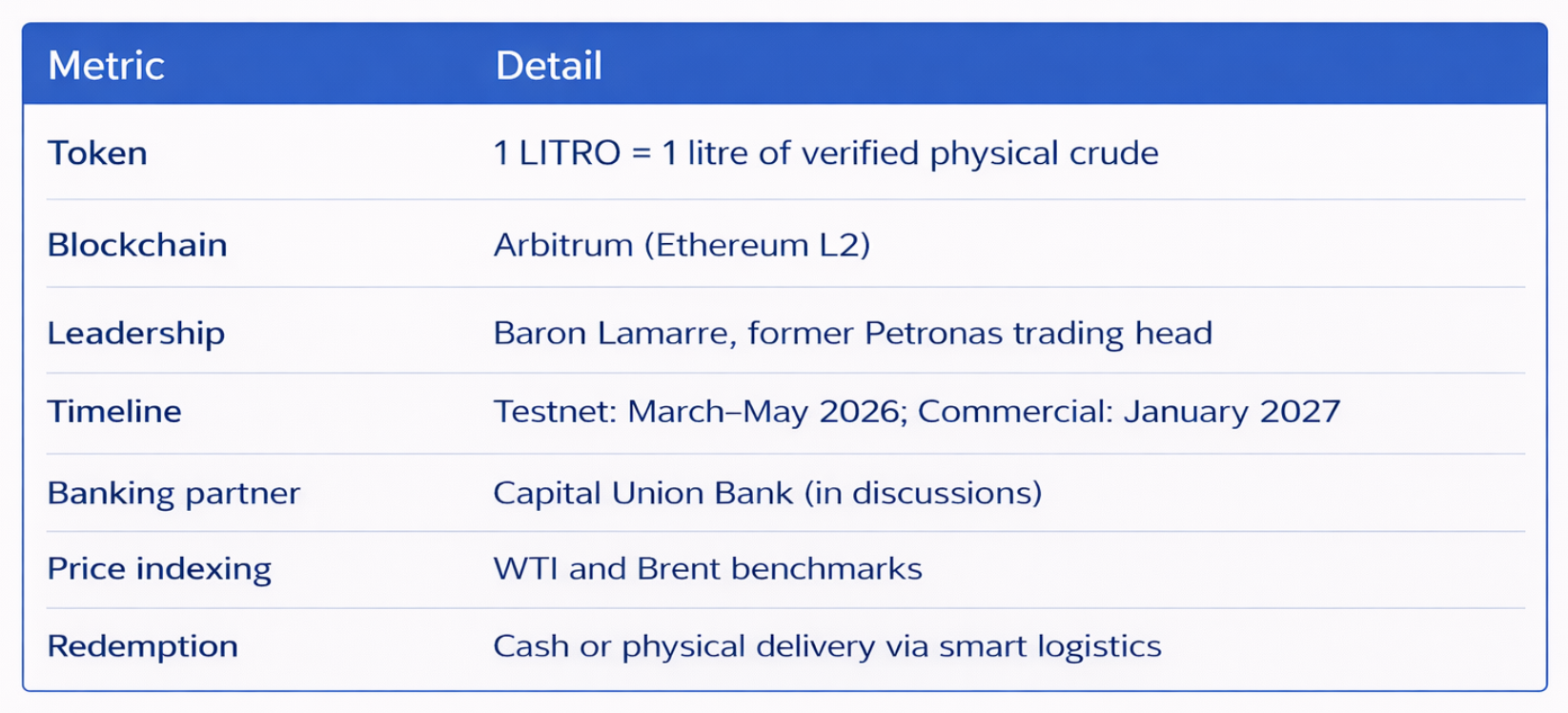
Key quote (Lamarre): "Only audited and verified reserves can be tokenized."
3.3 Komgo — Blockchain Trade Finance
Live since 2018, Komgo provides digital Letters of Credit, KYC/AML verification, and commodity trade finance on Quorum. Bank consortium includes ABN Amro, BNP Paribas, Citi, Credit Agricole, ING, MUFG, Natixis, Rabobank, Societe Generale.
3.4 ADNOC / IBM — Blockchain Oil Production Tracking
Abu Dhabi National Oil Company (ADNOC), producing ~4.2 mb/d, deployed IBM Hyperledger Fabric to track oil and gas from well to customer, enabling real-time sustainability tracking and reduced reporting time.
3.5 Equinor / Data Gumbo — Smart Contract Drilling Payments
GumboNet automates commercial payments in North Sea drilling operations. Smart contracts release payment when performance metrics (volume pumped, hours worked) are met, eliminating invoice disputes.
3.6 Chevron / ConsenSys — Joint Venture Accounting
Blockchain solution for managing joint venture (JV) accounting across oil and gas partnerships, synchronizing financial data between partners in real time.
3.7 Chainlink — Proof of Reserve for Oil Tokenization
Chainlink's Proof of Reserve system is identified as critical infrastructure for maintaining the 1:1 peg between on-chain tokens and physical oil inventory.
3.8 Singapore — MAS Commodity Tokenization Framework
Singapore is the world's most advanced jurisdiction for commodity tokenization regulation. MAS consultation paper (October 2024) expanded regulatory scope to include tokenized RWAs. SGX reported $2.1 billion in digitised commodity trades in 2024.
3.9 OOC Oil & Gas Blockchain Consortium
Multi-company initiative (Chevron, Shell, ExxonMobil) exploring blockchain across upstream production data integrity to downstream logistics.
3.10 Hyperliquid — 24/7 Oil Derivatives
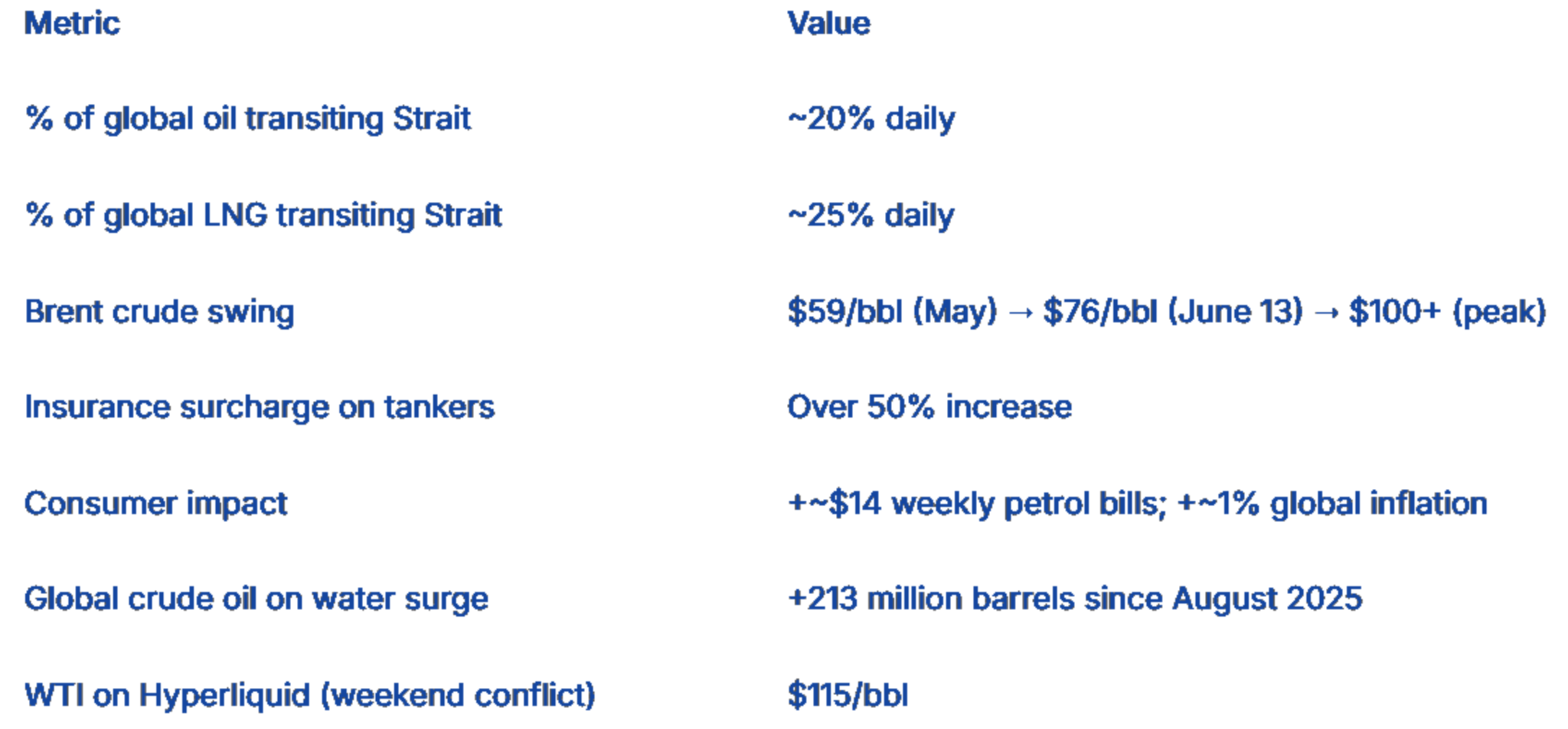
Decentralised perpetual futures exchange for 24/7 crude oil price exposure. By March 2026, RWA trading surpassed $1.3 billion in open interest and $1.4 billion in weekend volume. During Israel–Iran conflict (June 2025), WTI hit $115/bbl on Hyperliquid during a weekend while traditional markets were closed.
3.11 Global Map of Tokenized Energy Projects
North America:
- EnergyFunders – oil & gas investment platform
- LO3 Energy – peer-to-peer electricity markets
- GridPlus – decentralized energy systems
- PermianChain – tokenizing oil & gas assets
Europe:
- WePower – renewable energy tokenization
- Energy Web Foundation – decentralized energy grid
- SolarCoin – solar energy reward token
- Barrel Proof Labs – MiCA-compliant oil-backed tokens
Asia:
- Power Ledger projects in India and Thailand
- TenneT blockchain grid balancing pilot
- Japanese blockchain energy trading experiments
Australia:
- Power Ledger renewable trading projects
- National energy market pilots
Middle East:
- Dubai blockchain energy trading pilot
- ADNOC/IBM production tracking
3.12 Top 25 Startups Building Tokenized Energy Infrastructure
Renewable Energy Platforms:
- Power Ledger
- Energy Web
- WePower
- Sun Exchange
- SolarCoin
Oil & Gas Tokenization:
- EnergyFunders
- PermianChain
- OilCoin
- INDEX/LITRO
- OIL1
Blockchain Infrastructure:
- Redbelly Network
- Canton Network
- ConsenSys Energy
- R3 Corda energy projects
- Hyperledger energy consortium
Carbon & ESG Tokenization:
- Toucan Protocol
- KlimaDAO
- Flowcarbon
- Regen Network
- Moss Earth
Decentralized Energy Trading:
- Dione Protocol
- Energi Mine
- LO3 Energy
- Electron
- Grid Singularity
Part 4: Middle East Conflicts, Surging Oil Prices & How Vessel Tokenization Helps
4.1 The War Premium — What Is Happening to Oil Prices
The period from mid-2025 through early 2026 has been defined by severe geopolitical disruption. The conflict between Israel and Iran—escalating in June 2025—created the most significant oil market crisis since Russia's 2022 invasion of Ukraine.
The Strait of Hormuz Crisis — Key Data:
4.2 The Three War-Related Structural Failures Tokenization Addresses
Failure 1: Dead Capital — Idle Tanker Inventory Cannot Be Borrowed Against
A VLCC carrying 2 million barrels worth $140–160 million idling outside the Strait represents capital completely frozen.
With tokenization:
Oil on the tanker is pre-tokenized. A bank accepts tokens as digital collateral instantly—Chainlink Proof of Reserve confirms existence, AIS confirms position. The owner borrows USDC stablecoins within minutes.
Failure 2: The Insurance Tax — Rising Premiums Paralyse Shipping
Marine war risk insurance premiums spiked over 50%. Underwriters cannot quickly assess true risk profiles of individual vessels.
With vessel tokenization:
Each tanker carries a digital twin with full history. Insurers query on-chain records for precise risk pricing. Decentralised insurance pools enable micro-premium models.
Failure 3: The Retail Disconnect — Consumers Cannot Hedge the War Premium
Small businesses dependent on fuel have no mechanism to protect themselves.
With oil barrel tokenization:
A logistics company can purchase oil tokens representing as little as 1/1,000th of a barrel (~$0.07). As geopolitical tensions spike fuel prices, token holdings rise proportionally—democratised hedging.
4.3 Vessel (Oil Tanker) Tokenization — Specific Architecture
Part 5: Compliance, Regulation & Legal Framework
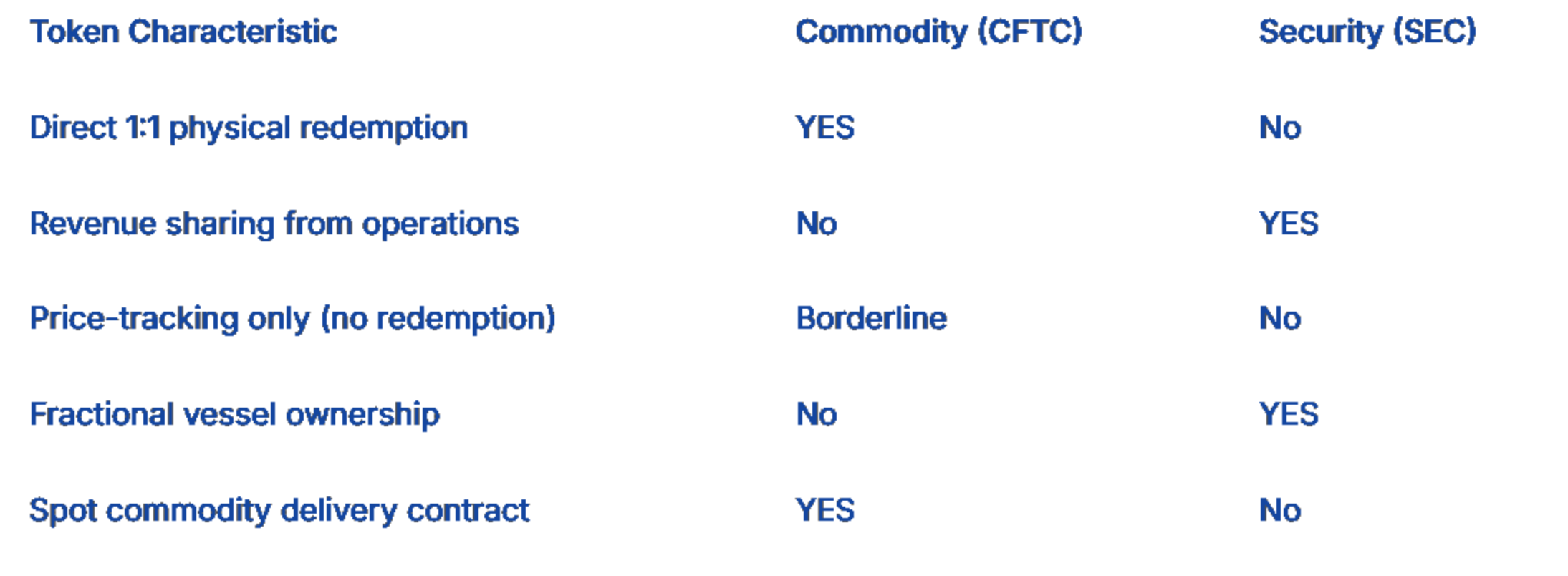
5.1 The Core Legal Question — Securities vs. Commodity
The most fundamental compliance question is whether the oil token constitutes a security or a commodity.
5.2 United States — CFTC & SEC Framework
- CFTC: Physical oil tokens that are spot delivery instruments are CFTC-governed or unregulated
- SEC: If token passes Howey Test (profit expectation from others' efforts), requires registration or exemption
- GENIUS Act (July 2025): Commodity-backed tokens are NOT stablecoins under this act
- FIT21 Act (2025): Provides clearer jurisdiction—digital commodities are CFTC, digital securities are SEC
- OFAC Compliance: Real-time SDN screening required; Iranian, Venezuelan, Russian crude carry sanctions risk
5.3 European Union — MiCA & Commodity Law
- MiCA: Commodity-backed tokens are likely OUTSIDE MiCA scope
- MiFID II: Tokenized commodity derivatives are MiFID II instruments
- EU DLT Pilot Regime: Allows licensed firms to issue and trade financial instruments on DLT
- EMIR: Tokenized OTC derivatives must be reported
5.4 Singapore — MAS Framework
- Payment Services Act: Commodity tokens may be 'digital payment tokens' or 'capital markets products'
- Securities and Futures Act: Investment instruments likely qualify as Collective Investment Scheme interests
- MAS Consultation Paper (Oct 2024): Explicitly creates compliance pathway for RWA tokenization
- FSM Act 2022: Provides framework for digital asset platforms
5.5 United Arab Emirates — VARA & ADGM
- VARA (Dubai): Commodity-backed tokens require VARA licensing
- ADGM: Digital Assets Framework governs tokenized commodities
5.6 FATF Travel Rule — Global AML Compliance
Requires VASPs to collect and transmit originator and beneficiary information for transfers above $1,000/€1,000. Fireblocks and Notabene are primary enterprise solutions.
Part 6: Comprehensive Data Reference
Part 7: Comparison — Oil vs Gold vs Carbon Credits vs LNG Tokenization
Part 8: Risks, Challenges & Mitigation Strategies
Part 9: $1B Startup Architecture — Tokenized Oil Exchange
Revenue Model
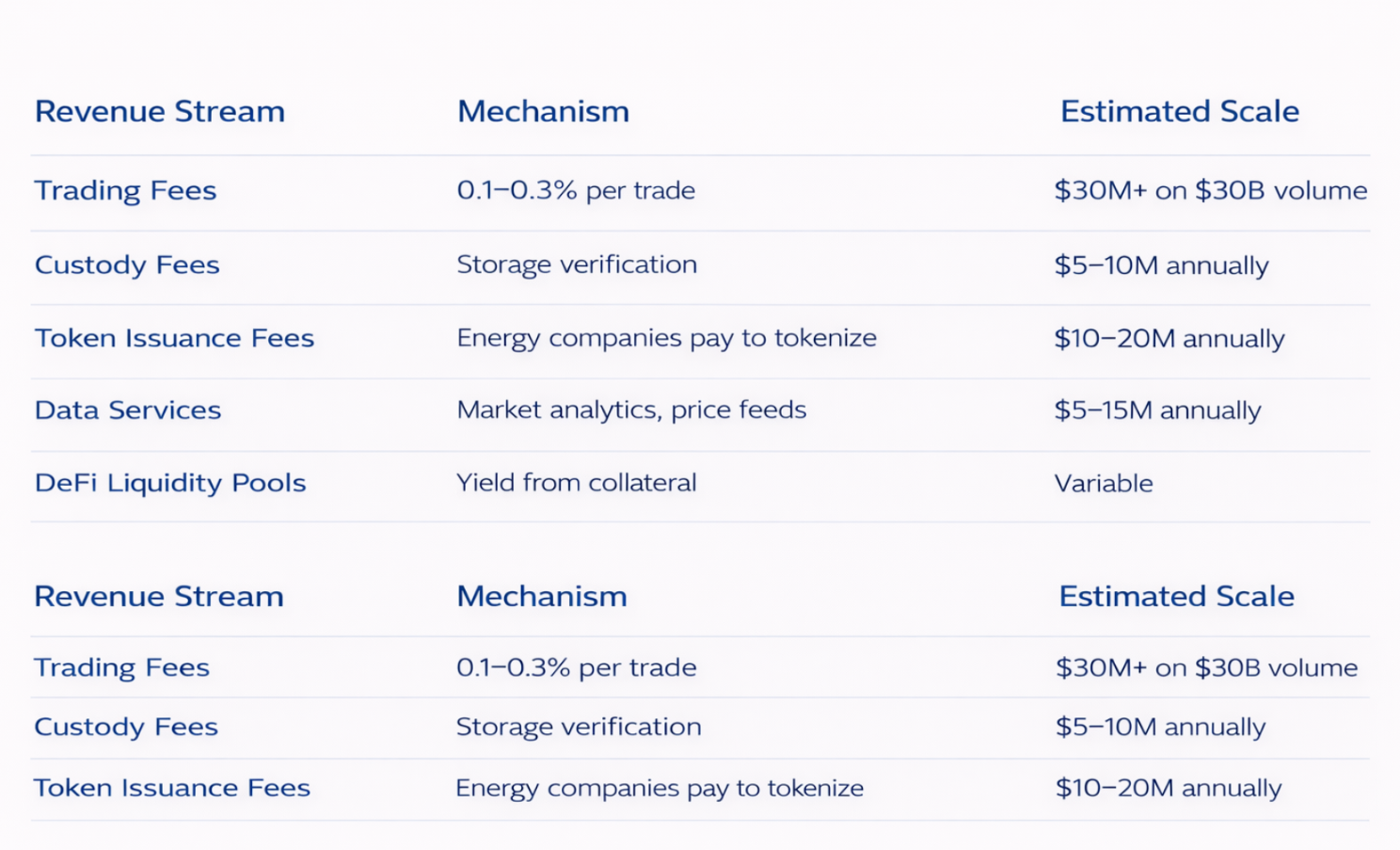
Market Opportunity: Capturing just 0.5% of global oil trading volume = $30B+ annual tokenized transactions
Part 10: Future Outlook & Conclusion
10.1 Market Projections
The blockchain in oil and gas market is projected to grow from $1.1 billion in 2024 to $23.5 billion by 2034 (CAGR 37%+). The broader tokenized asset market could reach $16 trillion by 2030, with energy and commodities as major components.
10.2 Key Milestones Ahead
- Successful INDEX/LITRO commercial launch (January 2027) demonstrating genuine 1:1 physical oil backing
- Expansion of Singapore's MAS commodity tokenization framework into a global standard
- CFTC and SEC regulatory clarity on commodity token classification in the United States
- Adoption of electronic Bills of Lading (eBL) under MLETR across all major shipping jurisdictions
- Integration with institutional trading infrastructure (CME, ICE, SGX)
Oil barrel tokenization is not a distant future technology—it is actively being built, tested, and deployed by the world's most sophisticated energy and financial companies.
- VAKT has been live since 2018.
- Komgo is providing digital trade finance.
- ADNOC and IBM have deployed blockchain production tracking.
- INDEX/LITRO is launching its testnet in spring 2026.
The case for oil tokenization in a conflict-riven world is stronger than at any previous moment. When Brent crude spikes above $100 on war news, when tankers sit idle due to insurance paralysis, when billions in crude inventory become frozen "dead capital"—tokenization offers specific, practical solutions that the legacy paper-based system cannot.
The global oil market is $6 trillion in annual value, 103.9 mb/d in daily consumption, and $34 billion in daily derivatives trading—and it still runs on paper. That mismatch between scale and infrastructure is the single largest opportunity in commodity market modernisation. Tokenization is the technology that will close it.
Case Studies
Empowering Digital
Evolution


Blogs
Empowering Digital
Evolution
BitViraj Technologies - Your Gateway to
Tomorrow's Innovations



Embark on a DigitalJourney


The next-generation digital technology company Bitviraj has the potential to empower and reinvent business in the current fast-paced market.


Our Service
- Website Development
- Application Development
- Blockchain Development
- Gaming and Metaverse