

BitViraj Technologies - Your Gateway to
Tomorrow's Innovations
Building a Cross-Border Stablecoin Payment Gateway: A Complete Architecture for the Future of Global Payments
Cross-border payments remain one of the most inefficient parts of the global financial system. Traditional banking rails rely heavily on correspondent banking networks, which introduce high fees, slow settlement times, liquidity constraints, and opaque transaction flows.

By Bitviraj Technology
April 20, 2024
Building a Cross-Border Stablecoin Payment Gateway
A Complete Architecture for the Future of Global Payments
Building a Cross-Border Stablecoin Payment Gateway: A Complete Architecture for the Future of Global Payments
Introduction
Cross-border payments remain one of the most inefficient parts of the global financial system. Traditional banking rails rely heavily on correspondent banking networks, which introduce high fees, slow settlement times, liquidity constraints, and opaque transaction flows.
Stablecoins are rapidly emerging as the next-generation settlement infrastructure for global payments. With near-instant settlement, programmability, and global accessibility, stablecoins offer a compelling alternative to traditional systems like SWIFT.
However, building a production-grade stablecoin payment gateway requires much more than simply integrating a blockchain wallet. It requires an enterprise-grade financial infrastructure stack spanning compliance, liquidity, treasury, orchestration, custody, banking integration, and user experience.
This article presents a complete 10-layer architecture for building a cross-border stablecoin payment gateway, expanding on existing stablecoin payment ecosystems with additional components necessary for global compliance, liquidity management, enterprise integrations, and operational resilience.
The Stablecoin Payment Infrastructure Stack
A robust cross-border stablecoin gateway can be structured across 10 core infrastructure layers, each responsible for a critical part of the payment lifecycle.
Layer 1 — User Experience Layer (Customer Interface)
This is the entry point for businesses and individuals interacting with the payment system.
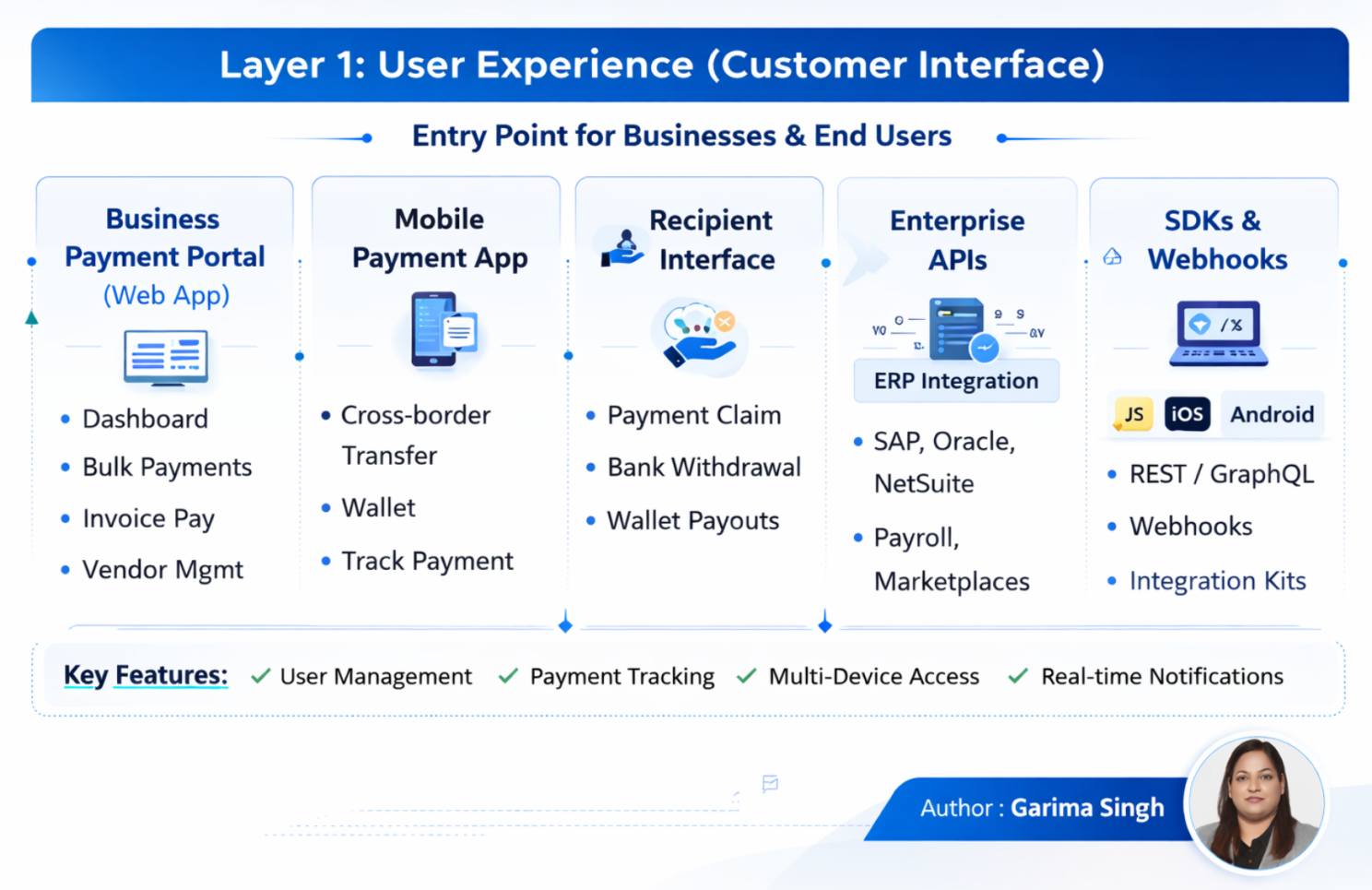
Core Components
Business Payment Portal
- Web dashboard for payments
- Bulk payments
- Invoice payments
- Vendor payments
Mobile Payment Application
- Cross-border remittances
- Wallet integration
- Payment tracking
Recipient Interface
- Payment claim portal
- Bank withdrawal interface
- Wallet-based withdrawal
Enterprise APIs
- REST / GraphQL APIs
- ERP integration (SAP, Oracle, NetSuite)
- Payroll systems
- Marketplace payouts
SDKs
- JavaScript SDK
- Mobile SDK (iOS / Android)
- Webhooks
This layer ensures easy integration with business systems and seamless user experiences.
Layer 2 — Payment Orchestration Layer (Transaction Brain)
This layer coordinates and manages the entire lifecycle of a payment transaction.
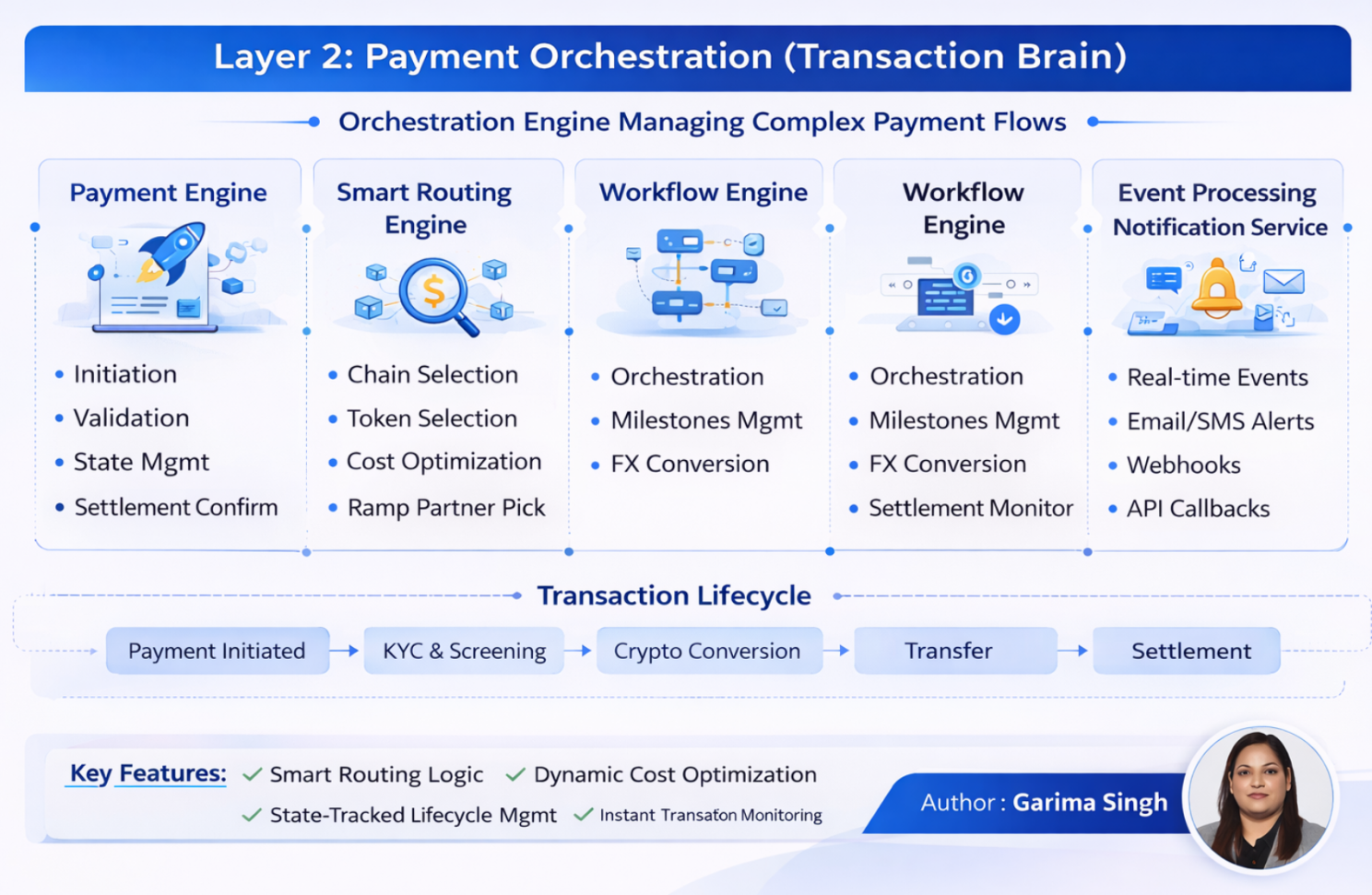
Key Modules
Payment Engine Handles:
- Payment initiation
- Transaction validation
- State management
- Settlement confirmation
Smart Routing Engine
Dynamically selects:
- optimal blockchain network
- cheapest stablecoin route
- most efficient on/off-ramp partner
- liquidity source
Routing decisions are based on:
- gas fees
- FX rates
- liquidity availability
- settlement speed
Workflow Engine
Handles multi-step flows such as:
Initiation → KYC → AML Screening → Conversion → Transfer → Settlement → Reconciliation
Event Processing System
- Kafka / RabbitMQ
- Real-time payment state updates
- asynchronous transaction management
Notification Service
- SMS
- Webhooks
- API callbacks
Layer 3 — Fiat On/Off Ramp Infrastructure
This layer connects the crypto ecosystem to traditional banking systems.
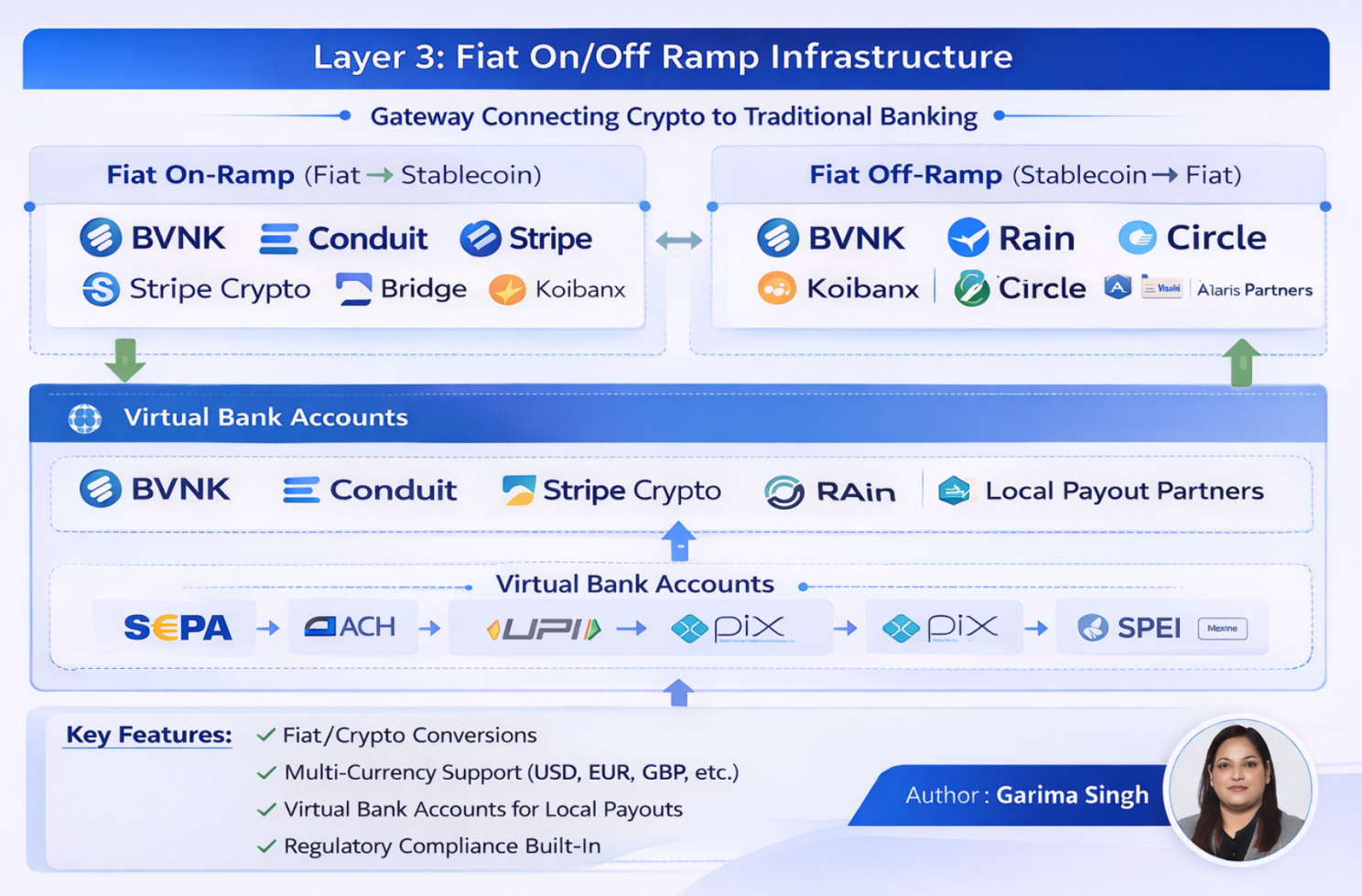
Fiat On-Ramp (Fiat → Stablecoin)
Allows users to convert fiat currencies into stablecoins.
Providers may include:
- BVNK
- Conduit
- Stripe Crypto
- Bridge
- MoonPay
- Ramp Network
Supported currencies:
- USD
- EUR
- GBP
- SGD
- AED
Fiat Off-Ramp (Stablecoin → Fiat)
Allows stablecoins to be converted into local currency payouts.
Providers include:
- BVNK
- Rain
- Koibanx
- Circle
- regional payout partners
Capabilities:
- bank transfers
- instant payouts
- card payouts
- mobile money
Virtual Bank Accounts
Businesses receive virtual IBANs or local account numbers.
Supported rails include:
- SEPA
- ACH
- Faster Payments
- UPI
- PIX
- SPEI
Layer 4 — Stablecoin Treasury & Liquidity Layer
This layer manages stablecoin reserves and liquidity across multiple networks.
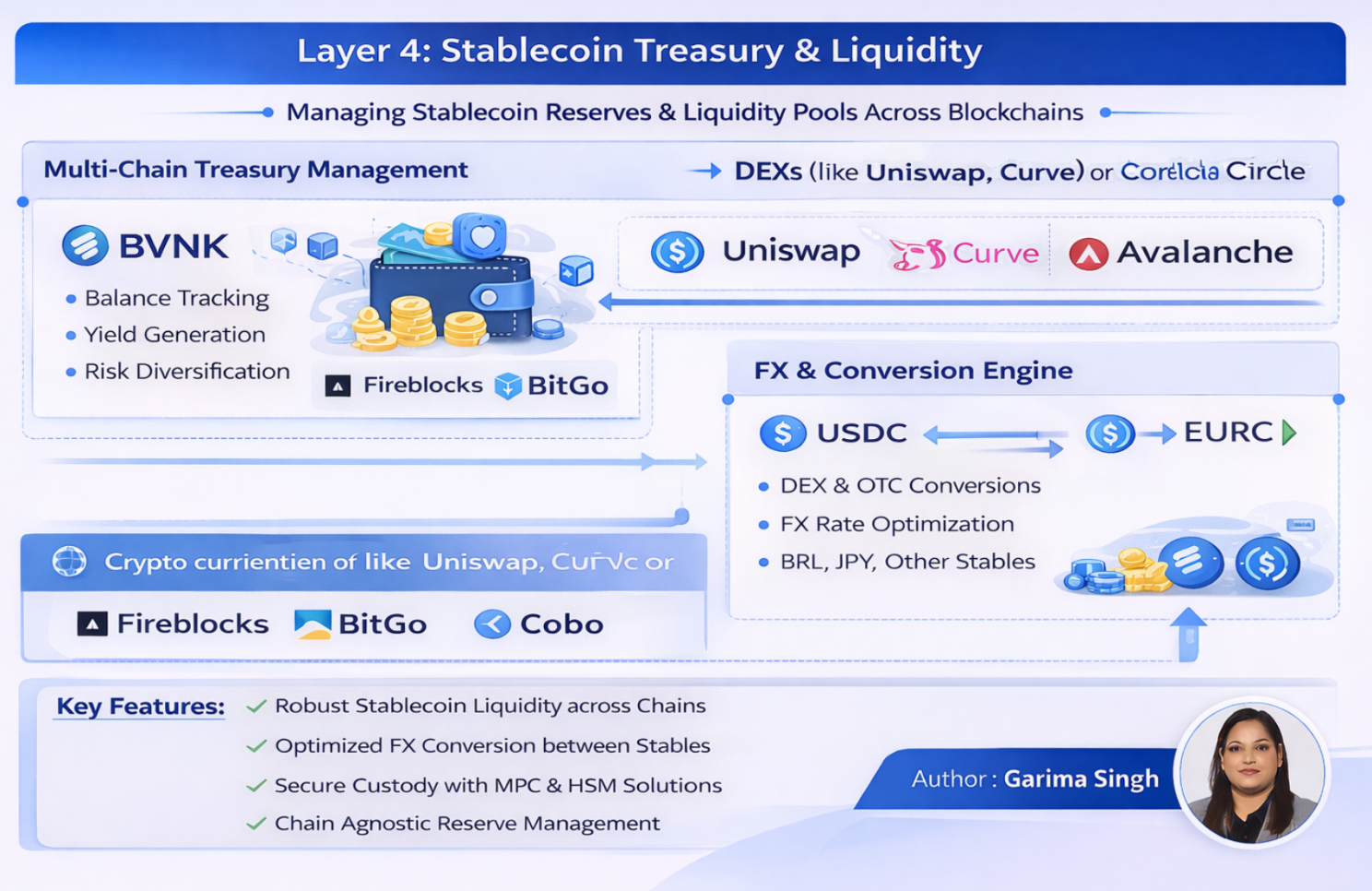
Core Infrastructure
Multi-Chain Treasury Management
Treasury wallets across:
- Ethereum
- Solana
- Polygon
- Arbitrum
- Stellar
Purpose:
- instant liquidity
- risk distribution
- settlement optimization
Liquidity Pools
Pre-funded pools for instant transactions.
Sources:
- DeFi liquidity pools
- OTC desks
- market makers
- institutional liquidity providers
FX & Conversion Engine
Handles:
- stablecoin swaps
- fiat conversion
- cross-stablecoin routing
Conversion sources:
- DEXs (Uniswap, Curve)
- Aggregators (1inch, Paraswap)
- OTC desks
- centralized exchanges
Layer 5 — Custody & Key Management
Institutional-grade custody ensures secure management of digital assets.
Custody Providers
- Fireblocks
- BitGo
- Cobo
- Copper
Security Infrastructure
- Multi-Party Computation (MPC): Eliminates single private key risk.
- Hardware Security Modules (HSMs): Enterprise-grade key storage.
- Policy Engine: Controls transaction approvals, withdrawal limits, multi-sig authorization.
Layer 6 — Compliance, Risk & Regulatory Layer
Compliance is the most critical component for operating a global payment gateway.
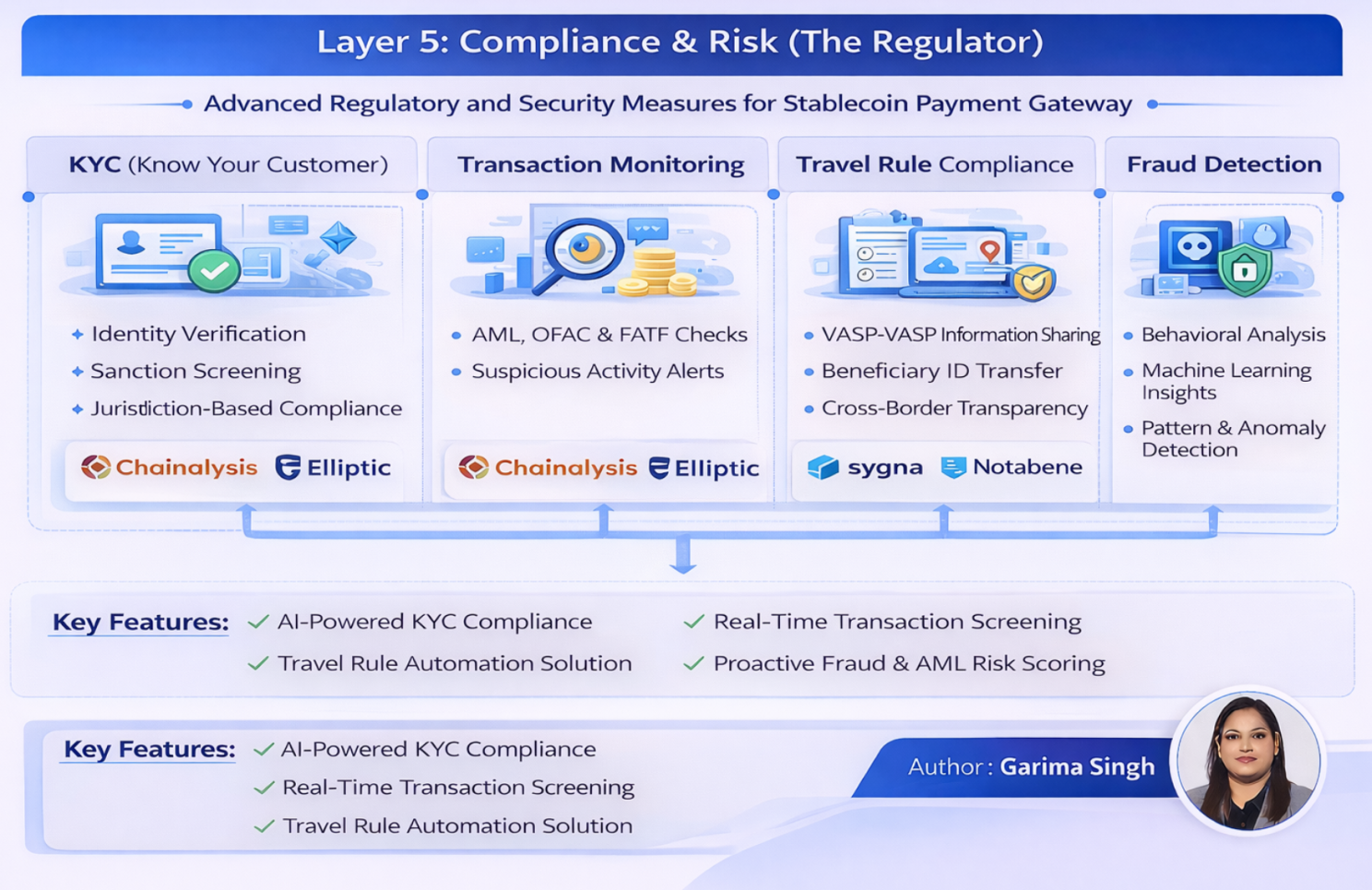
Identity Verification
KYC / KYB
Identity providers:
- SumSub
- Onfido
- Persona
- Trulioo
Verification includes:
- document verification
- biometric checks
- business verification
AML & Transaction Monitoring
Tools:
- Chainalysis
- Elliptic
- TRM Labs
Capabilities:
- wallet screening
- sanctions checks
- suspicious activity detection
- transaction tracing
Travel Rule Compliance
Required by FATF regulations.
Providers:
- Notabene
- Sygna
- TRISA
Ensures beneficiary information exchange between VASPs.
Fraud Detection
AI-based monitoring detects:
- abnormal transaction patterns
- velocity anomalies
- account takeover risks
Layer 7 — Blockchain Settlement Layer
This layer represents the actual movement of stablecoins.
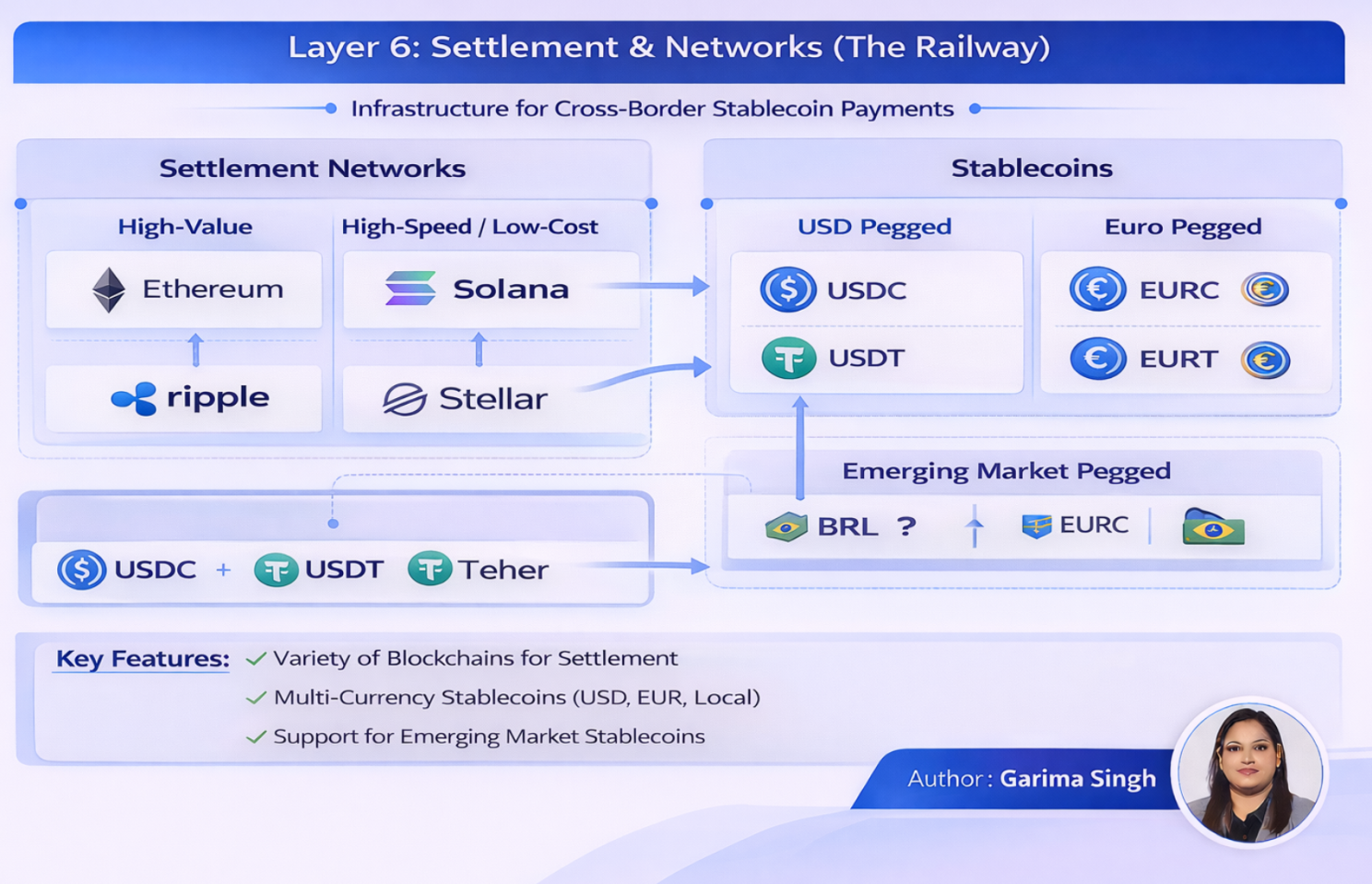
Settlement Networks
High-value networks
- Ethereum
- Avalanche
- Ripple
High-speed networks
- Solana
- Polygon
- Stellar
- Base
- Arbitrum
Stablecoin Assets
USD Stablecoins
- USDC
- USDT
- PYUSD
- FDUSD
Euro Stablecoins
- EURC
- EURT
Emerging Market Stablecoins
- BRL stablecoins
- MXN stablecoins
- INR-backed tokens (future potential)
Layer 8 — Liquidity Providers & Market Makers
Stablecoin payment systems require deep liquidity for seamless FX conversion.
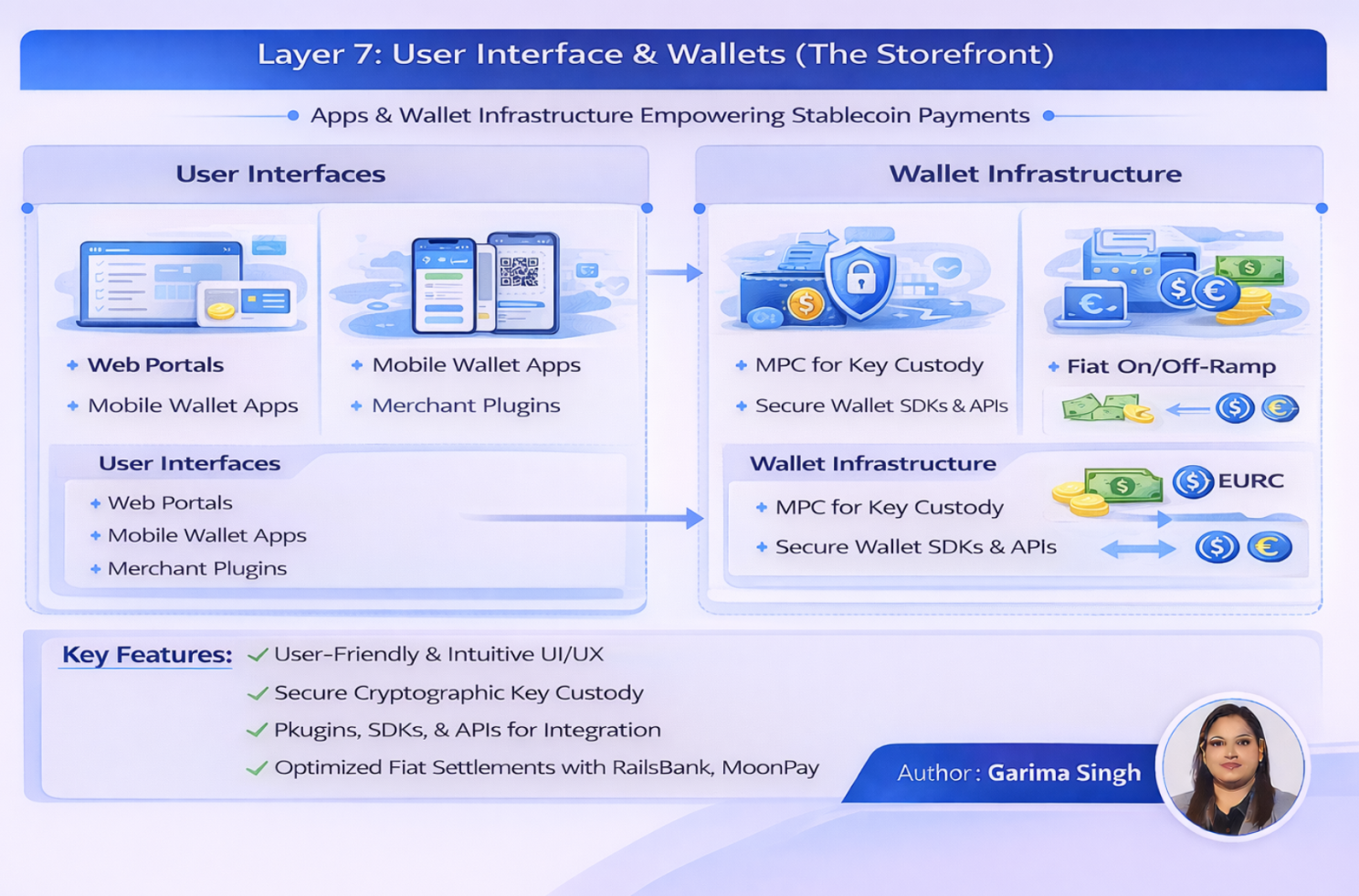
Key participants:
- Keyrock
- Wintermute
- Cumberland
- Jump Trading
- Amber Group
Responsibilities:
- provide market liquidity
- reduce slippage
- support FX swaps
- maintain stable pricing
Layer 9 — Banking Infrastructure Layer
This layer connects the system to traditional financial institutions.
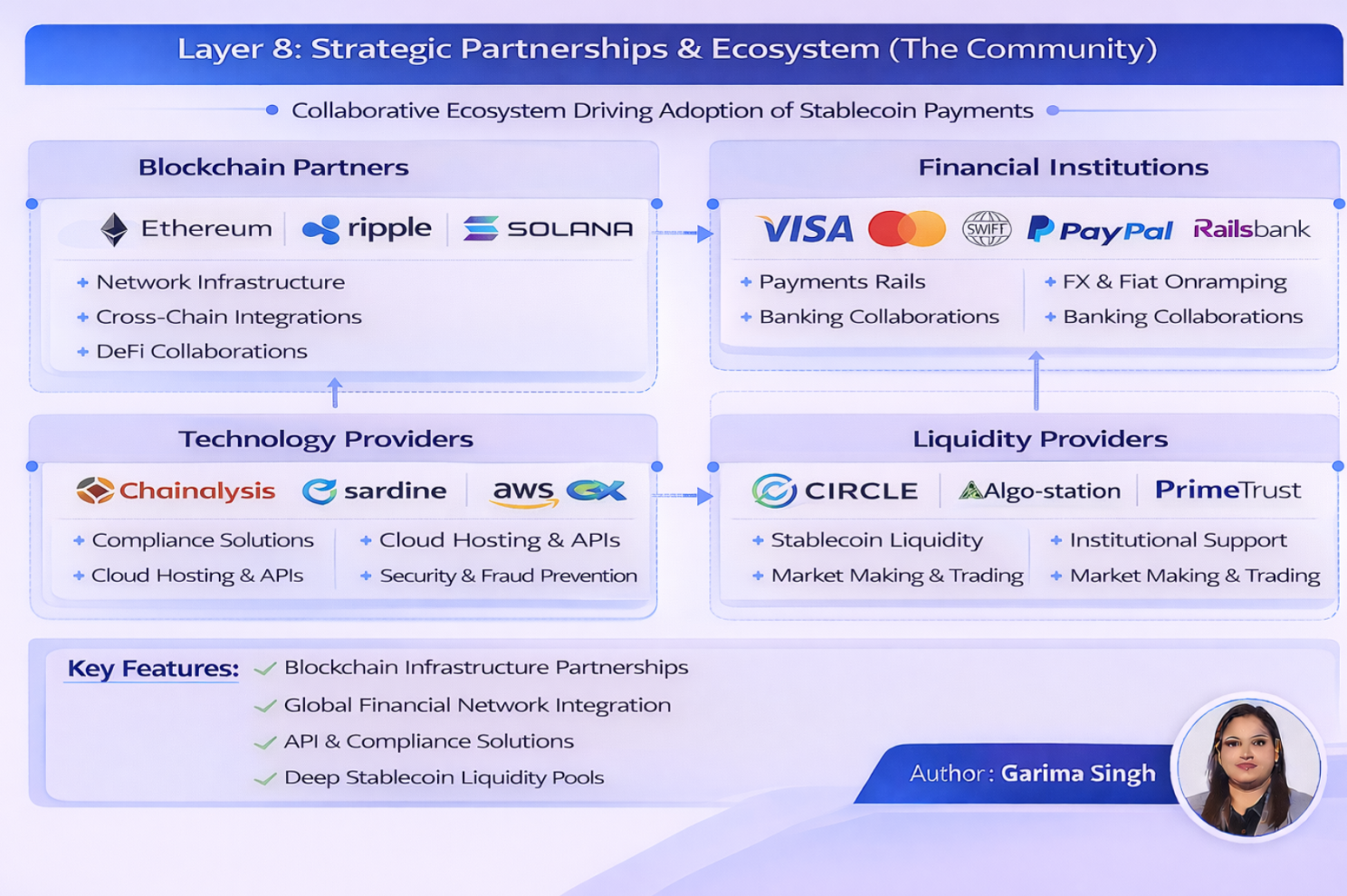
Banking Partners
Roles include:
- Correspondent banks
- Settlement banks
- Liquidity banks
Responsibilities:
- fiat settlement
- liquidity provisioning
- payment rail access
Local Payment Networks
Integration with regional payment systems:
- SEPA (Europe)
- ACH (US)
- Faster Payments (UK)
- UPI (India)
- PIX (Brazil)
- SPEI (Mexico)
Layer 10 — Data, Observability & Infrastructure Layer
Enterprise payment systems require robust operational infrastructure.
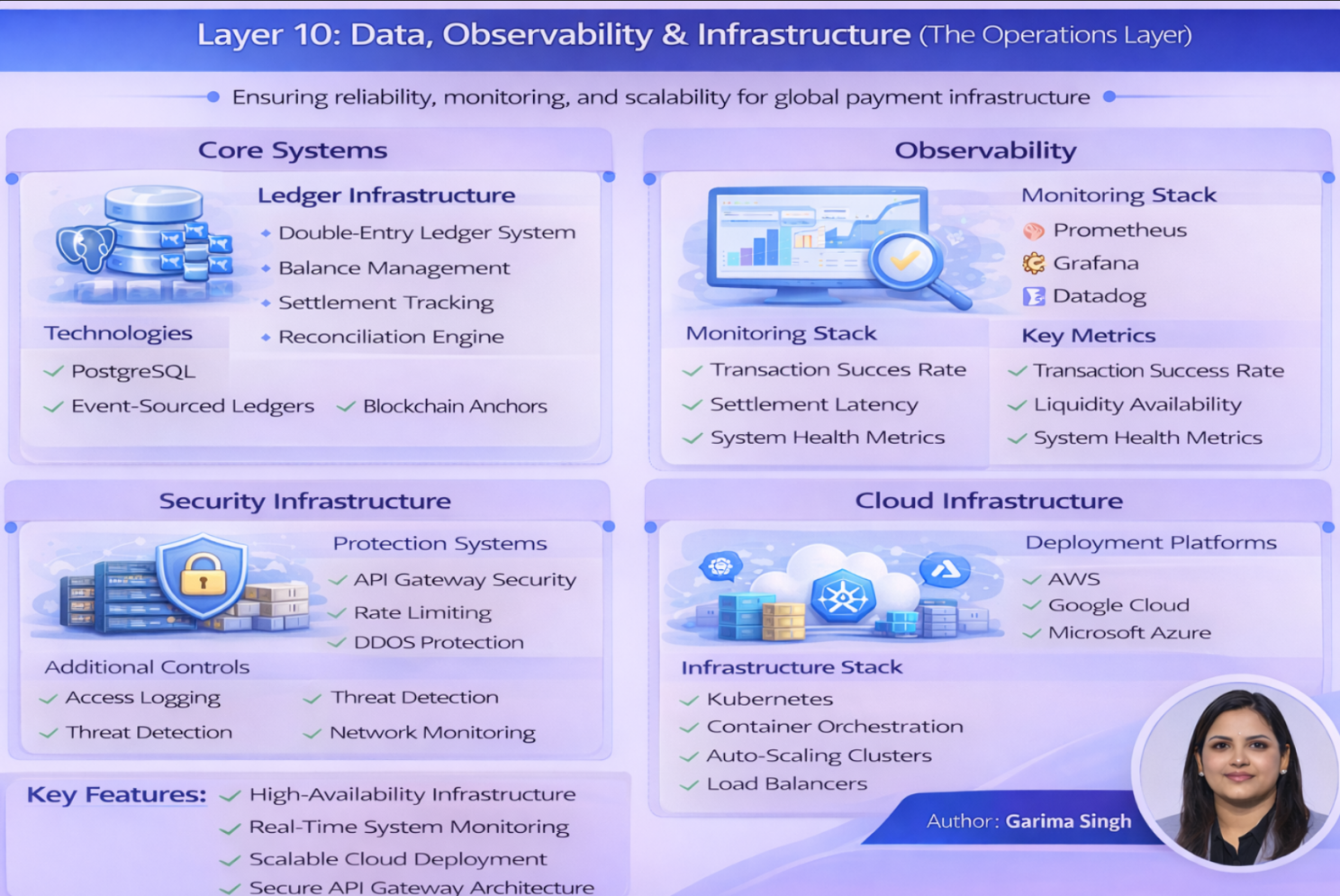
Core Systems
Ledger Infrastructure
A double-entry ledger tracks:
- balances
- settlements
- reconciliation
Technologies:
- PostgreSQL
- event-sourced ledgers
- blockchain anchors
Observability
Monitoring tools:
- Prometheus
- Grafana
- Datadog
Tracks:
- transaction success rates
- settlement times
- liquidity availability
Security Infrastructure
- API gateways
- rate limiting
- WAF protection
- DDoS protection
Cloud Infrastructure
Deployment on:
- AWS
- GCP
- Azure
Using:
- Kubernetes
- container orchestration
- auto-scaling
Example Cross-Border Transaction Flow
Consider a US business paying a Mexican supplier.
- Step 1 — Payment Initiation: The business sends 50,000 MXN payment request via API.
- Step 2 — Smart Routing: The system determines: Solana is cheapest network, USDC is most liquid stablecoin, BVNK is best on-ramp.
- Step 3 — Fiat Conversion: The business transfers USD to the gateway bank account. On-ramp converts it to USDC.
- Step 4 — Compliance Screening: Transaction is screened against sanctions lists, AML risk models, suspicious transaction patterns.
- Step 5 — Blockchain Settlement: USDC is transferred via Solana network. Settlement occurs within seconds.
- Step 6 — FX Conversion: Gateway swaps USDC → MXN liquidity pool.
- Step 7 — Off-Ramp Payout: Mexican partner sends MXN bank transfer to supplier.
- Step 8 — Notification: Both parties receive confirmation via API webhook, dashboard notification, email.
Key Benefits of Stablecoin Payment Infrastructure
Faster Settlement
Transactions settle in seconds rather than days.
Lower Costs
Reduced intermediaries significantly lower fees.
Global Accessibility
Stablecoins enable borderless financial access.
Programmability
Smart contracts allow automated escrow, milestone payments, programmable payouts.
24/7 Payments
Unlike banking systems, blockchain networks operate continuously.
The Future of Global Payments
Stablecoin infrastructure is rapidly becoming the next generation of global payment rails. Major financial institutions, fintech companies, and payment networks are already integrating stablecoins into their infrastructure.
In the coming years, stablecoin gateways will power:
global payroll systems
B2B international payments
remittance networks
global marketplaces
decentralized financial services
The combination of blockchain settlement, compliant financial infrastructure, and enterprise-grade payment orchestration will fundamentally transform how money moves across borders.
Case Studies
Empowering Digital
Evolution



Blogs
Empowering Digital
Evolution
BitViraj Technologies - Your Gateway to
Tomorrow's Innovations



Embark on a DigitalJourney


The next-generation digital technology company Bitviraj has the potential to empower and reinvent business in the current fast-paced market.


Our Service
- Website Development
- Application Development
- Blockchain Development
- Gaming and Metaverse