

BitViraj Technologies - Your Gateway to
Tomorrow's Innovations
Real Estate Tokenization in India: A Deep-Dive Analysis of Technological, Legal, and Market Evolution (2026)
The Indian Real Estate Paradox: Access vs. Scale. Statistical Reality: The Investment Gap. Market Size: Indian real estate valuation: ₹15,00,000+ crore (USD ~200+ billion) commercial segment alone.


By Bitviraj Technology
Real Estate Tokenization in India: 2026 Deep-Dive Analysis

Real Estate Tokenization in India: A Deep-Dive Analysis of Technological, Legal, and Market Evolution (2026)
The Indian Real Estate Paradox: Access vs. Scale
Statistical Reality: The Investment Gap
Market Size
Indian real estate valuation: ₹15,00,000+ crore (USD ~200+ billion) commercial segment alone
Participation Rate
Less than 0.7% of Indian retail investors own Grade-A commercial assets
Capital Concentration
Top 3% of investors control 67% of premium real estate holdings
Liquidity Crisis
Average property holding period: 8.2 years vs. 3.1 years for equities
New Data Point (2025):
According to Knight Frank India, the fractional ownership market has grown from ₹2,300 crore in 2021 to ₹9,800 crore in 2025, representing a 326% growth despite regulatory ambiguity.
Structural Bottlenecks
Title Verification Time
68 days average for conclusive title checks
Transaction Costs
8–12% of property value (stamp duty, registration, legal)
Geographic Imbalance
Mumbai, Delhi NCR, and Bengaluru constitute 73% of institutional-grade inventory
Technical Architecture: The 5-Layer Stack
1
Layer 1: Physical Asset Layer
Asset Classes Tokenized
Commercial Office Spaces
45% of tokenized volume
Warehouses & Logistics Parks
28%
Retail Malls
15%
Residential Complexes
9%
Special Purpose
3%
Due Diligence Protocol
Integration with National E-Governance Services Ltd (NeSL) for electronic charge validation
2
Layer 2: Legal & Compliance Layer
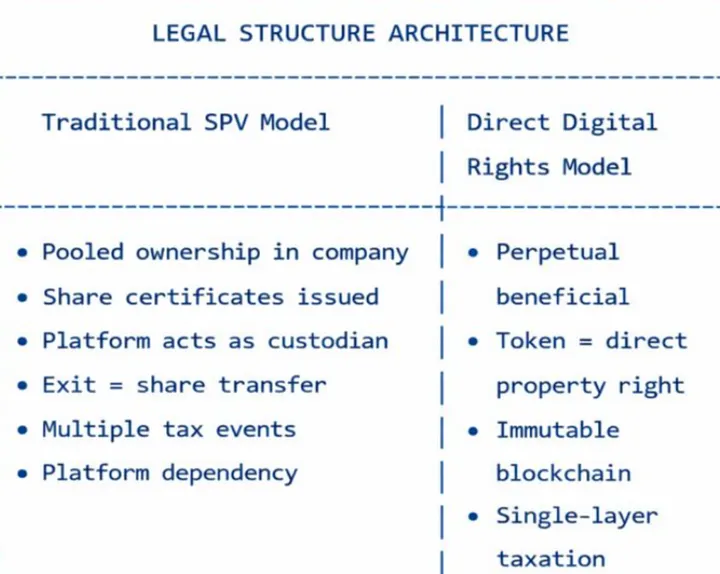
Innovation: Digital Title Escrow Protocol
Property title held by regulated title escrow agent
Smart contracts map token ownership to beneficial rights
Automatic lien prevention through on-chain encumbrance registry
Integration with state-level land record modernization programs
3
Layer 3: Blockchain Infrastructure
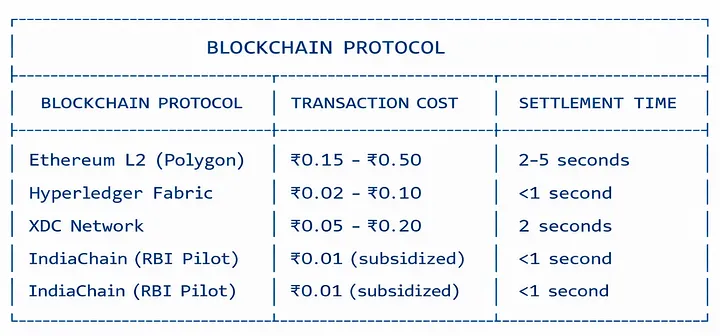
Token Standards Evolution
R.E.T. Standard (Real Estate Token)
ERC-3643 compliant security token standard
Smart Contract Functions
// Simplified RET Functions
function mintToken(address investor, uint256 fraction) public onlyOwner {
    require(kycVerified[investor], "KYC not complete");
    require(fraction >= minFraction, "Below minimum");
    _mint(investor, fraction);
    emit OwnershipRecorded(investor, fraction, block.timestamp);
}

function distributeRent(uint256 amount) public onlyAssetManager {
    uint256 totalTokens = totalSupply();
    for(uint256 i = 0; i < holders.length; i++) {
        uint256 share = (balanceOf(holders[i]) * amount) / totalTokens;
        transferToWallet(holders[i], share);
    }
}
4
Layer 4: Regulatory Integration Stack
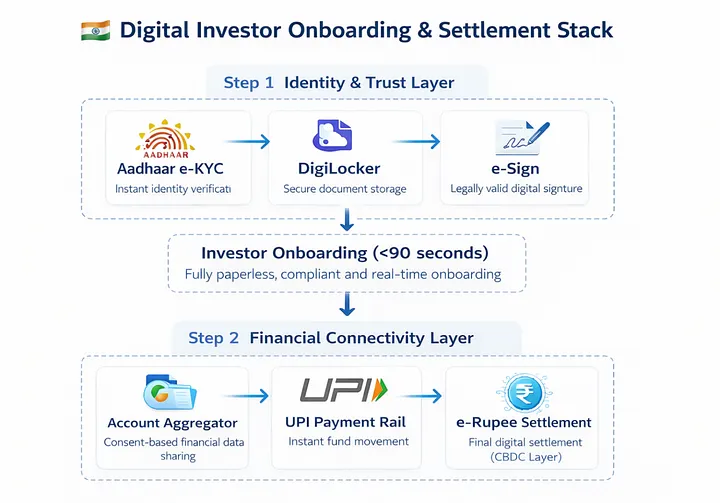
Regulatory Compliance Automation
SEBI Alternative Investment Funds (AIF) Rules
Auto-enforcement of minimum corpus (₹20 crore) and investor qualifications
Income Tax Act Compliance
TDS deduction at source (31.2% for companies, 10% for individuals) via smart contract
FEMA Regulations
Automatic checking of foreign investment caps (sector-specific limits)
RBI Circular Compliance
Prevention of token transfer to non-compliant wallets
5
Layer 5: Market Infrastructure
Four-Pillar Secondary Market Architecture
1
Primary Issuance Platform
SEBI-registered platforms for initial token offering
2
Institutional Liquidity Pool
AIFs and mutual funds providing bid-ask spreads
3
Retail P2P Exchange
Regulated peer-to-peer trading with price discovery
4
Automated Market Maker (AMM)
Liquidity pools for instant partial exits
The FRAX Protocol: Revolutionary Micro-Ownership
Mathematical Foundation
1 Property
= 100% ownership rights
1 FRAX
= 0.00001% ownership (10^-5)
Standardization
1 Acre
= 43,560 square feet
1 Square Foot
= 144 square inches
1 FRAX
= 1/144 of 1 square inch of 1 square foot
= 1/6,272,640 of an acre
Economic Implications
Minimum Investment
Can theoretically reach ₹10 (for ultra-high-value assets)
Diversification Potential
₹1 lakh can buy fractions in 100+ properties across 15 cities
Inheritance & Gifting
Transfer of specific FRAX units without property division
Case Study Analysis: India's First Tokenized REIT
Project: Bengaluru TechPark Commercial Complex (2024)
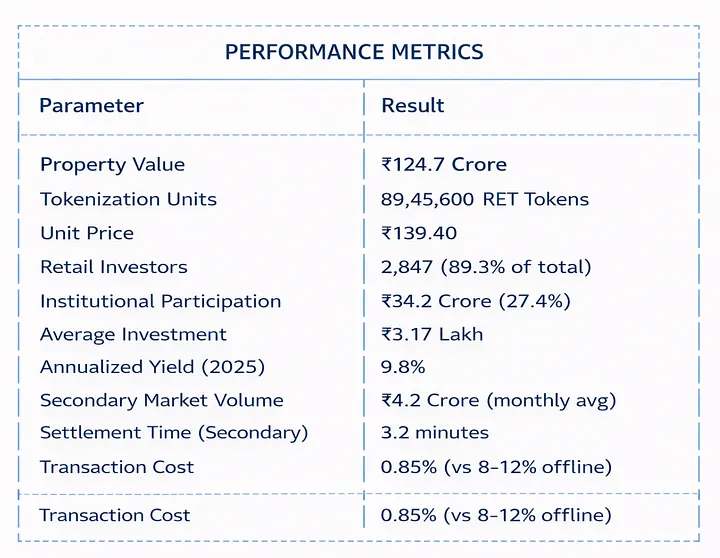
Technical Implementation
Blockchain:Polygon zkEVM
Token Standard:ERC-1400 (Security Token)
Oracle Integration:Chainlink for NAV calculation
Identity:Aadhaar-based soulbound tokens for compliance
Key Performance Indicators
Tokenization Time:45 days
Minimum Investment:₹25,000
Investor Count:1,250 investors
Annual Yield:9.2%
Regulatory Evolution Timeline (2023–2026)
I
Phase 1: Recognition (2023–2024)
RBI: Digital Rupee pilot includes real estate token settlements
SEBI: Discussion paper on fractional ownership platforms
Ministry of Electronics & IT: Blockchain standardization committee formed
II
Phase 2: Framework Development (2024–2025)
SEBI: Consultation paper on "Real Estate Digital Assets"
RBI: Guidelines for tokenized asset custody
G20 Influence: Global regulatory alignment under Indian presidency
III
Phase 3: Implementation (2025–2026) — CURRENT
Expected Regulatory Milestones
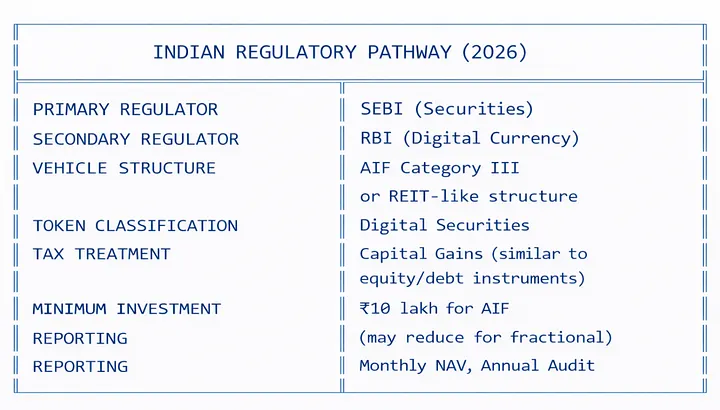
Digital Securities Act 2025
- Defining legal status of tokenized assets
SEBI (Real Estate Tokens) Regulations 2026
- Minimum platform capital: ₹25 crore
- Investor accreditation: ₹10 lakh minimum income or ₹50 lakh net worth
- Asset quality: Only Grade-A properties in top 10 cities initially
RBI Circular
- Integration of e-Rupee with tokenized asset settlements
Risk Analysis Matrix
Technical Risks
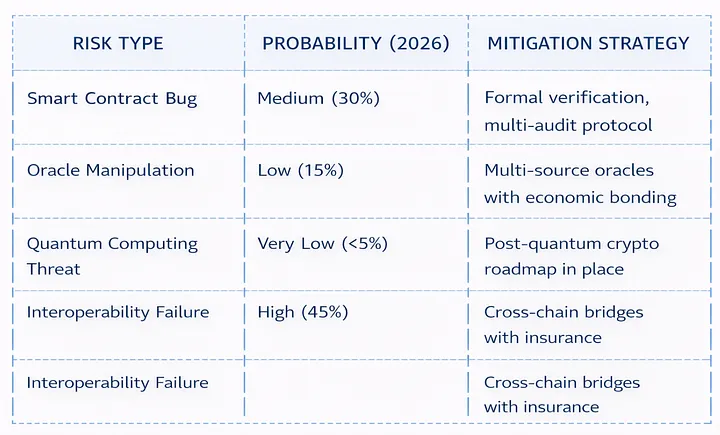
Market & Regulatory Risks
Liquidity Gap Risk
Secondary market depth insufficient for large exits
Mitigation: Market maker obligations for platform operators
Valuation Disputes
Disagreement on property NAV calculations
Mitigation: SEBI-registered valuer panel with blockchain oracle input
Taxation Ambiguity
GST applicability on token transfers unclear
Mitigation: Advance ruling mechanism with CBDT
Legal Precedent Analysis
Landmark Cases (2024–2025)
1
Mumbai High Court Ruling (2024)
Recognized blockchain records as "electronic evidence" under Section 65B of Indian Evidence Act
2
SEBI vs. TokenPlatform Ltd (2025)
Established that tokens representing real estate ownership qualify as "securities" under SCRA
3
Delhi District Court (2025)
Upheld inheritance of tokenized property through digital wills
Economic Impact Projections (2026–2030)
Market Size Forecast
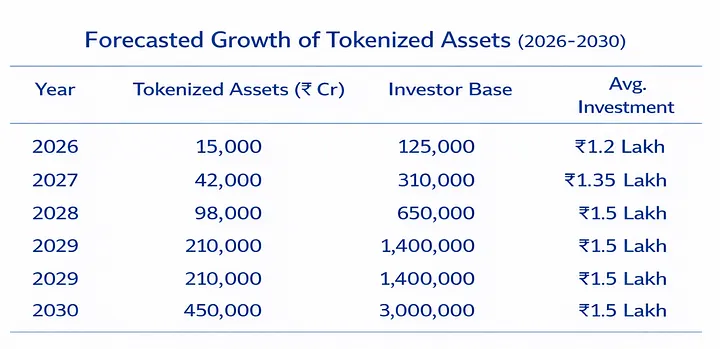
Source: NASSCOM Blockchain Report 2025, BCG Analysis
Macroeconomic Benefits
Capital Efficiency
Reduction in locked capital by ₹1.2 lakh crore by 2030
Formalization
Bringing ₹45,000 crore of informal real estate into regulated economy
Fiscal Impact
Additional ₹3,200 crore in stamp duty collections through increased transaction velocity
Employment
Creation of 25,000+ jobs in PropTech, legal-tech, and compliance sectors
Global Comparative Analysis
Adoption Metrics Across Jurisdictions
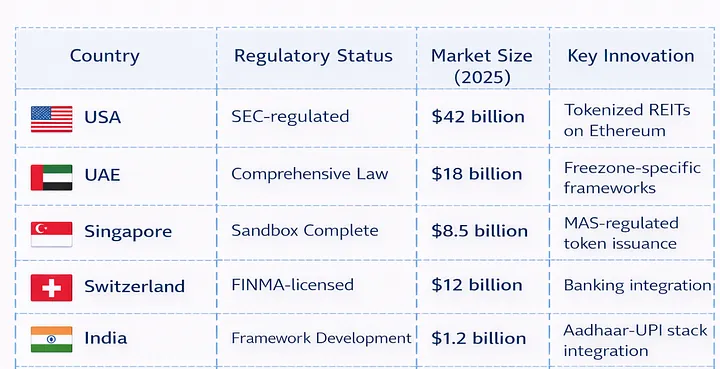
India's Competitive Advantage:
Digital Public Infrastructure
World's only country with integrated identity (Aadhaar), payments (UPI), and data sharing (Account Aggregator)
Scale Potential
50 million potential investors vs. 2 million in UAE
Cost Arbitrage
Development cost 40–60% lower than Western counterparts
Judicial Precedent
Common law system with robust property rights jurisprudence
Technical Implementation Roadmap
1
Phase 1: Foundation (Q1-Q4 2026)
Integration with Central Registry of Securitisation Asset Reconstruction and Security Interest (CERSAI)
e-Rupee integration for atomic settlements
Development of India-specific token standards (BIS Standards)
2
Phase 2: Scale (2027)
Interoperability with international blockchain networks
AI-powered valuation models with on-chain data verification
Integration with Goods and Services Tax Network (GSTN) for automated compliance
3
Phase 3: Maturity (2028–2030)
Cross-border tokenization framework
Derivatives market for real estate tokens
Complete disintermediation through DAO governance models
Conclusion: The 2026 Inflection Point
The convergence of four factors creates India's unique opportunity:
Regulatory Readiness
Evolving from ambiguity to structured frameworks
Technological Maturity
IndiaStack + blockchain + CBDC integration
Market Demand
Growing retail investor base (20 million+ demat accounts added in 2025)
Asset Supply
Commercial real estate vacancy rates at 10-year lows (12.7%)
Critical Success Factors for 2026:
Establishment of SEBI-approved digital asset custodians
Clear tax treatment for token transfers (capital gains vs. business income)
Development of institutional liquidity providers
Judicial education on blockchain evidence and smart contract enforcement
Final Assessment:
Real estate tokenization represents not merely an investment alternative but a fundamental re-architecture of property rights management. By 2026, India has the potential to leapfrog developed markets through its integrated digital infrastructure, creating the world's most accessible, transparent, and efficient real estate market.
Case Studies
Empowering Digital
Evolution



Blogs
Empowering Digital
Evolution
BitViraj Technologies - Your Gateway to
Tomorrow's Innovations



Embark on a DigitalJourney


The next-generation digital technology company Bitviraj has the potential to empower and reinvent business in the current fast-paced market.


Our Service
- Website Development
- Application Development
- Blockchain Development
- Gaming and Metaverse