

BitViraj Technologies - Your Gateway to
Tomorrow's Innovations
AI Agents Will Be the Next User in DeFi: A Comprehensive Analysis of AI Agent Use Cases, Market Growth, and Real-World Impact
The convergence of artificial intelligence (AI) and decentralized finance (DeFi) represents one of the most profound shifts in the modern financial ecosystem. AI agents are autonomous financial participants executing trades, reallocating capital, and managing billions in agentic volume.
AI Agents Will Be the Next User in DeFi: A Comprehensive Analysis of AI Agent Use Cases, Market Growth, and Real-World Impact
Overview
The convergence of artificial intelligence (AI) and decentralized finance (DeFi) represents one of the most profound shifts in the modern financial ecosystem. Unlike traditional finance—defined by gatekeepers, NDAs, closed data, and proprietary APIs—DeFi is permissionless, programmable, transparent, and settles in milliseconds.
These characteristics make DeFi not just compatible with AI agents, but native to them.
As of 2025, AI agents are no longer experimental curiosities. They are autonomous financial participants—executing trades, reallocating capital, managing risk, and coordinating across protocols in real time. Some already manage billions of dollars in aggregate agentic volume.
This analysis synthesizes market data, adoption statistics, and real-world deployments to support a clear conclusion:
The bottleneck for AI agents in DeFi is no longer infrastructure.
It is imagination.
The AI Agent Market Explosion
Global Market Size & Growth Trajectory
The AI agent economy is expanding at an unprecedented pace:
$7.6B
Market valuation in 2025
(up from $5.4B in 2024)
$47.1B
Projected size by 2030
45.8%
CAGR (2025–2030)
68%
Projected AI market share by 2030
of $594B global AI market
Agent-based systems are rapidly becoming the dominant interface between software and economic activity.
Crypto-Native AI Agent Growth
The intersection of AI and crypto is accelerating even faster:
Q4 2024
AI agent crypto market value surged
$4.8B → $15.5B
in 3 months
AI Token MCAP
$23B → $50.5B
mid-2024 to Feb 2025
$3.8B
VC raised by AI agent startups in 2024
Nearly 3× YoY growth
Capital is flowing not into theory, but into production-grade agent systems.
Enterprise Adoption Signals
AI agents are no longer confined to startups:
Enterprises in Production
51%
Planning Deployment
78%
Financial Services:
Actively deploying AI87%
Planning agentic AI within 12 months76%
By 2028, 33% of enterprise software will include agentic AI (up from <1% in 2024)
Finance is leading this transformation—and DeFi is its most natural execution layer.
AI Agents as Native DeFi Participants
DeFi was unintentionally designed for autonomous agents:
✓
No permission required
✓
No proprietary APIs
✓
Fully observable state
✓
Programmatic asset control
✓
Near-instant settlement
For AI agents, DeFi is not an integration challenge—it is home territory.
Core AI Agent Use Cases in DeFi
1. Yield Farming & Liquidity Optimization
Autonomous yield optimization is one of the most mature agentic use cases.
Real-world example: Arma Agents (launched Nov 2024)
TVL Growth
$200K → $11.2M
in 7 months
5,500% increase
Agents
33,000
executing strategies
Cumulative Volume
$324M
agentic volume
Protocols
Allocate USDC across
Morpho, Moonwell, Aave
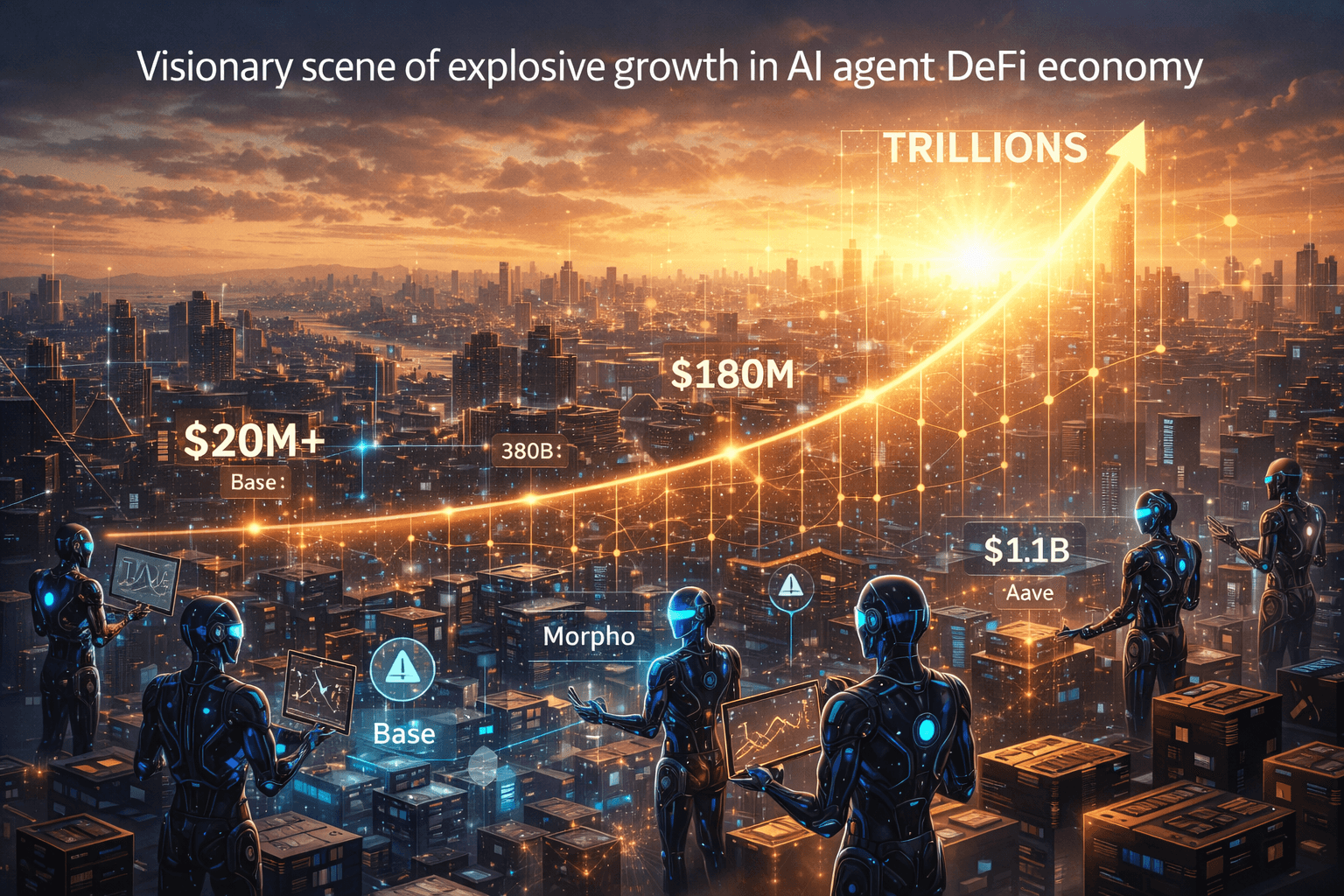
By June 2025, stablecoin-focused AI agents exceeded $20M TVL on Base alone, signaling institutional-grade confidence in automated yield strategies.
2. Arbitrage & Statistical Trading
AI agents outperform humans in fragmented, high-velocity markets:
Win Rates
>70%
in backtested futures grid strategies
Execution
Millisecond-level
trade execution
Availability
24/7
operation across global markets
Cross-chain
Exploiting price inefficiencies across L1s and L2s
Notable case:
On Polymarket, an account (AlphaRaccoon) generated $1M+ by winning 22 out of 23 bets, a level of consistency strongly indicative of ML-driven decision-making.
3. Lending & Risk Management
AI agents continuously monitor:
Collateral ratios
Liquidation thresholds
Interest rate movements
Protocol-level risk
They dynamically rebalance positions—something humans cannot do at scale without automation.
4. Market Sentiment & Price Prediction
Advanced agents combine:
On-chain flows
Order-book dynamics
Social sentiment
(X, Telegram, Discord)
They trade on emerging narratives before markets fully price them in, creating a new form of AI-driven information asymmetry.
Real-World Business & Economic Impact
Enterprise Efficiency
Average efficiency gain
43%
Annual cost savings
~$2.3M
per deployed agent
For DeFi trading desks and crypto funds, these gains directly translate to higher alpha per unit of capital.
Revenue & Macroeconomic Impact
Revenue uplift
6–10%
for companies adopting agentic AI
GDP contribution by 2030
$2.6T
low estimate
–
$4.4T
high estimate
(PwC estimate)
Finance is the highest-impact vertical.
Challenges & Emerging Risks
Despite rapid growth, risks remain.
Data Quality & Integration
- •On-chain data is clean, but off-chain sentiment and macro inputs introduce latency and bias
- •Poor data → catastrophic decisions at machine speed
The "Black Box" Problem
- •Users delegate capital without fully understanding agent reasoning
- •Transparency and explainability are unresolved challenges
Herd Behavior & Systemic Risk
- •Similar strategies deployed at scale could amplify volatility
- •Cascading liquidations remain a real concern
Regulatory Uncertainty
- •AI agents operate across jurisdictions
- •Compliance frameworks lag far behind deployment reality
Why DeFi Is Purpose-Built for AI Agents
Traditional finance cannot replicate these properties:
No gatekeepers
Permissionless deployment
Fully programmable
Smart contracts as native execution
Fast settlement
Near-real-time finality
Radical transparency
Verifiable state at all times
Native incentives
Tokens enable AI-to-AI economies
DeFi is not just compatible with AI agents—it is optimized for them.
The Real Bottleneck: Imagination
The technology stack is ready:
Agent frameworks
Fetch.ai, SingularityNET, Autonolas
Scalable L2s
Mature smart contract platforms
What's missing is new mental models.
Early prototypes already include:
Pump-and-dump detection agents
Reinforcement-learning lending optimizers
Uniswap v3 active liquidity managers
Fully autonomous perpetual futures traders
These exist today—at small scale.
The unanswered question is not "can this work?"
It is "what else becomes possible when software becomes a financial actor?"
2025–2026 Outlook
Likely next-phase developments:
Agent-to-agent economies
Autonomous negotiation and coordination
AI-driven DAO governance
Delegated voting by analytical agents
Cross-chain orchestration
Unified capital management across ecosystems
Clearer regulation
Reduced uncertainty for institutional deployment
Institutional adoption
Hedge funds and asset managers deploying agentic crypto stacks
Conclusion
AI agents represent a fundamental shift, not an incremental upgrade.
For the first time, software can:
Observe markets
Learn from outcomes
Allocate capital
Act autonomously
DeFi's open, programmable architecture makes it the ideal substrate for this transformation.
By mid-2025, AI agents had already captured $20M+ TVL on Base alone.
Growth is exponential. Capital, talent, and infrastructure are aligned.
The infrastructure exists.
The standards are emerging.
The market signals are clear.
The next major user in DeFi will not be human.
It will be an AI agent.
And the only remaining constraint is imagination.
Case Studies
Empowering Digital
Evolution



Blogs
Empowering Digital
Evolution
BitViraj Technologies - Your Gateway to
Tomorrow's Innovations




Embark on a DigitalJourney


The next-generation digital technology company Bitviraj has the potential to empower and reinvent business in the current fast-paced market.


Our Service
- Website Development
- Application Development
- Blockchain Development
- Gaming and Metaverse