

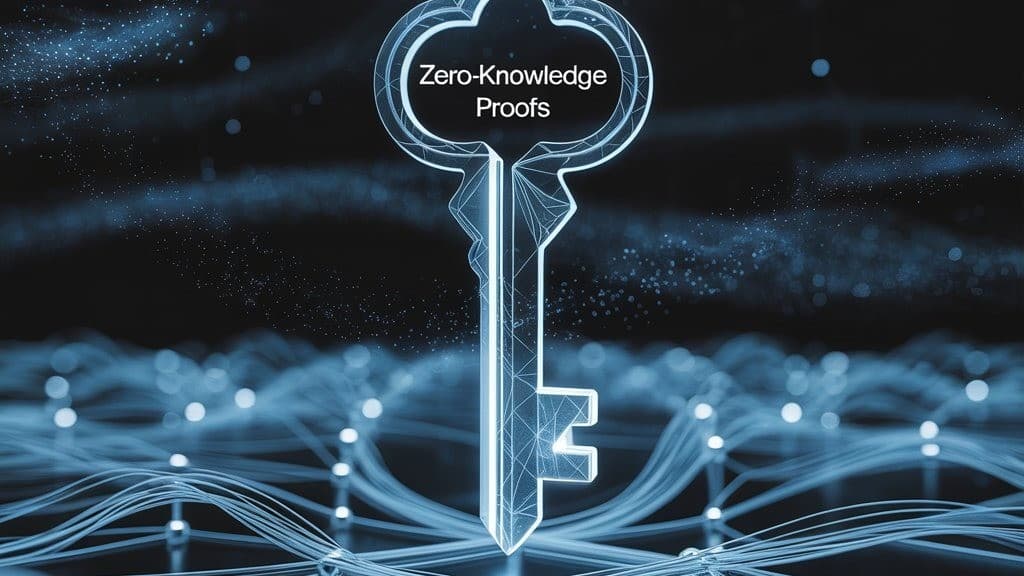
BitViraj Technologies - Your Gateway to
Tomorrow's Innovations
Zero-Knowledge Proofs for Homomorphically Encrypted Transactions: A Practical Guide
In the evolving landscape of financial systems, blockchain networks, and privacy-preserving computation, one challenge stands out:
How can we verify computations over encrypted transaction data without revealing the data itself?
This is where Zero-Knowledge (ZK) proofs and Homomorphic Encryption (HE) meet. HE allows computation on encrypted data; ZK proofs let you prove those computations were done correctly — without exposing the plaintext.
In this blog, we take a deep dive into practical designs for such systems, covering:
- Core cryptographic building blocks
- Security models and goals
- Three architecture patterns for ZK + HE
- Concrete protocol sketches
- Implementation guidance and use cases
- Current limitations and open research problems
The Core Problem
Imagine:
- A custodian aggregates transactions for compliance checks.
- A DeFi aggregator computes risk metrics over encrypted balances.
- A bank sums encrypted customer deposits for a regulator.
In all cases:
- The data must stay encrypted for confidentiality.
- The verifier (auditor, smart contract, regulator) needs assurance that the computation was correct and policy rules were followed.
Solution: Combine HE (for privacy) with ZK proofs (for verifiable correctness).
Building Blocks
Homomorphic Encryption (HE)
- Additive HE (e.g., Paillier) – supports addition and scalar multiplication.
- Somewhat / Leveled HE (e.g., BFV, CKKS) – supports bounded-depth circuits.
- Fully Homomorphic Encryption (FHE) – supports arbitrary circuits, but costly.
Key property:
Eval(f, Enc(x1), ..., Enc(xn)) = Enc(f(x1, ..., xn))
Zero-Knowledge Proofs
- Sigma Protocols – efficient, interactive, best for simple linear relations.
- NIZKs / SNARKs – succinct, non-interactive proofs for arbitrary circuits.
- Bulletproofs – logarithmic-size range and inner-product proofs.
Security Goals
Any architecture must ensure:
- Correctness – Output ciphertext decrypts to the intended function of inputs.
- Zero-Knowledge – Proof leaks no extra info about inputs.
- Soundness – Cheating provers can't pass verification with false results.
- Efficiency – Proof size and verification must be practical.
Three Practical Architectures
A. Sigma-Protocol over Additive HE (Efficient Linear Checks)
Best for:
- Balance conservation checks
- Simple sum/weighted sum verification
How it works:
- Clients encrypt values with Paillier and also publish Pedersen commitments.
- Prover computes the encrypted sum homomorphically.
- Prover generates a ZK proof that the decrypted sum matches the committed sum.
✓ Pros:
Very fast, small proofs, low verification cost.
✗ Cons:
Works only for linear relations, needs trusted or threshold decryption.
B. zkSNARK over Circuit-Friendly HE (General-Purpose)
Best for:
- Arbitrary policy checks
- On-chain verification
How it works:
- Prover runs homomorphic evaluation to get encrypted output.
- Builds a SNARK circuit that proves the correctness of the homomorphic evaluation.
- Verifier checks the SNARK — cheap, constant-time.
✓ Pros:
Succinct, verifier-friendly, fits blockchain verification.
✗ Cons:
High prover cost, complex circuits for HE encryption logic.
C. Homomorphic MAC + ZK Proof (Streaming & Batch-Friendly)
Best for:
- Continuous aggregation
- IoT/streaming data
How it works:
- Each encrypted value has a homomorphic authentication tag.
- Tags combine along with ciphertexts during computation.
- Prover produces a ZK proof that the tag matches the encrypted result.
✓ Pros:
Lightweight aggregation, efficient batching.
✗ Cons:
Needs pre-distributed MAC keys, special setup.
Example — Sum Verification with Paillier HE
Encryption: Ci = gmi riN mod N²
Commitment: Com(mi) = gmi hr'i
Proof: Use Chaum–Pedersen to show decrypted sum matches committed sum.
Performance & Deployment Guidance
Approach trade-offs:
- Sigma + Additive HE: Fast, minimal overhead, ideal for audits.
- zkSNARK + HE: Succinct, works for any computation, best for blockchain.
- MAC + ZK: Efficient in high-frequency streaming settings.
Implementation tips:
- Use established libraries: libsnark, bellman, SEAL, TFHE.
- Precompute where possible (especially for SNARK witnesses).
- Store proofs & commitments immutably for audit trails.
Real-World Applications
- Banking compliance: Encrypted aggregate balances with proofs for regulators.
- Custody services: MPC wallets proving no double-spend or quota violations.
- DeFi privacy pools: Prove liquidity balances without revealing addresses.
- Federated learning: Verifiable encrypted model aggregation.
Challenges & Open Problems
- Efficiency: SNARK + HE circuits still heavy — need optimized encodings.
- Post-Quantum security: Current pairing-based SNARKs are not PQ-safe.
- Composable security: Formal frameworks for HE + ZK in multi-party setups.
- Metadata leakage: Side-channel protections for timing and traffic analysis.
Conclusion
Combining Zero-Knowledge Proofs with Homomorphic Encryption is a powerful way to ensure confidentiality + integrity in modern financial, blockchain, and analytic systems.
The right architecture depends on:
- The type of relations (linear vs. arbitrary)
- Performance constraints (prover/verifier resources)
- Deployment context (off-chain, on-chain, streaming)
As cryptographic tooling matures, we expect more efficient, post-quantum-ready, and developer-friendly frameworks for building verifiable encrypted transaction systems.
Case Studies
Empowering Digital
Evolution



Blogs
Empowering Digital
Evolution
BitViraj Technologies - Your Gateway to
Tomorrow's Innovations



Embark on a DigitalJourney


The next-generation digital technology company Bitviraj has the potential to empower and reinvent business in the current fast-paced market.


Our Service
- Website Development
- Application Development
- Blockchain Development
- Gaming and Metaverse