


BitViraj Technologies - Your Gateway to
Tomorrow's Innovations
By Bitviraj Technology
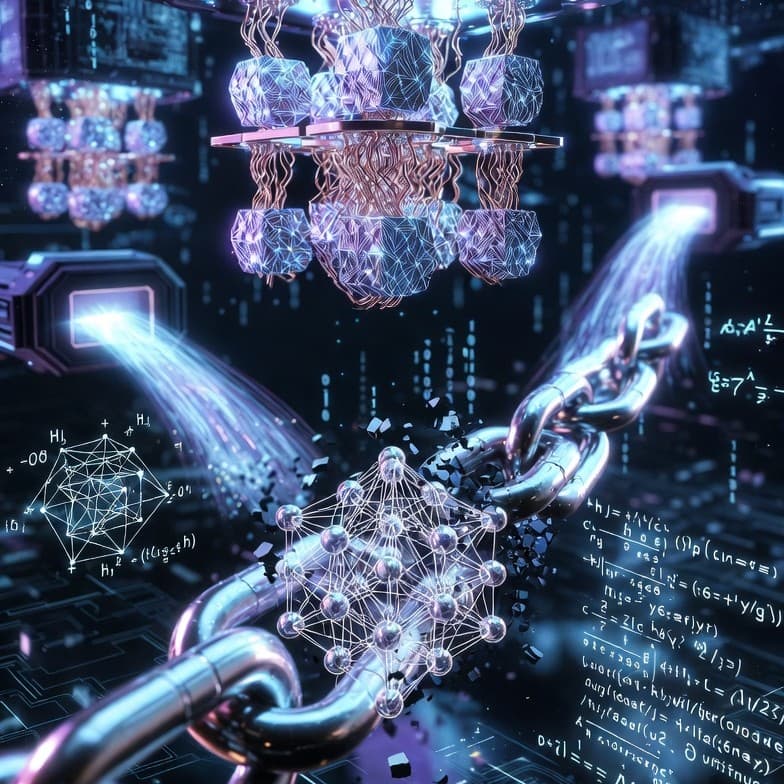
How Quantum Computing Could Break Today's Blockchains—and Fix Them
Blockchain was designed to solve a human problem: trust in a digital world where trust is scarce. By combining cryptography, distributed consensus, and economic incentives, blockchains created systems where truth does not depend on a single authority.
But every technological foundation rests on assumptions. One of blockchain's core assumptions is that certain cryptographic problems are computationally infeasible to break. Quantum computing challenges that assumption-not hypothetically, but mathematically.
At Bitviraj Technology, we believe the quantum era will not end blockchain. Instead, it will force blockchain to evolve, mature, and become more resilient than ever before.
This article explores how quantum computing threatens today's blockchains-and how the same quantum principles can ultimately make them stronger.
Why Blockchain Security Depends on Mathematics, Not Magic
Blockchains do not rely on secrecy. They rely on hard math.
Modern blockchains use cryptographic techniques such as:
Public-key cryptography
for wallet ownership
Digital signatures
for transaction authenticity
Hash functions
for immutability and consensus
These mechanisms are secure because, on classical computers, solving the underlying math would take thousands to millions of years.
Quantum computing changes that timeline.
The Quantum Threat: What Exactly Breaks?
Quantum computers don't "hack" blockchains. They solve certain mathematical problems exponentially faster than classical machines.
1
Public-Key Cryptography at Risk
Most blockchains rely on elliptic curve cryptography (ECC) or RSA-style schemes. Quantum algorithms-most notably Shor's algorithm-can theoretically break these systems by efficiently solving:
Integer factorization
Discrete logarithm problems
What this means:
If a sufficiently powerful quantum computer exists, it could derive a private key from a public key.
That threatens:
Wallet ownership
Digital signatures
Transaction authenticity
2
The Real Risk Is Stored Public Keys
A subtle but critical detail: not all blockchain assets are equally exposed.
Public keys are revealed:
When funds are spent
In smart contracts
In reused addresses
Once revealed, they become quantum-vulnerable. The danger is not instant collapse-but long-term exposure, especially for:
High-value wallets
Long-lived smart contracts
Government or enterprise blockchains
3
Hash Functions Are More Resilient (But Not Immune)
Hashing algorithms (like SHA-256) are more resistant to quantum attacks. Quantum algorithms such as Grover's algorithm only provide a quadratic speedup, not an exponential one.
This means hash-based security weakens but does not break outright. Longer hash lengths can mitigate risk.
Blockchain consensus remains mostly intact-but identity and ownership are the weak links.
Why Quantum Won't Kill Blockchain Overnight
Despite the headlines, quantum computing is not an existential threat today.
Reasons:
•
Large-scale fault-tolerant quantum computers don't yet exist
•
Quantum attacks require enormous resources
•
Networks can upgrade cryptography before the threat materializes
Blockchain is software-and software can evolve. The real risk lies in inaction, not inevitability.
The Fix: Post-Quantum Blockchains
The same scientific rigor that exposed blockchain's cryptographic assumptions also offers solutions.
1
Post-Quantum Cryptography (PQC)
New cryptographic algorithms are designed to resist quantum attacks, based on problems like:
Lattice mathematics
Hash-based signatures
Multivariate equations
Impact:
Wallets, transactions, and smart contracts become quantum-resistant.
2
Crypto-Agility by Design
Future-ready blockchains must be crypto-agile-able to upgrade cryptographic primitives without breaking the network.
This requires:
Modular cryptographic layers
Governance mechanisms for coordinated upgrades
Backward compatibility planning
Crypto-agility turns quantum risk into a manageable transition.
3
Hybrid Classical–Quantum Security Models
Ironically, quantum technology can strengthen blockchain security.
Examples:
Quantum Random Number Generators (QRNG)
for stronger entropy
Quantum Key Distribution (QKD)
for ultra-secure communication between nodes
Quantum-enhanced verification
for critical infrastructure blockchains
Quantum becomes a defensive asset, not just an offensive threat.
What This Means for Enterprises and Governments
For enterprises and public institutions, the implications are strategic, not theoretical.
Key considerations:
Long-term data confidentiality
(data harvested today, decrypted tomorrow)
Regulatory readiness
for post-quantum standards
Protection of national digital infrastructure
Trust in digital identity systems
Blockchains used for:
Supply chains
Digital identity
Financial settlement
Government records
must be quantum-safe by design, not patched later.
Bitviraj Technology's Perspective: Evolution, Not Replacement
At Bitviraj Technology, we see blockchain and quantum computing as complementary forces.
Blockchain provides:
Transparency
Immutability
Decentralized trust
Quantum computing challenges blockchain to:
Strengthen cryptography
Improve resilience
Adopt long-term security thinking
Our approach focuses on:
Designing quantum-aware blockchain architectures
Enabling post-quantum migration strategies
Building crypto-agile enterprise systems
Aligning innovation with regulatory expectations
The goal is not to fear quantum computing-but to design responsibly for it.
The Bigger Picture: Trust in a Post-Quantum World
The quantum era forces a deeper question: What does digital trust mean when computational assumptions change?
The answer is not abandoning blockchain-but making trust adaptive.
Blockchains that survive the quantum transition will be:
More robust
More standardized
More enterprise-ready
Quantum computing will not destroy decentralized systems. It will pressure them to become stronger, smarter, and more future-proof.
Final Thoughts
Quantum computing exposes the limits of today's cryptography-but it also opens the door to better security models.
Blockchains that evolve will endure. Those that remain static will not.
At Bitviraj Technology, we believe the future belongs to systems that anticipate change rather than react to it-and quantum computing is the next great test of digital trust.
The time to prepare is not when quantum computers arrive. It is now.
Case Studies
Empowering Digital
Evolution



Blogs
Empowering Digital
Evolution
BitViraj Technologies - Your Gateway to
Tomorrow's Innovations



Embark on a DigitalJourney


The next-generation digital technology company Bitviraj has the potential to empower and reinvent business in the current fast-paced market.


Our Service
- Website Development
- Application Development
- Blockchain Development
- Gaming and Metaverse