


BitViraj Technologies - Your Gateway to
Tomorrow's Innovations
By Bitviraj Technology
AI Models Lifecycle
Understanding AI Models: From Training to Real-World Impact
Introduction: Why AI Models Matter More Than the Buzzwords
Artificial Intelligence is no longer a futuristic concept reserved for research labs or tech giants.
Today, AI models quietly influence how businesses operate, how decisions are made, and how customers experience products and services.
Yet, despite widespread adoption, AI often remains a black box-spoken about in buzzwords but rarely understood in practical terms.
What exactly is an AI model? How is it trained? And most importantly, how does it create real-world impact?
At Bitviraj Technology, we believe that understanding AI models is the first step toward using them responsibly, effectively, and strategically.
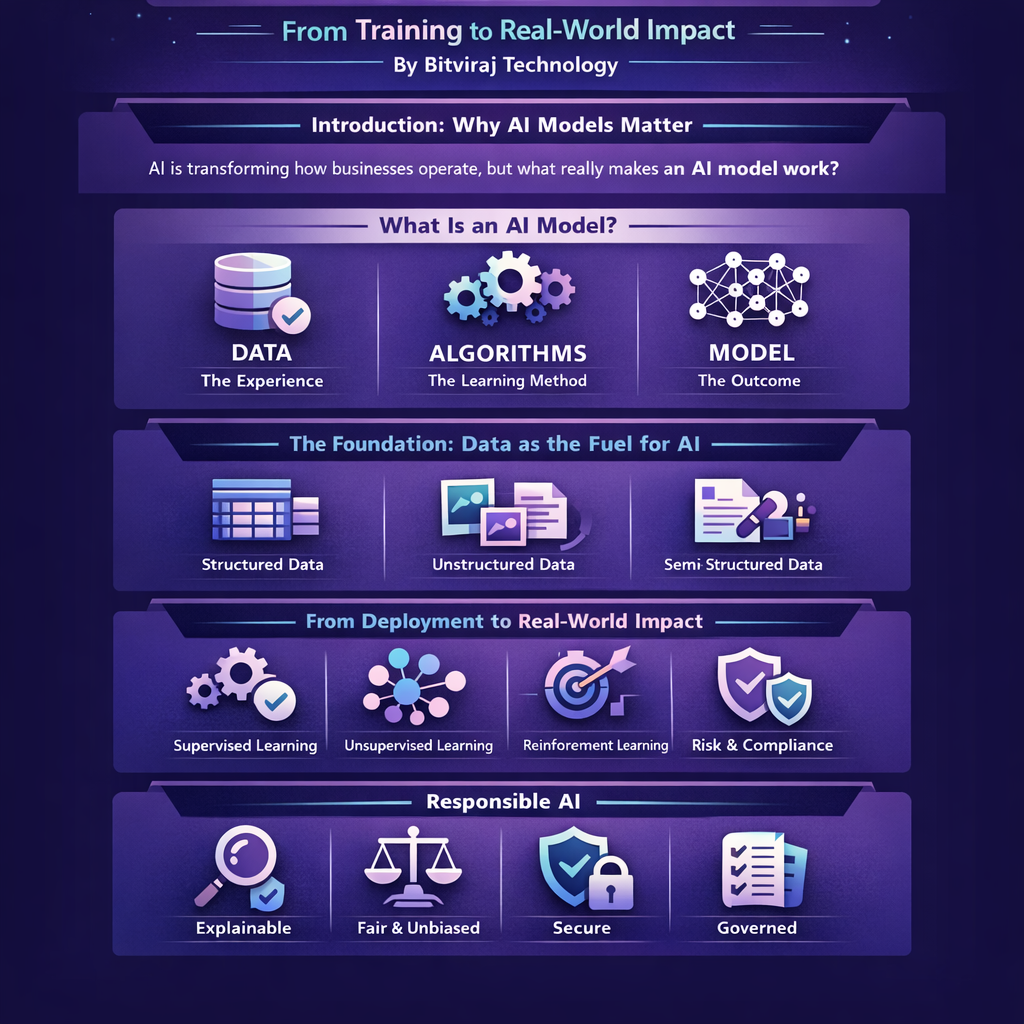
What Is an AI Model?
An AI model is a mathematical representation of learned patterns derived from data.
Instead of being explicitly programmed with rules, the model learns relationships, trends, and signals by analyzing examples.
Data is the experience
Algorithms are the learning method
The model is the outcome
Once trained, the model can make predictions, classify information, or generate insights when exposed to new data.
The Foundation: Data as the Fuel for AI
Every AI model begins with data-and the quality of that data determines the quality of the model.
Types of Data Used in AI
Structured data
Tables, databases, transaction records
Unstructured data
Text, images, audio, videos
Semi-structured data
Logs, emails, sensor data
Before training begins, data must be:
Cleaned
Labeled (when required)
Balanced
Governed for privacy and security
Poor data doesn't just slow AI down-it leads to misleading outcomes.
Training an AI Model: How Machines Learn
Training is the process where an AI model learns from historical data to identify patterns.
1
Supervised Learning
The model learns from labeled data-where the correct output is already known.
Common use cases include fraud detection, image classification, and demand forecasting.
2
Unsupervised Learning
The model identifies hidden patterns without labeled outcomes.
This is useful for customer segmentation, anomaly detection, and behavioral analysis.
3
Reinforcement Learning
The model learns through trial and error, improving decisions based on feedback.
This approach is often used in robotics, gaming, and optimization systems.
Training involves iterative adjustments, where the model improves accuracy with each learning cycle.
Validation and Testing: Measuring Intelligence
Once trained, an AI model must be tested to ensure it performs reliably beyond its training data.
Key evaluation steps include:
Testing on unseen datasets
Measuring accuracy, precision, recall, and bias
Identifying overfitting or underfitting
At Bitviraj Technology, model validation is treated as a risk management process, not just a technical checkpoint.
Deployment: From Model to Business Capability
An AI model only creates value when it is deployed into real systems.
Deployment involves:
Integrating the model with applications or workflows
Ensuring scalability and performance
Monitoring real-time behavior
Establishing fallback and override mechanisms
This is where many AI initiatives fail-not due to poor models, but due to poor integration.
Real-World Impact: How AI Models Create Value
1. Operational Efficiency
AI models automate repetitive decisions, reduce processing time, and minimize errors across operations.
2. Predictive Intelligence
From forecasting demand to anticipating system failures, AI enables businesses to act before problems arise.
3. Personalized Experiences
AI models tailor recommendations, communications, and services based on individual behavior and preferences.
4. Risk and Compliance Management
Models continuously monitor patterns to detect anomalies, fraud, and compliance violations in real time.
Responsible AI: Trust, Ethics, and Governance
With power comes responsibility. AI models must be:
Explainable
Fair and unbiased
Secure
Aligned with regulatory requirements
Responsible AI is not optional-it is essential for long-term trust and adoption.
Bitviraj Technology embeds governance frameworks and human oversight into every AI deployment to ensure ethical and transparent outcomes.
Continuous Learning: AI Models Are Never "Finished"
Unlike traditional software, AI models evolve.
Post-deployment, models require:
Performance monitoring
Retraining with fresh data
Drift detection
Continuous optimization
This lifecycle approach ensures that AI remains relevant as business environments change.
Bitviraj Technology's Perspective on AI Models
At Bitviraj Technology, we view AI models as living systems, not static assets.
Business-first model design
Secure and scalable architectures
Human-in-the-loop controls
Measurable business impact
We work closely with organizations to ensure AI delivers value-not just technical sophistication.
Conclusion: From Algorithms to Outcomes
Understanding AI models is about more than algorithms and data science.
It's about bridging the gap between technology and real-world outcomes.
When designed, trained, and governed correctly, AI models become trusted decision partners-enhancing efficiency, insight, and innovation across the enterprise.
The future of AI isn't just intelligent.
It's understandable, responsible, and impactful.
About Bitviraj Technology
Bitviraj Technology helps organizations design, deploy, and scale intelligent AI solutions that drive real-world business transformation.
Case Studies
Empowering Digital
Evolution



Blogs
Empowering Digital
Evolution
BitViraj Technologies - Your Gateway to
Tomorrow's Innovations




Embark on a DigitalJourney


The next-generation digital technology company Bitviraj has the potential to empower and reinvent business in the current fast-paced market.


Our Service
- Website Development
- Application Development
- Blockchain Development
- Gaming and Metaverse