

BitViraj Technologies - Your Gateway to
Tomorrow's Innovations
Token Wrapping and Multichain Liquidity Management
In today's fragmented blockchain landscape, where dozens of chains operate with varying technical architectures, the need for asset interoperability has never been greater. Token wrapping has emerged as a foundational technology enabling assets to transcend their native blockchain environments, while sophisticated liquidity management approaches ensure these multichain ecosystems remain balanced and efficient.

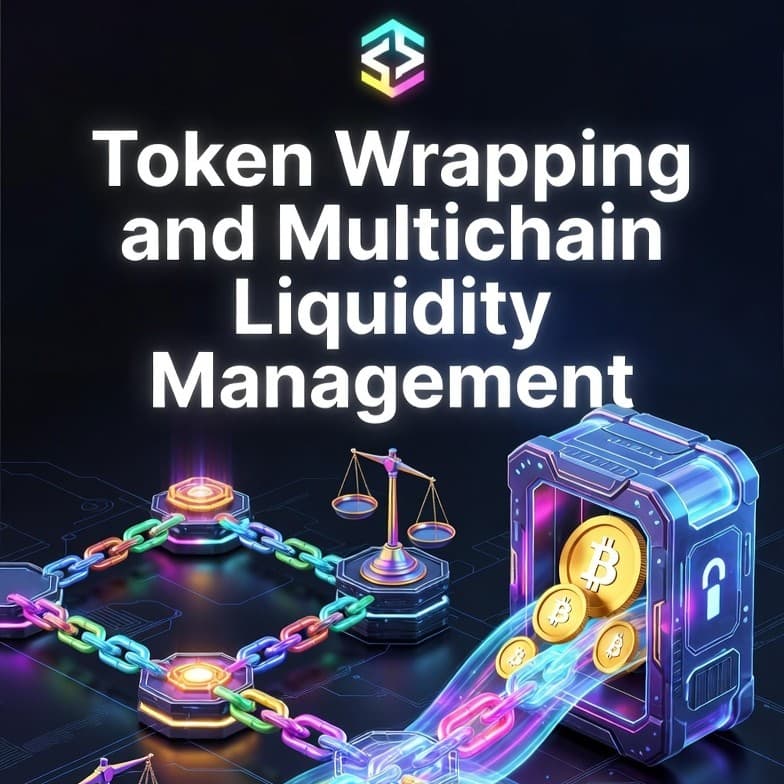
Token Wrapping and Multichain Liquidity Management
Foundations of Cross‑Chain Interoperability

Token Wrapping and Multichain Liquidity Management
Architecture, Implementation & Best Practices
Introduction: The Rise of Cross‑Chain Interoperability
In today's fragmented blockchain landscape, where dozens of chains operate with varying technical architectures, the need for asset interoperability has never been greater. Token wrapping has emerged as a foundational technology enabling assets to transcend their native blockchain environments, while sophisticated liquidity management approaches ensure these multichain ecosystems remain balanced and efficient. Together, these innovations form the backbone of the interconnected Web3 economy, allowing value to flow freely across previously isolated networks while maintaining security and stability.
Token Wrapping – Architecture and Implementation
The Core Concept: What Is Token Wrapping?
Token wrapping is a versatile mechanism for enabling cross-chain asset compatibility. At its core, wrapping relies on a vault-based smart contract architecture, where tokens from a source blockchain are locked in a secure vault, and equivalent tokens are minted on a target blockchain. This process creates a synthetic representation of the original asset that can operate within an entirely different blockchain ecosystem while maintaining a 1:1 value peg to the underlying asset.
The vault-based smart contract architecture underpinning wrapped tokens unlocks tremendous cross-chain utility, enabling tokens like BTC, LTC, and ADA to participate in ecosystems beyond their native blockchains. The flexibility of wrapping also allows external assets, including physical commodities, to integrate into blockchain ecosystems. However, ensuring security and decentralization in vaults remains critical to building user trust and protecting wrapped assets. With ongoing innovations like decentralized vault management and enhanced bridging protocols, the wrapped token landscape is poised for even greater adoption.
How the Wrapping Process Works
Wrapping Process:
- Locking: The original asset (e.g., BTC) is deposited in a secure vault or custodian smart contract on its native blockchain.
- Minting: An equivalent amount of wrapped tokens (e.g., wBTC) is created on the target blockchain.
- 1:1 Pegging: Each wrapped token is backed by the corresponding amount of the original asset, ensuring trust and value parity.
Unwrapping Process:
To reclaim the original asset, the wrapped token is burned, and the equivalent locked asset is released from the vault.
Technical Architecture of Vault-Based Smart Contracts
- Vault Smart Contract on Source Chain: Holds original tokens, implements strict deposit/withdrawal controls, often with multi-signature security.
- Minting Smart Contract on Target Chain: Communicates with vault, mints wrapped tokens, manages token standard compliance.
- Oracle System or Validators: Ensures accurate cross-chain communication, triggers minting/burning based on deposits.
- Unwrapping Mechanism: Burns wrapped tokens on target chain, unlocks original assets from vault.
Enhanced Features of Modern Vault Smart Contracts
Collateralization Guarantees: 1:1 backing through transparent on-chain reserves.
Multisignature Security: Multiple independent parties required for high-value vaults.
Decentralized Vaults: RenVM, ThorChain – distributed node networks with threshold signatures.
Customizable Minting Rules: Dynamic limits, governance approvals, time-based restrictions.
Real-World Examples of Wrapped Tokens
| Token | Source | Target | Use Case |
|---|---|---|---|
| wBTC | Bitcoin | Ethereum | DeFi on Ethereum |
| wLTC | Litecoin | Ethereum/BSC | Liquidity for Litecoin |
| wETH | Ethereum (native) | Ethereum (ERC-20) | ERC-20 compatibility |
| renBTC/renDOGE | BTC/DOGE | Ethereum/Solana | Decentralized wrapping |
| PAX Gold (PAXG) | Physical gold | Ethereum | Fractional gold ownership |
| wADA, wDOT, wSOL | Cardano/Polkadot/Solana | Ethereum/BSC | Cross-chain DeFi |
Limitations and Challenges of Token Wrapping
Centralization Risks: Custodial vaults introduce trust dependencies.
Smart Contract Vulnerabilities: High‑profile bridge hacks (Poly Network $611M).
Regulatory Uncertainty: Security/derivative classification gray areas.
Fragmentation: Multiple wrapped versions (wBTC, renBTC, tBTC) divide liquidity.
Oracle Reliability: Manipulated oracles can enable fraudulent minting.
Gas Costs & Complexity: Multi‑transaction process creates friction.
Liquidity Management in Multichain Token Ecosystems
The Challenge of Multichain Liquidity
As tokens become available across multiple blockchains, managing liquidity and token supply becomes exponentially more complex. Balancing token supply between integrated blockchains is essential for maintaining market stability, aligning rewards, and optimizing user experience.
Key Principles of Cross‑Chain Supply Balancing
- Initial Supply Allocation Strategy: Analyze expected trading volume and average transaction size per chain (BSC/Polygon for small trades, Ethereum for high‑value).
- Dynamic Supply Adjustments: Mint tokens on chains with demand, burn from chains with excess supply – total supply unchanged.
- Market‑Driven Rebalancing: Respond to price discrepancies, pool utilization, arbitrage opportunities.
Technical Implementation Approaches
- Manual Balancing: Team periodically evaluates supply/demand – flexible but slow.
- Automated Balancing with Thresholds: Smart contracts monitor imbalances and trigger rebalancing in real time.
Synchronization of Staking and Rewards Across Chains
Unified APY/APR Across Chains: Use external oracles to aggregate staked and LP data across all chains, treat all contributions as a single virtual vault, implement logarithmic reward distribution.
Cross‑Chain Reward Synchronization Models:
- Deflationary/Fixed Supply Models – rewards based on aggregated staking data, maintain supply caps.
- Flat Reward Models – simpler but can inflate supply.
- Hybrid Approaches – combine both, adjust dynamically.
Technical Architecture for Multichain Balancing
- Cross‑Chain Communication Layer: Bridges, messaging protocols (LayerZero, Wormhole, CCIP), relay networks.
- Monitoring and Data Infrastructure: Oracles, analytics engines, dashboards.
- Balancing Execution Layer: Smart contracts for simultaneous mint/burn, scheduler contracts, emergency controls.
- Governance and Control Systems: Community voting, multi‑sig, on‑chain transparency.
Example Implementations and Use Cases
Liquidity Pools Across Chains
DeFi projects on Ethereum and BSC dynamically adjust token supply when liquidity drops below thresholds.
Multichain Yield Farming
SushiSwap incentivizes LPs across chains with synchronized APY through aggregated staked data.
GameFi and Metaverse Economies
Play‑to‑earn tokens maintain liquidity across Polygon and Ethereum with consistent rewards.
Enterprise Tokenization Platforms
RWA tokenization ensures consistent pricing across chains without chain‑specific premiums.
Advanced Considerations and Emerging Solutions
Zero‑Knowledge Proof Enhanced Wrapping: zk‑SNARKs/zk‑STARKs for privacy‑preserving reserve proofs.
Liquidity Aggregation Protocols: ThorChain enables native asset swapping without wrapping.
Insurance and Risk Mitigation: Reserve funds and protocol‑funded insurance.
Cross‑Chain MEV Considerations: Balancing operations must minimise MEV extraction.
Best Practices for Multichain Token Systems
Start with conservative allocations
Implement progressive decentralization
Monitor market dynamics continuously
Secure oracle and bridge infrastructure
Align community expectations
Plan for regulatory compliance
Establish emergency protocols
Conclusion: The Future of Cross‑Chain Asset Management
Token wrapping and multichain liquidity management represent critical infrastructure for the evolving blockchain ecosystem. As the industry moves toward a genuinely multichain future, these technologies will only grow in importance.
The next evolution will involve more sophisticated automated balancing systems, enhanced security through formal verification and zero‑knowledge proofs, and greater regulatory clarity that enables institutional adoption.
Projects that master the balance between security, efficiency, decentralization, and usability will unlock tremendous value by creating truly interconnected blockchain economies.
Case Studies
Empowering Digital
Evolution



Blogs
Empowering Digital
Evolution
BitViraj Technologies - Your Gateway to
Tomorrow's Innovations



Embark on a DigitalJourney


The next-generation digital technology company Bitviraj has the potential to empower and reinvent business in the current fast-paced market.


Our Service
- Website Development
- Application Development
- Blockchain Development
- Gaming and Metaverse