


BitViraj Technologies - Your Gateway to
Tomorrow's Innovations
Agent-to-Agent (A2A) Communication
The Foundation of Collaborative AI Networks
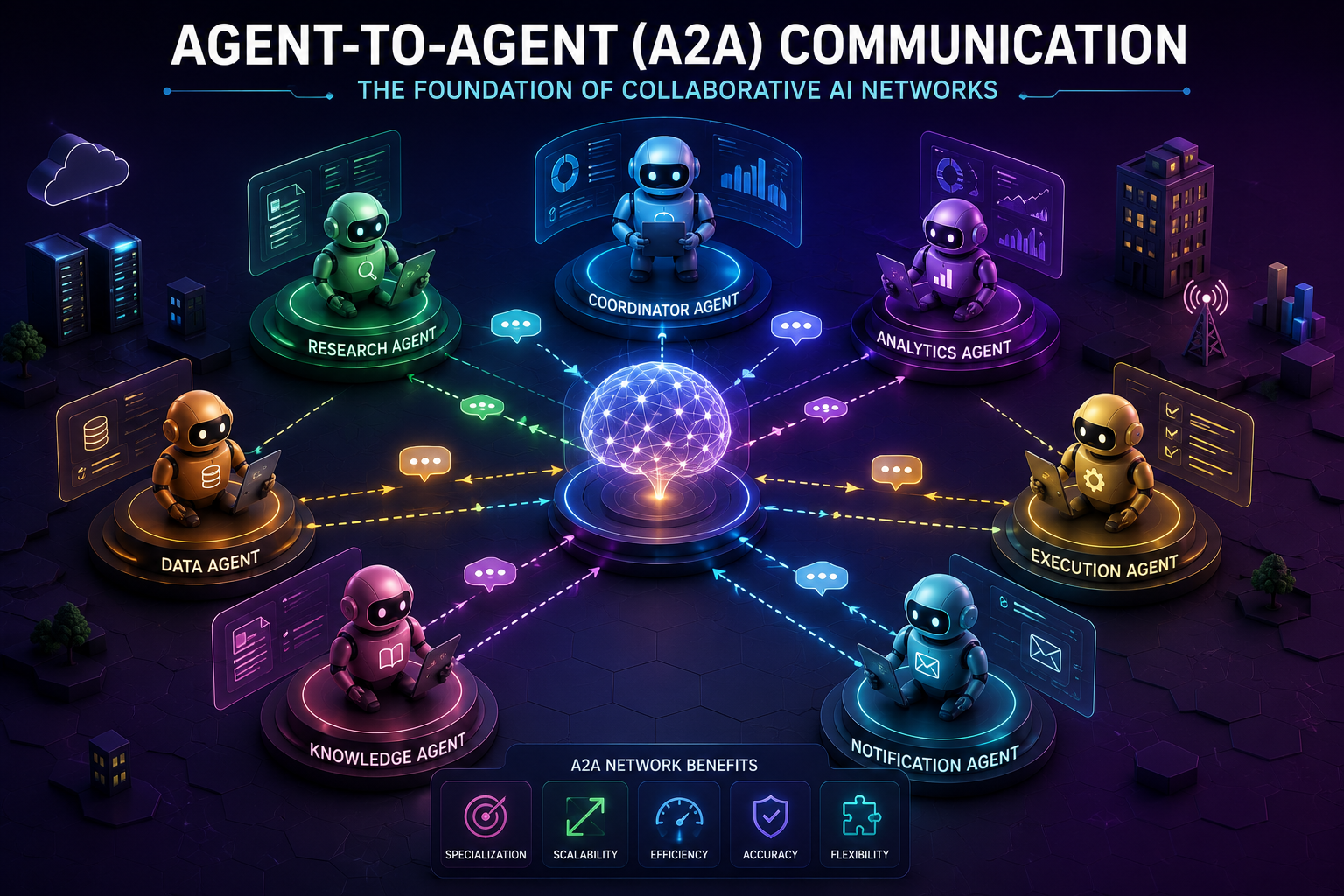
Agent-to-Agent (A2A) Communication:
The Foundation of Collaborative AI Networks
Why the Future of AI Is Not One Agent—But Many
For the past few years, most conversations around artificial intelligence have focused on what a single AI system can do.
Can it answer questions?
Can it generate content?
Can it automate workflows?
Can it make decisions?
The answer to all of these questions is increasingly yes.
However, the next phase of AI evolution is moving beyond individual agents. The future belongs to intelligent systems that can communicate, collaborate, and coordinate with one another to solve complex business challenges.
This emerging concept is known as Agent-to-Agent (A2A) Communication.
Instead of relying on one powerful AI agent to handle every task, organizations are beginning to build networks of specialized agents that work together much like human teams. Each agent contributes its expertise, exchanges information with other agents, delegates responsibilities, and collectively achieves outcomes that would be difficult for any single agent to accomplish alone.
As enterprises embrace Agentic AI at scale, A2A communication is rapidly becoming one of the most important developments shaping the future of intelligent automation.
The Shift from Individual Agents to Agent Ecosystems
Most enterprise AI implementations today are relatively straightforward.
A customer service agent handles support requests.
A sales assistant qualifies leads.
A finance agent processes invoices.
A knowledge assistant answers internal questions.
Each agent operates largely within its own domain.
While this approach delivers significant value, business processes rarely exist in isolation.
Consider a simple customer order.
Fulfilling that order may require:
- Customer verification
- Inventory validation
- Payment processing
- Logistics coordination
- Customer communication
- Reporting and analytics
Traditionally, a single AI system would attempt to manage all these activities.
However, as workflows become more sophisticated, organizations are discovering that specialized agents working together often deliver better outcomes.
Just as companies rely on teams rather than individual employees to handle complex projects, AI systems are evolving toward collaborative agent networks.
What Is Agent-to-Agent Communication?
Agent-to-Agent (A2A) communication refers to the ability of autonomous AI agents to exchange information, coordinate activities, delegate tasks, and collaborate toward shared objectives without requiring constant human intervention.
In an A2A environment, agents can:
- Share context
- Request assistance
- Delegate responsibilities
- Exchange results
- Coordinate workflows
- Resolve dependencies
- Synchronize decision-making
Instead of functioning as isolated systems, agents become active participants in a broader intelligence network.
This transforms AI from individual automation tools into collaborative digital workforces.
Why A2A Communication Matters
Many enterprise challenges involve multiple areas of expertise.
A single agent may excel at retrieving information but struggle with executing transactions.
Another may be excellent at data analysis but lack access to operational systems.
A third may specialize in workflow orchestration.
Rather than forcing one agent to perform every function, A2A communication allows each agent to focus on its strengths while collaborating with others.
The result is:
- Greater efficiency
- Better decision-making
- Improved scalability
- Enhanced flexibility
- Reduced complexity
Organizations can create highly specialized agents that work together seamlessly rather than relying on large, monolithic AI systems.
How AI Agents Delegate Tasks
Task delegation is one of the most powerful capabilities enabled by A2A communication.
Humans delegate work naturally.
Managers assign responsibilities to specialists based on expertise and availability.
AI agents are beginning to operate in similar ways.
Imagine a customer submits a request to update billing information and inquire about service upgrades.
A primary customer service agent receives the request.
Instead of handling every component itself, it may:
- Send billing updates to a finance agent.
- Request eligibility analysis from a sales agent.
- Obtain account details from a CRM agent.
- Receive recommendations from a product advisor agent.
- Consolidate responses and communicate with the customer.
Each agent contributes its expertise while the coordinating agent manages the overall workflow.
This collaborative approach often produces more accurate and efficient outcomes.
Understanding A2A Protocols
For agents to collaborate effectively, they need a common method of communication.
This is where A2A protocols become important.
An A2A protocol defines how agents:
- Discover one another
- Exchange information
- Request services
- Share context
- Report outcomes
- Handle errors
Without standardized communication methods, collaborative agent networks become difficult to scale.
A useful comparison is the internet.
The internet works because systems follow shared communication protocols.
Similarly, AI agents require agreed-upon structures that enable interoperability across platforms, tools, and organizations.
As the Agentic AI ecosystem matures, standardized A2A protocols are expected to play a critical role in enabling large-scale collaboration.
The Anatomy of an A2A Interaction
Although implementations vary, most agent-to-agent interactions follow a similar pattern.
Step 1: Task Identification
An agent recognizes that a particular task falls outside its area of expertise.
Step 2: Agent Discovery
The agent identifies another agent capable of performing the required work.
Step 3: Context Sharing
Relevant information is securely transferred to the receiving agent.
Step 4: Task Execution
The receiving agent performs the assigned responsibility.
Step 5: Response Delivery
Results are returned to the requesting agent.
Step 6: Workflow Continuation
The original agent integrates the response into the broader process.
This cycle may repeat multiple times during complex workflows.
Building Collaborative Agent Networks
As organizations expand AI adoption, they are increasingly moving toward collaborative agent architectures.
These networks consist of multiple specialized agents working together toward common objectives.
A typical enterprise network may include:
Customer Support Agents
Handle customer inquiries and requests.
Finance Agents
Manage billing, payments, and financial processes.
Operations Agents
Coordinate workflows and resource allocation.
Knowledge Agents
Retrieve organizational information and documentation.
Compliance Agents
Validate actions against policies and regulations.
Analytics Agents
Generate insights and performance reports.
Rather than operating independently, these agents continuously exchange information and collaborate across business functions.
The result is a more adaptive and intelligent operational environment.
Real-World Applications of A2A Communication
The value of A2A communication becomes particularly evident in enterprise use cases.
Intelligent Customer Service
Multiple agents collaborate to:
- Verify customer identity
- Access account information
- Evaluate policies
- Generate recommendations
- Resolve issues
This creates faster and more personalized customer experiences.
Supply Chain Optimization
Agents coordinate across:
- Procurement
- Inventory management
- Logistics
- Demand forecasting
By sharing real-time information, organizations can improve efficiency and reduce disruptions.
Healthcare Operations
Different agents may support:
- Appointment scheduling
- Patient record management
- Insurance verification
- Clinical recommendations
Collaborative workflows improve operational effectiveness while reducing administrative burdens.
Enterprise IT Management
IT organizations can deploy networks of agents responsible for:
- Incident detection
- Root cause analysis
- Infrastructure monitoring
- Ticket management
- Remediation recommendations
Together, these agents create a more responsive and resilient IT environment.
Challenges in Agent-to-Agent Communication
While A2A communication offers tremendous potential, it also introduces new challenges.
Trust and Verification
How can one agent trust information received from another? Verification mechanisms become essential to ensure reliability.
Security and Authorization
Agents must communicate securely while respecting organizational access controls. Unauthorized interactions can create significant risks.
Context Management
Maintaining consistent context across multiple agents can be difficult. Information loss or misinterpretation may impact outcomes.
Governance
As agent networks grow, organizations need visibility into interactions, decisions, and responsibilities. Governance frameworks become increasingly important.
Observability
Businesses must understand which agents participated, what information was exchanged, why decisions were made, and where failures occurred. Without observability, troubleshooting complex agent ecosystems becomes extremely difficult.
The Relationship Between A2A and MCP
As organizations explore Agentic AI architectures, discussions increasingly include the Model Context Protocol (MCP).
MCP focuses on enabling AI agents to connect with tools, systems, and external resources.
A2A communication focuses on interactions between agents themselves.
Together, these technologies create a powerful ecosystem.
MCP allows agents to access capabilities. A2A allows agents to collaborate using those capabilities.
Combined, they form the foundation for highly intelligent enterprise automation.
The Future of Collaborative AI
The long-term vision for Agentic AI extends far beyond isolated assistants.
Future enterprises may operate thousands of specialized agents simultaneously.
These agents will:
- Collaborate across departments
- Coordinate business processes
- Exchange expertise
- Solve complex challenges
- Adapt to changing conditions
Rather than functioning as standalone tools, AI systems will increasingly resemble digital organizations composed of interconnected specialists.
The companies that embrace collaborative agent architectures early will be better positioned to scale automation, improve efficiency, and unlock new forms of innovation.
Why A2A Communication Is a Strategic Priority
Agent-to-Agent communication is not simply a technical enhancement.
It represents a fundamental shift in how organizations design and deploy AI systems.
The move from individual agents to collaborative networks creates opportunities to:
- Increase operational efficiency
- Improve decision quality
- Reduce workflow bottlenecks
- Scale intelligent automation
- Enhance organizational agility
As enterprises continue their AI transformation journeys, A2A communication will become a core capability rather than an optional feature.
Organizations that invest in collaborative agent architectures today are laying the groundwork for the next generation of intelligent business operations.
Conclusion
The future of enterprise AI is not centered on a single all-knowing agent. It is built on networks of specialized agents working together to achieve shared goals.
Agent-to-Agent communication enables these systems to exchange information, delegate responsibilities, coordinate actions, and solve increasingly complex problems. By creating collaborative agent ecosystems, organizations can move beyond isolated automation and unlock entirely new levels of intelligence, scalability, and efficiency.
As Agentic AI continues to evolve, A2A communication will become one of the most important building blocks of enterprise innovation.
Bitviraj Technology helps organizations design and implement next-generation AI ecosystems that combine Agentic AI, A2A communication, orchestration frameworks, governance, security, and observability. Our solutions empower businesses to build intelligent agent networks that are scalable, secure, and ready for the future of enterprise automation.
Case Studies
Empowering Digital
Evolution


Blogs
Empowering Digital
Evolution
BitViraj Technologies - Your Gateway to
Tomorrow's Innovations

Embark on a DigitalJourney

The next-generation digital technology company Bitviraj has the potential to empower and reinvent business in the current fast-paced market.


Our Service
- Website Development
- Application Development
- Blockchain Development
- Gaming and Metaverse