


BitViraj Technologies - Your Gateway to
Tomorrow's Innovations
Agent Observability and Monitoring
The Missing Layer of Enterprise AI Success
Agent Observability and Monitoring:
The Missing Layer of Enterprise AI Success
Why Visibility Matters More Than Intelligence in Autonomous AI Systems
The excitement around AI agents is easy to understand.
Organizations are deploying intelligent systems that can analyze information, make decisions, automate workflows, interact with customers, and execute complex business processes with minimal human intervention. What once required teams of employees can now be handled by autonomous AI agents operating around the clock.
But as businesses accelerate their adoption of Agentic AI, a critical question is emerging:
How do you know what your AI agents are actually doing?
For many organizations, the answer is surprisingly unclear.
An AI agent may successfully complete thousands of tasks every day. However, when something goes wrong—a failed transaction, an inaccurate recommendation, a security violation, or a customer complaint—business leaders often discover they lack visibility into the agent's decision-making process.
This is where agent observability becomes essential.
Just as enterprises monitor applications, networks, databases, and cloud infrastructure, they must now monitor AI agents. Without observability, organizations risk operating autonomous systems they cannot fully understand, troubleshoot, or govern.
As AI becomes more autonomous, observability is no longer a technical luxury. It is a business requirement.
The Evolution from Traditional Monitoring to Agent Monitoring
Traditional software systems are relatively predictable.
Developers define rules, workflows, and expected outputs. When an issue occurs, logs and monitoring tools help engineers identify the source of the problem.
AI agents operate differently.
Modern agents:
- Make dynamic decisions
- Interpret natural language
- Interact with multiple systems
- Access external data sources
- Execute actions autonomously
- Collaborate with other agents
Because of this flexibility, traditional monitoring approaches are no longer sufficient.
Organizations need visibility into not only what happened but also why it happened.
Monitoring infrastructure alone cannot explain an agent's reasoning, decision path, or interactions with other systems.
This gap is what agent observability is designed to solve.
What Is Agent Observability?
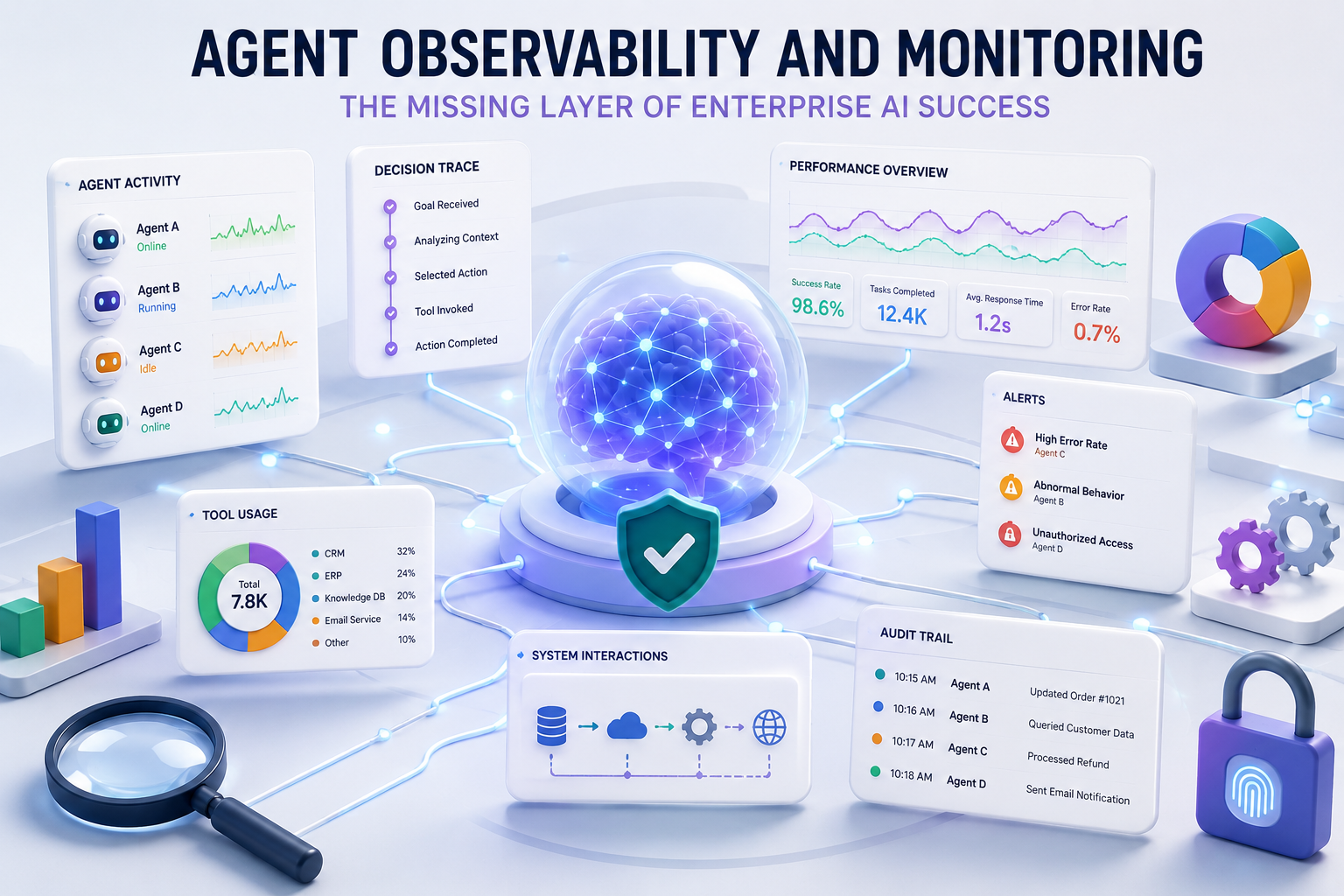
Agent observability is the ability to understand, track, analyze, and audit the behavior of AI agents throughout their operational lifecycle.
It provides visibility into:
- Agent decisions
- Actions performed
- Workflow execution
- Tool usage
- Data access
- System interactions
- Performance metrics
- Errors and failures
In simple terms, observability answers three critical questions:
- What did the agent do?
- Why did it do it?
- What happened as a result?
Without these answers, enterprises cannot confidently scale autonomous AI systems.
Why Agent Observability Has Become a Business Priority
The more autonomy an AI agent receives, the greater the need for transparency.
Consider a customer service agent that automatically processes refund requests.
If the agent incorrectly approves thousands of refunds, the financial impact could be significant.
Now imagine trying to answer:
- Which decisions were incorrect?
- What information influenced those decisions?
- When did the issue begin?
- Which customers were affected?
Without observability, organizations are left guessing.
This challenge becomes even more serious in industries such as:
- Banking
- Healthcare
- Insurance
- Manufacturing
- Telecommunications
- Government services
In these environments, every decision may require accountability, compliance, and auditability.
Observability transforms AI from a black box into a manageable business system.
The Core Components of AI Agent Monitoring
Effective agent monitoring goes beyond tracking uptime and response times.
Organizations should monitor several critical dimensions simultaneously.
1. Decision Monitoring
Every significant decision made by an AI agent should be recorded and traceable.
This includes:
- Inputs received
- Context analyzed
- Actions selected
- Outcomes generated
Decision monitoring allows teams to understand why an agent reached a specific conclusion.
This becomes invaluable when investigating unexpected behavior.
2. Action Monitoring
Autonomous agents often perform actions directly within business systems.
Examples include:
- Creating support tickets
- Processing invoices
- Updating CRM records
- Sending emails
- Triggering workflows
Organizations need visibility into every action performed by an agent.
Action monitoring helps identify unauthorized activities, process failures, and operational inefficiencies.
3. Tool and System Usage Tracking
Modern AI agents frequently interact with multiple tools and applications.
An enterprise agent may access:
- CRM platforms
- ERP systems
- Databases
- APIs
- Cloud services
- Knowledge repositories
Monitoring these interactions helps organizations understand how agents use enterprise resources and identify unusual patterns that may indicate security or operational issues.
4. Performance Monitoring
Just because an agent is active does not mean it is performing effectively.
Organizations should measure:
- Task completion rates
- Success rates
- Error rates
- Response times
- User satisfaction metrics
- Business outcomes
Performance monitoring ensures agents continue delivering value as environments evolve.
5. Security Monitoring
AI agents often operate with privileged access.
This creates a new category of enterprise risk.
Security monitoring should track:
- Authentication events
- Permission usage
- Sensitive data access
- Policy violations
- Unusual activity patterns
Security teams need the same visibility into AI agents that they have for human users.
Agent Observability: The Missing Layer of AI Architecture
Many organizations invest heavily in AI development and deployment while overlooking observability.
As a result, they create sophisticated systems with limited visibility.
Imagine operating a commercial aircraft without cockpit instruments.
The aircraft may function normally most of the time, but when turbulence occurs, pilots would have no way to understand what is happening.
The same principle applies to AI agents.
Observability provides the operational intelligence required to manage autonomous systems confidently.
Without it, enterprises are effectively flying blind.
The organizations achieving the greatest success with Agentic AI are treating observability as a foundational layer rather than an afterthought.
Debugging Multi-Agent Workflows
One of the most challenging aspects of Agentic AI is the emergence of multi-agent systems.
Instead of a single agent handling a task, multiple agents collaborate to complete a workflow.
For example:
A customer request may involve:
- A classification agent
- A customer verification agent
- A policy evaluation agent
- A recommendation agent
- An execution agent
When everything works correctly, the process appears seamless.
When a failure occurs, identifying the source becomes significantly more complex.
The problem may not originate from the final agent.
It could stem from:
- Incorrect data from an earlier agent
- Miscommunication between agents
- Context loss
- Workflow orchestration issues
- Tool failures
- External system disruptions
Without observability, debugging these workflows can become nearly impossible.
Organizations need end-to-end tracing capabilities that map every interaction across the entire agent ecosystem.
This visibility allows teams to identify bottlenecks, failures, and performance issues quickly.
Understanding AI Agent Audit Trails
As organizations adopt AI at scale, audit trails are becoming a critical governance requirement.
An AI agent audit trail is a chronological record of an agent's activities and decisions.
A comprehensive audit trail typically includes:
- User requests
- Agent inputs
- Context retrieved
- Reasoning steps
- Decisions made
- Actions executed
- System interactions
- Final outcomes
Audit trails provide evidence that can support:
Compliance Requirements
Regulators increasingly expect organizations to demonstrate accountability for AI-driven decisions.
Internal Governance
Leadership teams need confidence that AI systems operate according to established policies.
Incident Investigations
When errors occur, audit trails provide the information necessary to identify root causes.
Performance Optimization
Historical records help organizations improve agent behavior over time.
In many industries, audit trails will soon become as important as traditional system logs.
Best Practices for Monitoring AI Agents in Production
Organizations looking to scale Agentic AI successfully should adopt several key practices.
Build Observability into the Design Phase
Do not wait until deployment to think about monitoring. Observability should be included during architecture and development.
Define Meaningful Metrics
Focus on metrics that connect agent behavior to business outcomes. Avoid monitoring only technical performance indicators. Measure: decision quality, task accuracy, business impact, customer experience.
Centralize Agent Visibility
Organizations should establish a unified dashboard that provides visibility into all deployed agents. This reduces operational complexity and improves governance.
Enable Real-Time Alerts
Critical failures should trigger immediate notifications. Examples include: repeated task failures, policy violations, security anomalies, unexpected behavior patterns. Early detection minimizes business disruption.
Maintain Comprehensive Audit Records
Every significant decision and action should be traceable. Comprehensive records improve accountability, compliance, and operational trust.
The Future of Agent Observability
As AI ecosystems mature, observability will evolve from a technical capability into a strategic business function.
Future enterprises may manage hundreds or even thousands of autonomous agents simultaneously.
Success will depend not only on deploying intelligent systems but also on understanding how those systems operate.
Organizations that invest in observability today will gain several advantages:
- Faster troubleshooting
- Stronger governance
- Better compliance readiness
- Improved security
- Higher operational trust
- Greater scalability
In the coming years, observability will likely become as essential to AI operations as monitoring is to cloud infrastructure today.
Conclusion
The rise of autonomous AI agents is transforming how organizations operate, innovate, and serve customers. However, greater autonomy also creates greater responsibility.
Businesses can no longer afford to treat AI systems as black boxes. They need visibility into decisions, actions, workflows, and outcomes.
Agent observability provides that visibility.
By combining monitoring, tracing, audit trails, performance analytics, and governance controls, organizations can deploy AI agents with confidence while maintaining accountability and trust.
The question is no longer whether enterprises should monitor AI agents.
The real question is whether they can afford not to.
Bitviraj Technology helps organizations build enterprise-grade AI solutions with robust observability, monitoring, governance, and security capabilities. Our approach ensures that businesses can scale Agentic AI responsibly while maintaining complete visibility into every decision, action, and outcome.
Case Studies
Empowering Digital
Evolution



Blogs
Empowering Digital
Evolution
BitViraj Technologies - Your Gateway to
Tomorrow's Innovations



Embark on a DigitalJourney


The next-generation digital technology company Bitviraj has the potential to empower and reinvent business in the current fast-paced market.


Our Service
- Website Development
- Application Development
- Blockchain Development
- Gaming and Metaverse