


BitViraj Technologies - Your Gateway to
Tomorrow's Innovations
Enterprise AI Agent Governance
Building Trust, Control, and Compliance in the Age of Agentic AI
Enterprise AI Agent Governance:
Building Trust, Control, and Compliance in the Age of Agentic AI
Why Governance Has Become the Missing Piece of Enterprise AI
Artificial Intelligence has entered a new phase. Organizations are no longer experimenting with simple chatbots or predictive models. Today, enterprises are deploying AI agents that can autonomously make decisions, execute workflows, interact with systems, generate content, analyze data, and even collaborate with other agents.
This shift toward Agentic AI promises unprecedented productivity gains. However, it also introduces a challenge that many organizations underestimate: governance.
As AI agents gain greater autonomy and access to critical business systems, governance is no longer just an IT concern—it has become a boardroom discussion. Executives are asking difficult questions:
- Who is accountable for an AI agent's actions?
- How do we prevent unauthorized decision-making?
- What happens when hundreds of agents operate across departments?
- How do we ensure regulatory compliance?
- Can we audit and explain agent behavior?
Without clear answers, organizations risk creating an uncontrolled ecosystem of autonomous systems that can introduce security vulnerabilities, compliance violations, operational risks, and reputational damage.
The future of enterprise AI will not be determined solely by how intelligent agents become. It will be determined by how effectively organizations govern them.
The Rise of Agentic AI in Enterprises
Unlike traditional AI systems that provide recommendations, AI agents are designed to take action.
An AI agent can:
- Process customer requests
- Approve routine transactions
- Generate reports
- Monitor infrastructure
- Coordinate workflows
- Access enterprise applications
- Trigger business processes
As organizations scale AI adoption, agents begin operating across multiple departments simultaneously.
Consider a modern enterprise:
- HR uses recruitment agents.
- Finance deploys invoice-processing agents.
- Customer service relies on support agents.
- IT teams utilize infrastructure management agents.
- Sales teams use autonomous lead qualification agents.
What starts as a handful of pilots can quickly grow into hundreds of independent AI agents operating throughout the organization.
This phenomenon is increasingly known as Agent Sprawl.
Understanding Agent Sprawl
Agent sprawl occurs when organizations deploy AI agents faster than they establish governance frameworks.
Initially, individual departments launch AI initiatives to improve efficiency. Over time, different teams adopt different tools, platforms, vendors, and agent architectures.
The result is a fragmented environment where:
- No centralized visibility exists.
- Ownership becomes unclear.
- Security standards vary.
- Compliance requirements are inconsistently enforced.
- Duplicate agents perform overlapping tasks.
- Sensitive data is exposed to unnecessary risks.
This situation mirrors what many organizations experienced during the early cloud adoption era. Shadow IT emerged because departments could provision cloud resources independently. Today, enterprises face a similar challenge with "Shadow AI."
Without governance, organizations may not even know how many AI agents are operating within their environment.
Why Enterprise Governance for Agentic AI Matters
Governance is often misunderstood as a mechanism that slows innovation.
In reality, effective governance accelerates AI adoption by creating trust, accountability, and operational consistency.
A robust governance framework helps organizations:
- Manage Risk: AI agents can make decisions that impact customers, employees, finances, and operations. Governance establishes safeguards that reduce unintended consequences.
- Ensure Compliance: Regulations surrounding AI are evolving rapidly. Governance helps organizations align with industry requirements and emerging AI regulations.
- Improve Transparency: Business leaders need visibility into how agents make decisions, what data they access, and which actions they perform.
- Strengthen Security: Autonomous agents often interact with sensitive systems and data. Governance ensures access controls and security policies remain intact.
- Enable Scalability: Organizations cannot effectively manage hundreds of AI agents manually. Governance creates a structured foundation for growth.
The Core Pillars of an AI Agent Compliance Framework
Governance should not be viewed as a single policy document. It requires a comprehensive framework that spans technology, processes, and people.
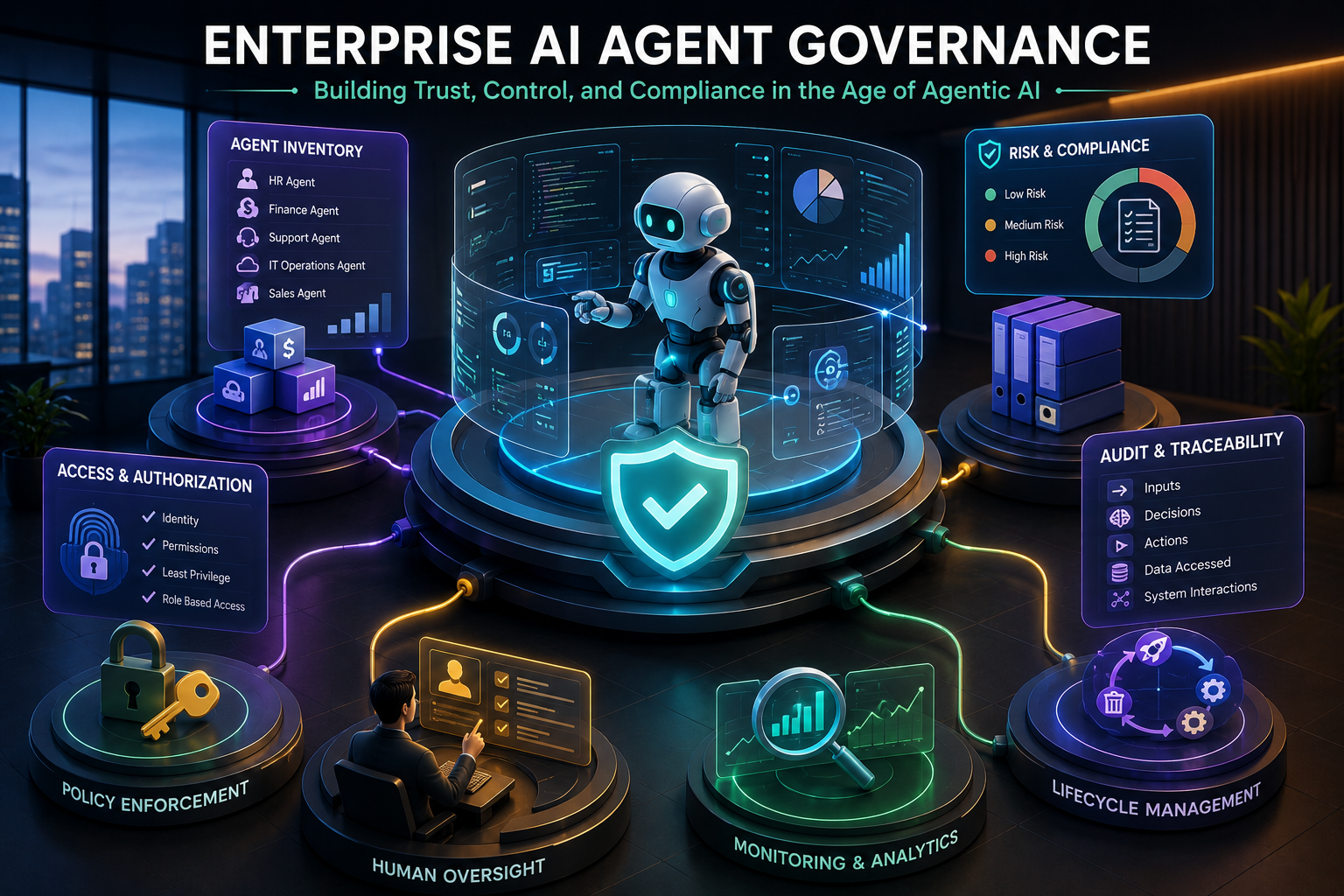
1. Agent Registration and Inventory
Every AI agent deployed within the organization should be registered in a centralized inventory.
This inventory should include:
- Agent name
- Purpose
- Owner
- Data sources
- Connected systems
- Risk classification
- Approval status
If an organization cannot answer "How many AI agents are currently active?" governance maturity is likely low.
2. Identity and Access Management
AI agents require digital identities just like human employees.
Organizations should define:
- Authentication requirements
- Authorization levels
- System permissions
- Data access policies
- Role-based controls
An agent should never receive broader access privileges than necessary.
The principle of least privilege remains essential in Agentic AI environments.
3. Decision Accountability
One of the biggest governance challenges involves accountability.
When an AI agent makes a decision:
- Who approved its deployment?
- Who monitors outcomes?
- Who investigates failures?
- Who accepts responsibility?
Every AI agent should have a designated business owner and technical owner.
Human accountability must remain intact regardless of agent autonomy.
4. Auditability and Traceability
Enterprises must be able to reconstruct an agent's actions.
Governance frameworks should maintain detailed logs of:
- Inputs received
- Decisions made
- Actions executed
- Data accessed
- System interactions
Comprehensive audit trails are essential for compliance, investigations, and performance reviews.
5. Risk Classification
Not all AI agents carry the same level of risk.
Organizations should classify agents based on:
Low Risk
Examples: Internal knowledge assistants, meeting summarization agents
Medium Risk
Examples: Workflow automation agents, operational support agents
High Risk
Examples: Financial approval agents, healthcare decision-support systems, customer-facing autonomous agents
Higher-risk agents should undergo stricter approval and monitoring processes.
Governance-First AI Architecture
Many organizations make a critical mistake.
They deploy AI agents first and attempt governance later.
This approach often creates operational complexity that becomes difficult to reverse.
Instead, organizations should adopt a Governance-First AI Architecture.
Governance should be embedded directly into the AI ecosystem from the beginning.
A governance-first architecture typically includes:
- Agent Registry Layer: Maintains visibility into all deployed agents.
- Policy Enforcement Layer: Applies organizational rules automatically.
- Identity and Access Layer: Controls permissions and authentication.
- Monitoring Layer: Tracks performance, risks, and anomalies.
- Audit Layer: Captures decision history and compliance records.
- Human Oversight Layer: Provides intervention mechanisms when necessary.
By embedding governance controls into the architecture itself, organizations avoid relying solely on manual processes.
Human-in-the-Loop Governance
Despite advances in autonomous systems, fully unsupervised AI remains inappropriate for many enterprise environments.
Human oversight continues to play a critical role.
Organizations should establish thresholds that determine when human review is required.
Examples include:
- High-value financial transactions
- Regulatory decisions
- Customer dispute resolutions
- Contract approvals
- Healthcare recommendations
Human-in-the-loop models balance efficiency with accountability.
The goal is not to eliminate human involvement but to focus human attention where it delivers the most value.
Compliance Challenges in the AI Era
Global regulators are increasingly focusing on AI accountability.
Organizations must prepare for requirements involving:
- Explainability
- Data privacy
- Bias management
- Decision transparency
- Security controls
- Risk assessments
Future audits may require businesses to demonstrate:
- How AI agents operate
- Why decisions were made
- What safeguards are in place
- Who approved deployment
Organizations that implement governance frameworks today will be better positioned to adapt as regulatory expectations evolve.
Best Practices for Managing AI Agents at Scale
Successful enterprises are adopting several common governance practices.
Establish an AI Governance Committee
Create a cross-functional team that includes:
- IT leaders
- Security teams
- Compliance officers
- Legal stakeholders
- Business leaders
Governance should never exist in a silo.
Define Agent Lifecycle Management
Every agent should have a defined lifecycle:
- Request
- Review
- Approval
- Deployment
- Monitoring
- Periodic Assessment
- Retirement
Not every AI agent should remain active indefinitely.
Standardize Development Frameworks
Organizations should avoid allowing every department to build agents using entirely different standards.
Standardization improves:
- Security
- Maintainability
- Monitoring
- Governance consistency
Continuously Monitor Agent Behavior
Governance is not a one-time exercise.
Organizations should continuously monitor:
- Agent performance
- Decision quality
- Policy violations
- Security incidents
- Drift and anomalies
Continuous oversight helps detect risks before they become business problems.
The Future of Enterprise AI Governance
The next generation of enterprises will likely operate thousands of AI agents simultaneously.
Some agents will support employees.
Others will interact directly with customers.
Many will collaborate with other agents across departments and systems.
As AI ecosystems become more sophisticated, governance will become a competitive advantage rather than a compliance obligation.
Organizations that establish governance-first foundations today will be able to innovate faster, scale more confidently, and earn greater stakeholder trust.
The companies that struggle will not necessarily be those with the weakest AI capabilities.
They will be the ones that failed to control and govern the systems they deployed.
Conclusion
AI agents are rapidly transforming enterprise operations, but autonomy without governance creates significant risk.
As organizations expand their use of Agentic AI, governance must evolve from an afterthought into a strategic priority. Effective AI agent governance provides visibility, accountability, security, compliance, and trust—all essential ingredients for sustainable AI adoption.
The most successful enterprises will not simply deploy more AI agents. They will build governance-first architectures that ensure every agent operates within clearly defined boundaries while delivering measurable business value.
In the age of Agentic AI, governance is no longer optional. It is the foundation upon which responsible, scalable, and enterprise-ready AI is built.
Bitviraj Technology helps organizations design, deploy, and govern enterprise AI solutions that align innovation with security, compliance, and operational excellence. By embedding governance into every stage of the AI lifecycle, businesses can unlock the full potential of AI while maintaining control, transparency, and trust.
Case Studies
Empowering Digital
Evolution



Blogs
Empowering Digital
Evolution
BitViraj Technologies - Your Gateway to
Tomorrow's Innovations



Embark on a DigitalJourney


The next-generation digital technology company Bitviraj has the potential to empower and reinvent business in the current fast-paced market.


Our Service
- Website Development
- Application Development
- Blockchain Development
- Gaming and Metaverse