

BitViraj Technologies - Your Gateway to
Tomorrow's Innovations
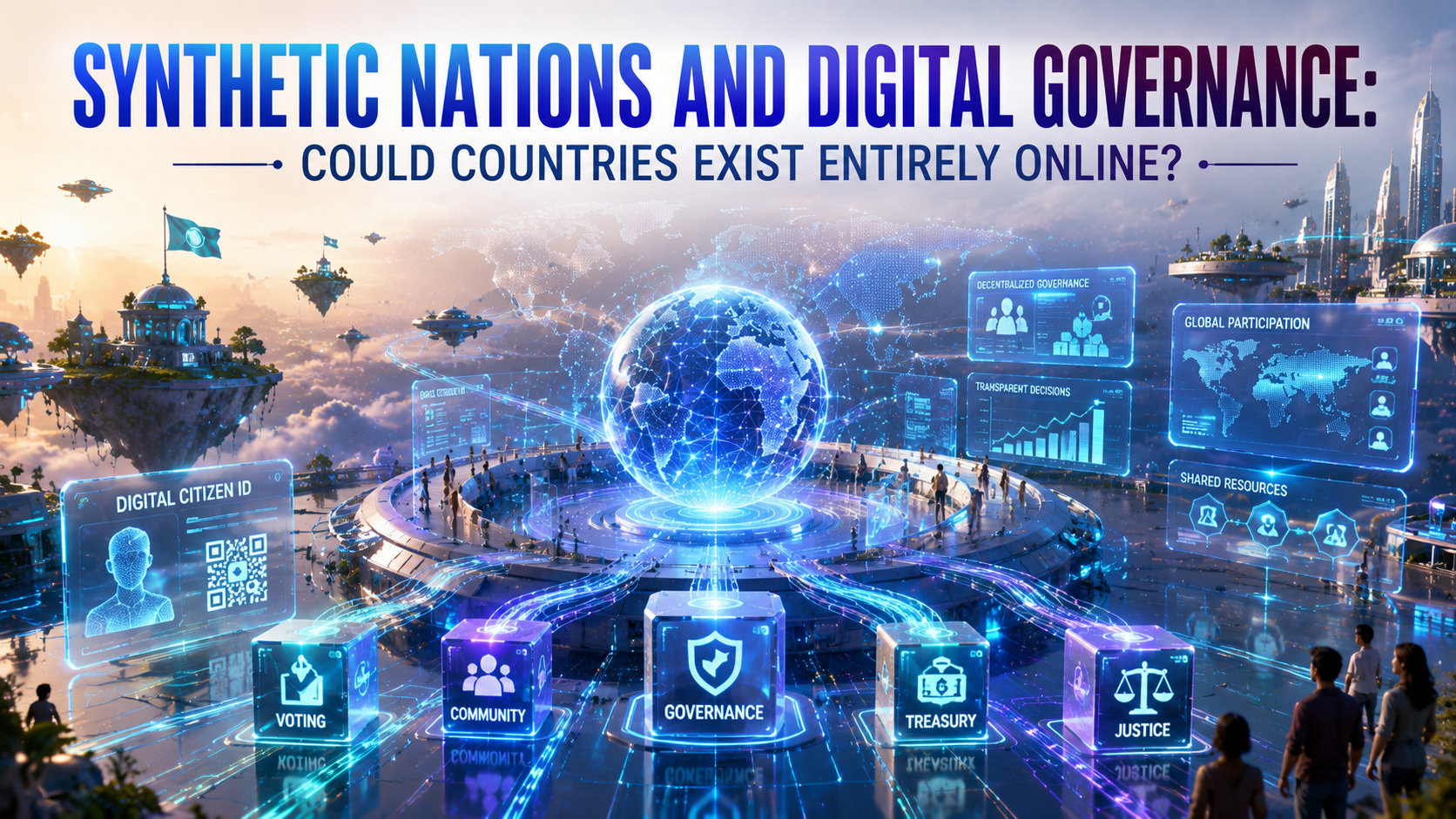
Synthetic Nations and Digital Governance: Could Countries Exist Entirely Online?
For most of human history, nations have been defined by geography. Countries have borders. Citizens live within those borders. Governments create laws, collect taxes, provide services, and represent the interests of their people. But what happens when communities become more connected through the internet than through physical location?

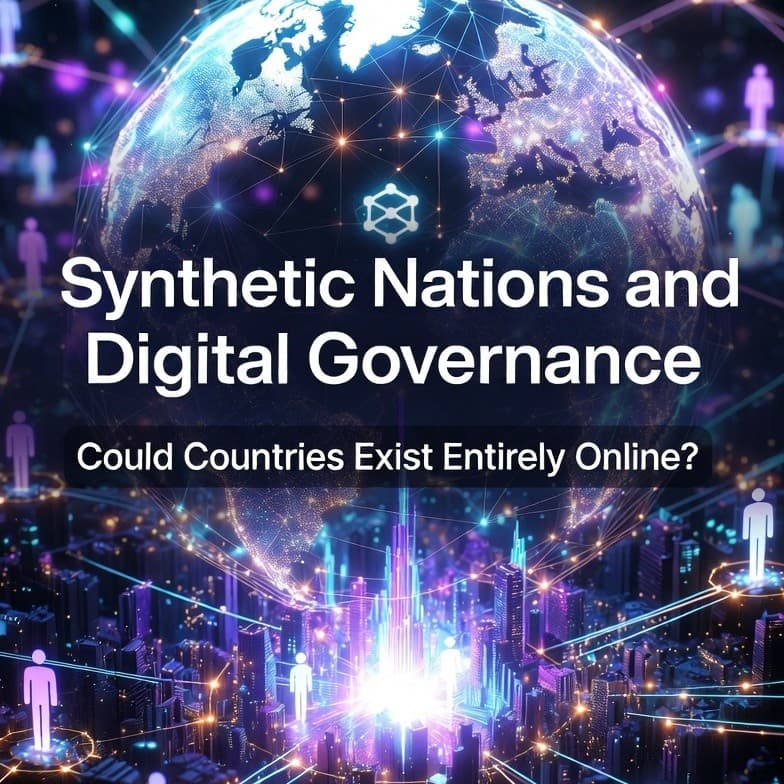
Synthetic Nations and Digital Governance
Could Countries Exist Entirely Online?
Introduction
For most of human history, nations have been defined by geography.
Countries have borders. Citizens live within those borders. Governments create laws, collect taxes, provide services, and represent the interests of their people.
But what happens when communities become more connected through the internet than through physical location?
What happens when millions of people work remotely, earn digital income, own digital assets, and spend more time in online communities than in their local neighborhoods?
And perhaps the most important question:
Can a nation exist without territory?
While this idea may sound like science fiction, it is increasingly becoming a topic of discussion among technologists, entrepreneurs, economists, and digital governance researchers.
The concept is often referred to as a Synthetic Nation—a digitally native society built around shared values, economic participation, governance systems, and online citizenship rather than physical borders.
As technologies like blockchain, artificial intelligence, decentralized finance, and digital identity continue to evolve, the idea of internet-based nations is moving from imagination toward possibility.
The Evolution of Human Organization
Human civilization has always evolved alongside technology.
Agricultural societies created villages.
Industrialization created modern cities.
The internet created global communities.
Today, millions of people belong to online networks that influence their daily lives more than traditional local institutions.
People collaborate across continents.
Businesses operate globally from day one.
Digital creators build communities larger than many cities.
Remote workers contribute to organizations without ever meeting in person.
In many ways, the foundations of digital societies already exist.
What remains is the development of governance systems capable of supporting them.
What Is a Synthetic Nation?
A synthetic nation is not simply an online community.
It is a structured digital society with mechanisms for:
- Identity
- Governance
- Participation
- Economic activity
- Decision-making
- Conflict resolution
- Resource allocation
Instead of citizenship being determined by birthplace, membership is based on participation and shared values.
Citizens may live in different countries while belonging to the same digital nation.
Their connection is ideological, economic, and technological rather than geographic.
The nation exists online, but its impact can extend into the physical world.
Why Traditional Governance Models Are Being Challenged
Governments face increasingly complex challenges in a globally connected world.
Technology evolves faster than regulation.
Digital businesses operate across multiple jurisdictions.
Remote workers earn income from organizations located on different continents.
Digital assets often exist beyond traditional national boundaries.
As a result, many existing governance systems struggle to adapt to the pace of technological change.
This does not mean traditional governments will disappear.
However, it does suggest that alternative governance models may emerge alongside them.
Synthetic nations represent one possible evolution.
Blockchain as the Foundation of Digital Governance
For digital nations to function effectively, trust must exist without centralized control.
This is where blockchain technology becomes important.
Blockchain systems provide:
- Transparency
- Security
- Verifiable records
- Decentralized decision-making
These characteristics make them attractive for governance applications.
In a synthetic nation, blockchain technology could be used to manage:
- Digital identities
- Voting systems
- Community rules
- Treasury management
- Resource allocation
- Public records
Instead of relying on traditional institutions, governance becomes transparent and auditable.
Citizens can verify decisions independently.
Trust shifts from institutions to systems.
The Rise of Digital Citizenship
One of the most fascinating aspects of synthetic nations is the concept of digital citizenship.
Today, citizenship is largely determined by birth or legal immigration processes.
In a digital nation, citizenship may be earned through participation.
Imagine joining a global community focused on:
- Technology innovation
- Climate solutions
- Scientific research
- Entrepreneurship
- Education
Members contribute knowledge, resources, and expertise.
Over time, they gain influence and voting rights based on their participation.
This creates a merit-driven model of citizenship that differs significantly from traditional systems.
The concept remains experimental, but it introduces new possibilities for organizing communities.
Could AI Help Govern Digital Nations?
Artificial intelligence may become one of the most important components of future governance systems.
Modern governments process enormous amounts of information.
Policy decisions require analysis of economic, social, environmental, and technological factors.
AI systems could assist by:
- Analyzing community feedback
- Identifying emerging issues
- Simulating policy outcomes
- Detecting inefficiencies
- Managing administrative processes
In synthetic nations, AI may function as a governance assistant rather than a governing authority.
Humans would still make key decisions.
However, AI could help improve transparency, efficiency, and responsiveness.
The combination of AI and decentralized governance could create entirely new models of administration.
Digital Economies Without Borders
A nation requires more than governance.
It also requires an economy.
Fortunately, digital economies already exist.
Every day, people earn income through:
- Freelancing
- Content creation
- Software development
- Online education
- Digital products
- Decentralized finance
Cryptocurrencies and digital payment systems have made global economic participation easier than ever.
Synthetic nations could potentially develop:
- Community currencies
- Shared treasuries
- Digital marketplaces
- Incentive systems
- Public funding mechanisms
Economic participation becomes independent of physical geography.
Opportunity becomes more accessible to global communities.
Challenges and Risks
Despite the excitement surrounding digital governance, significant challenges remain.
Legal Recognition
Synthetic nations currently have no formal legal status under international law. Their relationship with traditional governments remains uncertain.
Security
Digital governance systems must be protected against attacks, manipulation, and fraud. Security becomes a foundational requirement.
Inclusion
Not everyone has equal access to technology. Ensuring accessibility and representation will be essential.
Concentration of Power
Even decentralized systems can become dominated by a small number of participants. Governance models must be designed carefully to avoid centralization.
Ethical Considerations
Questions surrounding privacy, identity, voting rights, and accountability will become increasingly important. Technology alone cannot solve governance challenges. Human values remain critical.
Are Synthetic Nations Inevitable?
Perhaps not.
But the forces driving their development are becoming stronger.
- Global connectivity.
- Remote work.
- Digital economies.
- Artificial intelligence.
- Blockchain infrastructure.
- Digital identity systems.
Together, these technologies are creating conditions where entirely new forms of social organization become possible.
Whether synthetic nations eventually become fully realized digital societies or simply influence traditional governance models, their impact could be significant.
They challenge long-standing assumptions about citizenship, governance, and community.
And they force us to ask an important question:
In an increasingly digital world, should geography remain the primary foundation of society?
Final Thoughts
The idea of synthetic nations may sound futuristic today.
Yet many of the technologies required to support them already exist.
Communities are becoming increasingly global.
Economic activity is becoming increasingly digital.
Governance systems are becoming increasingly transparent and decentralized.
As these trends continue, the line between physical and digital societies may become less distinct.
Synthetic nations are not necessarily a replacement for traditional countries.
Instead, they may represent a new layer of human organization—one built around shared interests, digital participation, and borderless collaboration.
Whether they emerge as powerful institutions or remain experimental communities, they offer a fascinating glimpse into the future of governance.
And in a world shaped by AI, blockchain, and global connectivity, that future may arrive sooner than many expect.
At BitViraj Technology, we explore the technologies shaping tomorrow's digital societies. From artificial intelligence and blockchain to decentralized governance and digital identity, we believe the next era of innovation will redefine not only how we work and communicate—but also how we organize ourselves as communities.
Case Studies
Empowering Digital
Evolution



Blogs
Empowering Digital
Evolution
BitViraj Technologies - Your Gateway to
Tomorrow's Innovations



Embark on a DigitalJourney


The next-generation digital technology company Bitviraj has the potential to empower and reinvent business in the current fast-paced market.


Our Service
- Website Development
- Application Development
- Blockchain Development
- Gaming and Metaverse