

BitViraj Technologies - Your Gateway to
Tomorrow's Innovations
Agentic AI Architecture Patterns: 10 Design Approaches Every Engineering Leader Should Know
The first wave of AI adoption was relatively simple. Organizations integrated chatbots, copilots, and generative AI tools into existing workflows. Most systems followed a straightforward request-response model. Agentic AI changes that equation entirely. Instead of merely responding to prompts, AI agents can plan tasks, make decisions, use tools, collaborate with other agents, and continuously work toward defined objectives.

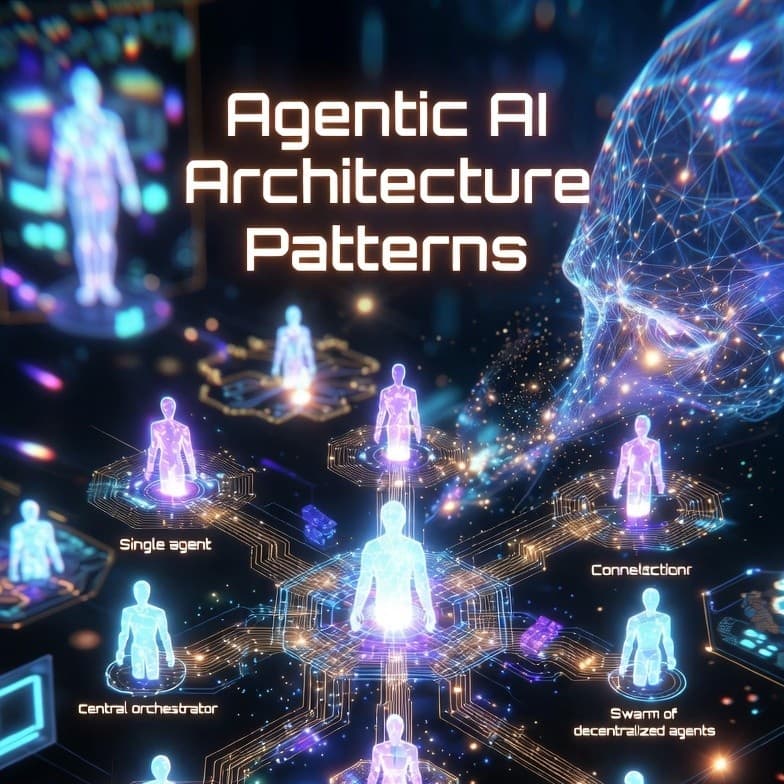
Agentic AI Architecture Patterns
10 Design Approaches Every Engineering Leader Should Know
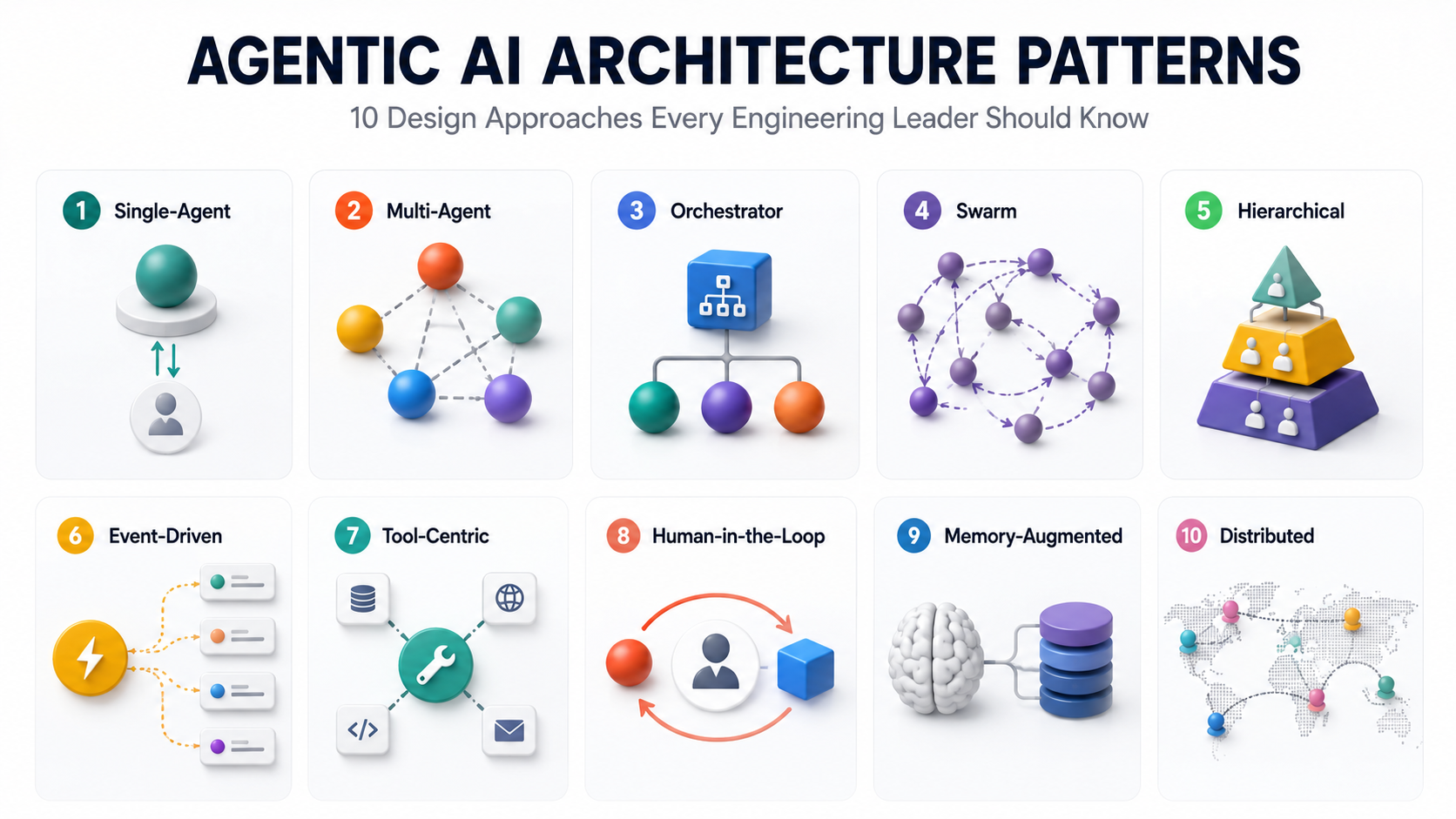
Agentic AI Architecture Patterns:
10 Design Approaches Every Engineering Leader Should Know
Why Architecture Matters in Agentic AI
Agentic systems operate with varying degrees of autonomy, dynamic reasoning, and decision-making capabilities. They interact with databases, APIs, enterprise applications, and increasingly, with other AI agents.
As a result, architectural decisions directly impact scalability, reliability, security, governance, cost efficiency, human oversight, and system performance. Selecting the wrong architecture often becomes the biggest obstacle to scaling AI initiatives.
The question is no longer whether companies should use AI agents. The real question is: Which architecture pattern should they choose?
10 Agentic AI Architecture Patterns
1. Single-Agent Architecture
A single AI agent is responsible for understanding requests, planning actions, invoking tools, and generating responses.
User → Agent → Tools → Response
Best for: Internal assistants, customer support bots, personal productivity tools
Advantages: Easy to build, lower costs, simple governance
Limitations: Limited scalability, context overload, difficult for highly specialized tasks
2. Multi-Agent Architecture
Instead of one general-purpose agent, multiple specialized agents collaborate to solve problems (e.g., Research Agent, Data Analysis Agent, Content Generation Agent).
Advantages: Better specialization, improved scalability, higher quality outputs
Challenges: Coordination complexity, communication overhead, increased governance requirements
3. Orchestrator Pattern
A central coordinator manages multiple agents, deciding which agents to invoke, task sequencing, resource allocation, and result aggregation.
Request → Orchestrator → Specialized Agents → Consolidated Response
Best for: Enterprise workflows, customer service operations, complex business processes
Benefits: Strong governance, predictable execution, easier monitoring
4. Swarm Architecture
Agents collaborate independently and self-organize around goals. Each agent can discover tasks, delegate work, exchange information, and make local decisions.
Benefits: High resilience, exceptional scalability, reduced bottlenecks
Challenges: Harder to govern, difficult debugging, unpredictable behavior
Orchestrator vs. Swarm
Orchestrator Pros
- Greater control
- Easier compliance
- Better auditability
- Predictable outcomes
Cons
- Central bottleneck
- Reduced flexibility
Swarm Pros
- High scalability
- Adaptive behavior
- Better fault tolerance
Cons
- Complex governance
- Difficult monitoring
Regulated industries (banking, healthcare, insurance) prefer orchestrator. Innovation-heavy environments may benefit from swarm.
5. Hierarchical Agent Architecture
Organizes agents into layers of authority: Strategic Agent → Manager Agents → Worker Agents. Top-level focuses on goals and planning; lower-level handles execution.
Benefits: Clear accountability, improved task decomposition, better scalability
Use Cases: Enterprise operations, supply chain management, large-scale automation
6. Event-Driven Agent Systems
Agents react automatically to business events (new registrations, payments, security alerts, inventory updates).
Event → Agent Activation → Decision → Action
Benefits: Real-time responsiveness, high scalability, reduced latency
Example: Fraud-detection agent triggered by banking event streams
7. Human-in-the-Loop Architecture
Agents perform tasks while humans approve critical decisions (financial approvals, legal document reviews, healthcare recommendations, compliance actions).
Benefits: Reduced risk, improved trust, regulatory compliance
Importance: Critical in industries where mistakes carry significant consequences
8. Tool-Augmented Agent Architecture
Agents interact with external systems: CRM platforms, ERP systems, databases, search engines, communication platforms, analytics tools.
Impact: Increased capabilities, better business integration, real-world action execution
Most production-grade AI agents today follow this architecture.
9. Memory-Centric Architecture
Agents retain information over time: user preferences, previous interactions, business context, workflow history.
Benefits: Personalization, improved decision-making, long-term task execution
Trend: Increasingly important for autonomous and context-aware systems
10. Autonomous Workflow Architecture
Combines planning, reasoning, execution, memory, and monitoring into a complete workflow engine. Agents manage entire business processes (e.g., customer onboarding: verify documents → compliance checks → create accounts → send communications → schedule follow-ups).
Benefits: End-to-end automation, significant productivity gains, reduced operational costs
Maturity Level: Most advanced stage of agentic system maturity
Choosing the Right Architecture
Business Complexity
Simple use cases → single-agent; complex workflows → multi-agent or hierarchical
Governance Requirements
Regulated industries → orchestrator and human-in-the-loop
Scalability Needs
Rapid growth → event-driven and swarm-based designs
Risk Tolerance
Greater autonomy → greater unpredictability; balance innovation with control
The Future of Agentic AI Architecture
The next generation of enterprise AI systems will likely combine multiple architecture patterns rather than relying on a single design approach.
A future enterprise platform may include hierarchical management, event-driven activation, multi-agent collaboration, human oversight checkpoints, persistent memory layers, and tool integration frameworks.
The organizations that master these architectural patterns will be better positioned to scale AI initiatives safely and effectively.
Technology may power agentic systems, but architecture determines whether they succeed.
Case Studies
Empowering Digital
Evolution



Blogs
Empowering Digital
Evolution
BitViraj Technologies - Your Gateway to
Tomorrow's Innovations



Embark on a DigitalJourney

The next-generation digital technology company Bitviraj has the potential to empower and reinvent business in the current fast-paced market.


Our Service
- Website Development
- Application Development
- Blockchain Development
- Gaming and Metaverse