

BitViraj Technologies - Your Gateway to
Tomorrow's Innovations
Why Distributed Computing Is Making a Comeback
The Technology Behind the Next Wave of Innovation
Introduction
For years, cloud computing dominated conversations around modern IT infrastructure. Businesses migrated applications to centralized cloud platforms, attracted by scalability, flexibility, and lower operational costs. While the cloud continues to be an essential part of digital transformation, another computing model is quietly returning to the spotlight—distributed computing.
Far from being an outdated concept, distributed computing is evolving to meet the demands of today's digital world. The rapid growth of artificial intelligence, edge computing, IoT devices, real-time analytics, and high-performance applications has exposed the limitations of relying solely on centralized systems.
At Bitviraj Technology, we see distributed computing not as a replacement for cloud computing but as the next step in building smarter, faster, and more resilient digital infrastructures. As organizations generate more data than ever before, distributing workloads across multiple systems is becoming a practical necessity rather than a technical luxury.
In this article, we'll explore why distributed computing is making a strong comeback, the benefits it offers, and why businesses should pay attention.
What Is Distributed Computing?
Distributed computing is a method of processing data where multiple computers work together as a single system. Instead of relying on one powerful machine to handle every task, the workload is divided among several interconnected computers, each contributing its processing power.
These systems communicate with one another over a network, sharing resources and coordinating tasks to achieve a common goal.
Although users experience the system as a unified platform, the actual processing happens across multiple locations, devices, or servers.
This approach has existed for decades, but modern technologies have made it significantly more efficient, scalable, and practical for businesses of all sizes.
Why Is Distributed Computing Becoming Popular Again?
Several major technological trends have changed the way organizations process information.
Today's applications generate enormous amounts of data every second.
Consider the following examples:
- Smart cities collecting traffic data
- Autonomous vehicles processing sensor information
- AI models analyzing millions of images
- Video streaming services serving global audiences
- Manufacturing plants using connected sensors
- Financial institutions processing real-time transactions
Handling all this information from a single centralized location creates performance bottlenecks, increases latency, and raises infrastructure costs.
Distributed computing solves these challenges by bringing computing resources closer to where data is created.
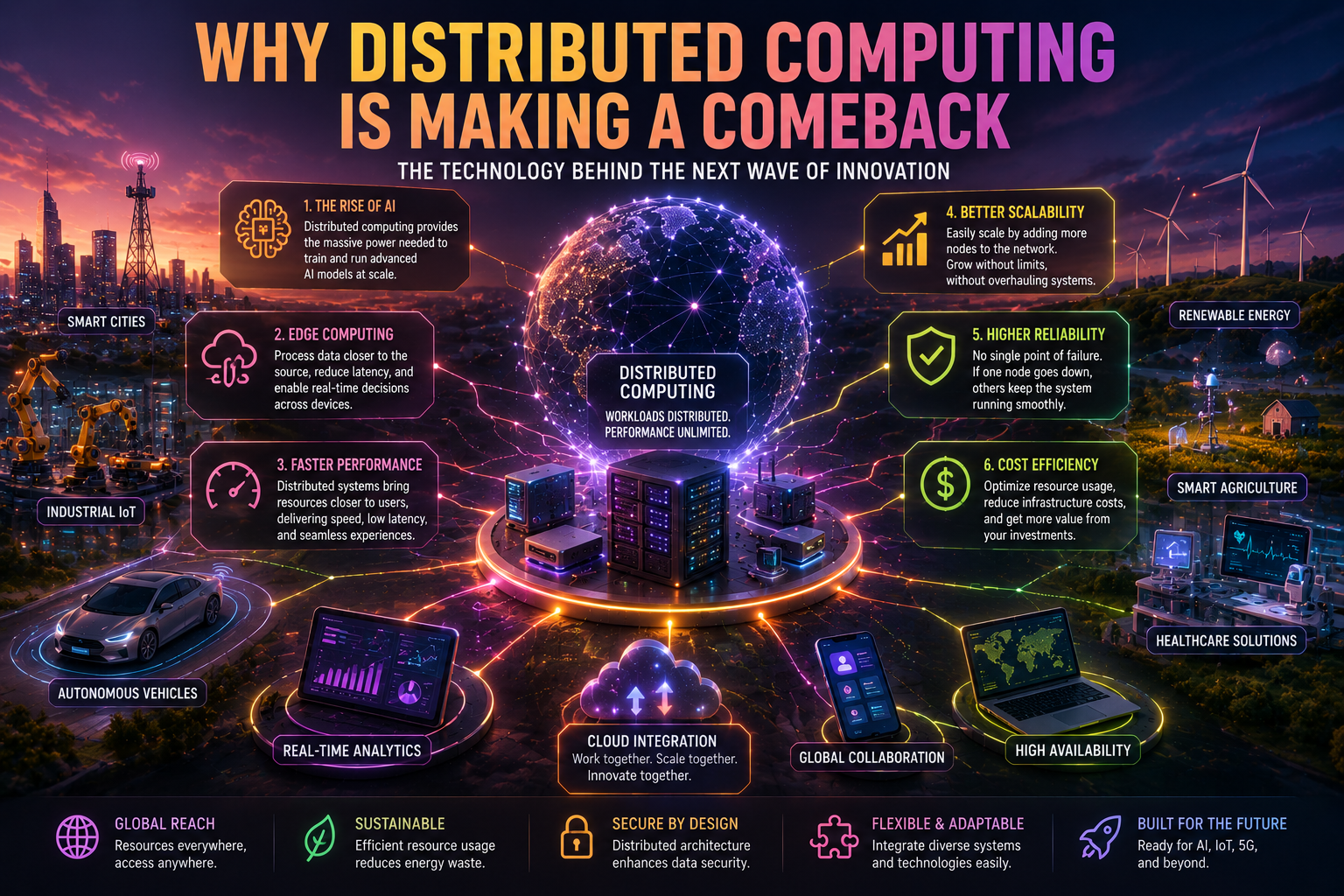
1. The Rise of Artificial Intelligence
Artificial Intelligence requires massive computational resources.
Training modern machine learning models involves processing billions of calculations across enormous datasets.
Rather than relying on a single server, distributed computing allows these tasks to be divided among hundreds or even thousands of machines working simultaneously.
This dramatically reduces training time while improving efficiency.
Without distributed computing, many of today's AI breakthroughs would simply not be practical.
2. Edge Computing Is Driving New Demand
Edge computing has transformed how businesses think about data processing.
Instead of sending every piece of information to a distant cloud server, edge devices process data locally whenever possible.
For example:
A security camera equipped with AI doesn't need to upload every second of video footage.
Instead, it analyzes the video locally and only sends important events to the cloud.
This reduces bandwidth usage while providing faster responses.
Distributed computing forms the foundation of this architecture by allowing processing to happen across multiple locations rather than within a centralized data center.
3. Faster Performance for Users
Modern users expect instant responses.
Whether they're shopping online, playing games, streaming videos, or using mobile apps, delays of even a few seconds can lead to frustration.
Distributed computing improves performance by placing computing resources closer to users.
Instead of routing every request through one central server, requests are processed by the nearest available system.
The result is:
- Faster loading times
- Lower latency
- Better customer experiences
- Higher application reliability
For businesses competing in digital markets, these improvements can directly impact customer satisfaction and revenue.
4. Better Scalability
As businesses grow, their computing requirements also increase.
Traditional systems often require expensive hardware upgrades to handle additional workloads.
Distributed computing takes a different approach.
Instead of replacing existing hardware, organizations simply add more machines to the network.
This horizontal scaling offers several advantages:
- Lower infrastructure costs
- Easier expansion
- Improved flexibility
- Minimal downtime during upgrades
Businesses can scale according to demand without completely redesigning their infrastructure.
5. Improved Reliability
One of the greatest strengths of distributed systems is resilience.
In centralized environments, a single hardware failure can disrupt an entire service.
Distributed systems eliminate this single point of failure.
If one server experiences problems, others continue processing requests.
Users often never notice that a component has failed.
This makes distributed computing particularly valuable for industries where continuous availability is critical, including healthcare, banking, telecommunications, and e-commerce.
6. Cost-Effective Infrastructure
Building one extremely powerful server is often more expensive than using multiple standard machines working together.
Distributed computing allows organizations to maximize existing hardware while reducing dependency on high-end infrastructure.
Cloud providers have also made distributed architectures more accessible through scalable computing services that businesses can use as needed.
Instead of making large upfront investments, organizations can expand gradually while maintaining cost efficiency.
7. Handling Massive Data Volumes
Data has become one of the world's most valuable resources.
Every click, transaction, sensor reading, social media interaction, and online purchase generates valuable information.
Processing these datasets efficiently requires parallel computing.
Distributed systems divide large datasets into smaller pieces and process them simultaneously.
This approach dramatically improves processing speed and makes real-time analytics possible.
Businesses gain insights faster, allowing them to make better decisions based on current information rather than outdated reports.
8. Supporting the Internet of Things (IoT)
The Internet of Things continues to expand rapidly.
Factories, hospitals, smart homes, transportation systems, and agriculture increasingly rely on connected devices.
Each device constantly produces data.
Sending all this information to one centralized server would create network congestion and unnecessary delays.
Distributed computing allows data to be processed closer to its source.
This enables:
- Faster decision-making
- Reduced bandwidth costs
- Improved security
- Better device performance
As billions of IoT devices come online, distributed computing becomes even more essential.
9. Powering Modern Cloud Services
Many people assume cloud computing and distributed computing are separate technologies.
In reality, modern cloud platforms are built on distributed computing principles.
Cloud providers operate enormous networks of interconnected servers spread across multiple geographic regions.
When users access cloud applications, distributed systems automatically balance workloads, replicate data, and maintain availability even if individual servers fail.
In other words, distributed computing is one of the hidden technologies that makes cloud computing possible.
Real-World Applications of Distributed Computing
Distributed computing is already driving many of the digital services people use every day.
Video Streaming
Streaming platforms distribute video content across global servers to reduce buffering and improve playback quality.
Online Banking
Banks process millions of secure transactions across distributed systems that ensure reliability and availability.
E-Commerce
Large online retailers use distributed infrastructure to handle traffic spikes during sales events without affecting customer experience.
Healthcare
Medical organizations analyze patient records, medical images, and research data across multiple computing environments.
Scientific Research
Researchers studying climate change, genetics, and space exploration rely on distributed computing to analyze enormous datasets that would overwhelm traditional systems.
Challenges of Distributed Computing
Although distributed computing offers significant advantages, it also introduces new complexities.
Organizations must address challenges such as:
- Network communication delays
- Data synchronization
- Security across multiple systems
- System monitoring
- Fault tolerance
- Infrastructure management
Fortunately, modern orchestration tools, container technologies, and cloud-native platforms have made these challenges much easier to manage than they were a decade ago.
The Future Looks Distributed
Emerging technologies continue to increase demand for distributed computing.
Artificial Intelligence, autonomous systems, 5G networks, smart cities, robotics, and real-time analytics all depend on processing data quickly and efficiently across multiple locations.
Rather than relying entirely on centralized cloud infrastructure, businesses are increasingly adopting hybrid architectures that combine cloud services with distributed computing.
This approach offers the best of both worlds—centralized management with decentralized performance.
As digital transformation accelerates, distributed computing is expected to become one of the foundational technologies supporting next-generation applications.
Final Thoughts
Distributed computing is no longer just a concept used by large technology companies or research institutions. It has become an essential part of building modern, scalable, and resilient digital systems.
By distributing workloads across multiple machines, businesses can improve performance, reduce downtime, process larger volumes of data, and create better experiences for their customers. As technologies like AI, edge computing, IoT, and real-time analytics continue to evolve, the importance of distributed computing will only grow.
At Bitviraj Technology, we help organizations embrace modern computing architectures that support long-term innovation and business growth. Whether you're modernizing existing infrastructure or designing new cloud-native applications, understanding the role of distributed computing is key to staying competitive in an increasingly connected world.
The future of technology isn't centered around one powerful machine—it's built on intelligent networks of systems working together. And that's exactly why distributed computing is making a comeback.
Case Studies
Empowering Digital
Evolution


Blogs
Empowering Digital
Evolution
BitViraj Technologies - Your Gateway to
Tomorrow's Innovations


Embark on a DigitalJourney


The next-generation digital technology company Bitviraj has the potential to empower and reinvent business in the current fast-paced market.


Our Service
- Website Development
- Application Development
- Blockchain Development
- Gaming and Metaverse