

BitViraj Technologies - Your Gateway to
Tomorrow's Innovations
The Future of Biometric Authentication: Beyond Passwords and PINs
For decades, passwords have been the gatekeepers of our digital lives. Whether logging into an email account, accessing online banking, or unlocking a smartphone, we've relied on combinations of letters, numbers, and symbols to protect sensitive information. But despite becoming increasingly complex, passwords remain one of the weakest links in cybersecurity.
The Future of Biometric Authentication
Beyond Passwords and PINs
Introduction
For decades, passwords have been the gatekeepers of our digital lives. Whether logging into an email account, accessing online banking, or unlocking a smartphone, we've relied on combinations of letters, numbers, and symbols to protect sensitive information. But despite becoming increasingly complex, passwords remain one of the weakest links in cybersecurity.
People forget them, reuse them across multiple platforms, or create predictable combinations that hackers can easily crack. As cyber threats continue to evolve, businesses and technology providers are searching for stronger, more convenient ways to verify identity. This is where biometric authentication is changing the game.
From fingerprint scanners and facial recognition to voice authentication and behavioral analysis, biometrics are transforming the way we access devices, applications, and secure environments. As artificial intelligence, machine learning, and sensor technology continue to improve, biometric authentication is moving beyond smartphones and becoming a key component of the future digital ecosystem.
But is a world without passwords truly possible? Let's explore how biometric authentication is evolving and what the future holds.
What Is Biometric Authentication?
Biometric authentication is a security process that verifies a person's identity using unique biological or behavioral characteristics instead of traditional passwords or PINs.
Unlike passwords that can be guessed, stolen, or forgotten, biometric traits are much harder to replicate because they are inherently linked to an individual.
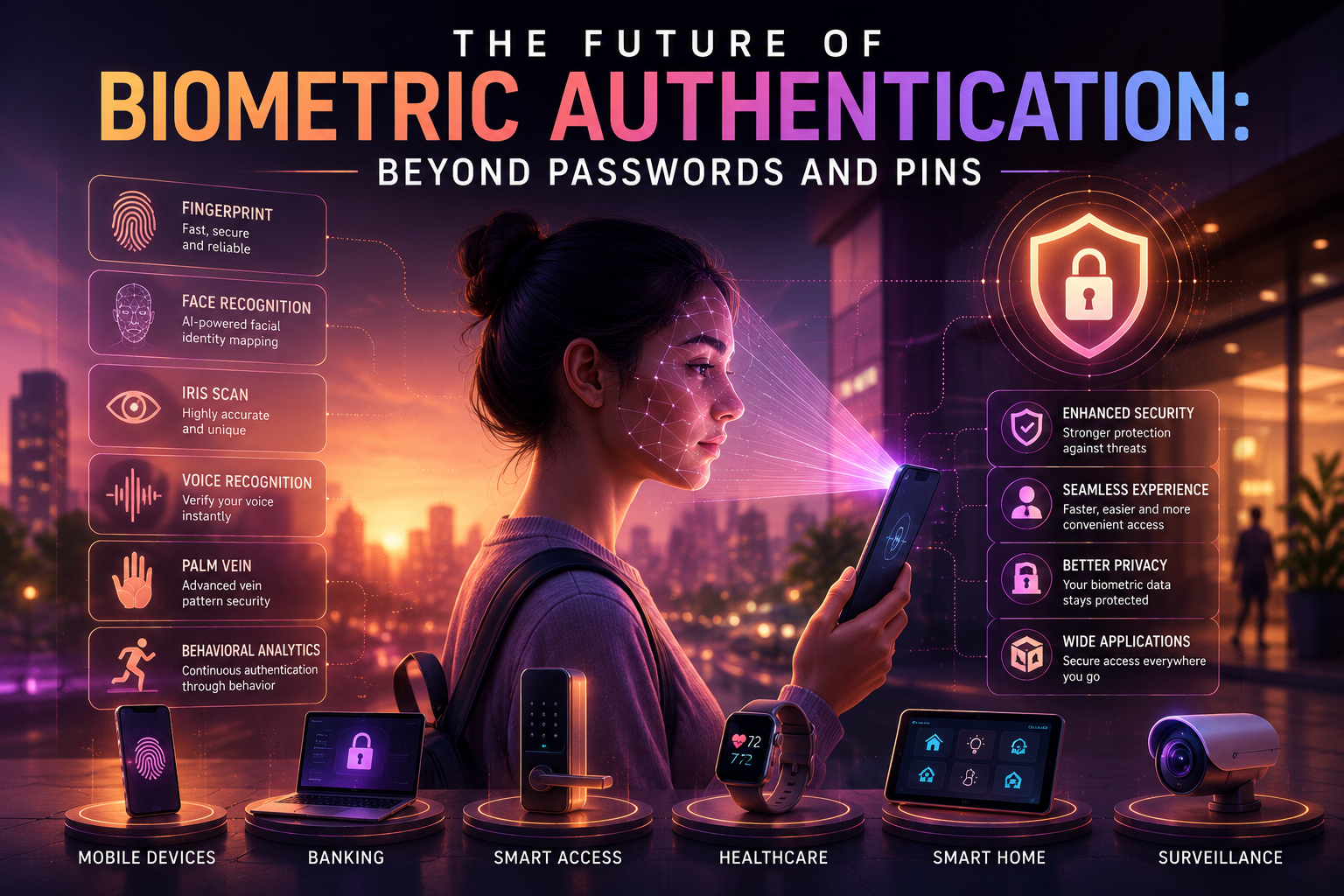
Some of the most widely used biometric methods include:
- Fingerprint recognition
- Facial recognition
- Iris scanning
- Retina scanning
- Voice recognition
- Palm vein recognition
- Behavioral biometrics, such as typing patterns or mouse movements
Each method offers different levels of accuracy, convenience, and security depending on the application.
Why Passwords Are No Longer Enough
Cybercriminals have become increasingly sophisticated. Phishing attacks, data breaches, credential stuffing, and brute-force attacks expose millions of passwords every year.
Even organizations that enforce strong password policies face significant risks because users often:
- Reuse passwords across multiple accounts
- Choose simple or predictable passwords
- Store passwords insecurely
- Share credentials with others
As businesses adopt cloud services and remote work models, securing digital identities has become more important than ever.
Biometric authentication reduces many of these risks by replacing something users know with something they are.
The Rise of Passwordless Authentication
One of the biggest trends in cybersecurity is the movement toward passwordless authentication.
Instead of remembering dozens of passwords, users can verify their identity through:
- Fingerprints
- Face scans
- Security keys
- Mobile authentication
- Biometric verification
This approach improves both security and user experience.
Logging into an application can take just a few seconds without typing a password, reducing frustration while minimizing opportunities for attackers.
Technology companies, financial institutions, healthcare providers, and government agencies are increasingly embracing passwordless systems as part of their cybersecurity strategies.
Artificial Intelligence Is Making Biometrics Smarter
Artificial intelligence is playing a major role in improving biometric authentication.
Modern AI systems can recognize subtle patterns that traditional algorithms might miss.
For example, facial recognition systems no longer rely solely on simple image matching. AI analyzes facial structure, depth, lighting conditions, expressions, and even slight movements to improve accuracy.
Similarly, voice authentication systems can distinguish between genuine users and recorded audio by analyzing speech dynamics, tone, rhythm, and pronunciation patterns.
Machine learning also enables biometric systems to improve over time by adapting to natural changes in a person's appearance or behavior.
Behavioral Biometrics: Security Without Extra Effort
One of the most exciting developments in authentication is behavioral biometrics.
Instead of identifying users through physical features, behavioral biometrics analyze how people naturally interact with devices.
Examples include:
- Typing speed
- Keystroke pressure
- Mouse movement
- Touchscreen gestures
- Walking patterns
- Device handling habits
These behaviors are difficult for attackers to imitate because they are developed unconsciously over time.
Behavioral authentication works continuously in the background, allowing systems to detect suspicious activity even after a user has successfully logged in.
This creates an additional layer of security without disrupting the user experience.
Biometrics in Everyday Life
Biometric authentication is no longer limited to high-security environments.
Today, millions of people use biometrics every day without giving it much thought.
Common applications include:
Smartphones
Fingerprint scanners and facial recognition allow users to unlock devices instantly while protecting personal data.
Banking
Financial institutions increasingly use biometric verification to approve transactions, prevent fraud, and authenticate mobile banking users.
Healthcare
Hospitals use biometric systems to identify patients, secure medical records, and control access to restricted areas.
Airports
Many airports now use facial recognition to speed up passenger verification during check-in, immigration, and boarding.
Workplaces
Organizations implement fingerprint or facial recognition systems for employee attendance and secure building access.
As technology becomes more affordable, biometric authentication will continue expanding into everyday business operations.
The Privacy Challenge
While biometrics offer greater convenience and stronger security, they also raise important privacy concerns.
Unlike passwords, biometric data cannot simply be changed if compromised.
You can reset a password.
You cannot replace your fingerprint.
This makes protecting biometric information critically important.
Organizations must ensure that biometric data is:
- Encrypted
- Securely stored
- Processed responsibly
- Collected with user consent
- Compliant with privacy regulations
Many modern authentication systems avoid storing raw biometric images altogether. Instead, they generate encrypted mathematical templates that cannot easily be reconstructed into the original fingerprint or facial image.
This significantly improves privacy while maintaining authentication accuracy.
Fighting Deepfakes and Identity Fraud
As artificial intelligence becomes more powerful, cybercriminals are also using AI to create sophisticated attacks.
Deepfake videos, cloned voices, and synthetic facial images present new challenges for biometric security.
Fortunately, AI is also helping defend against these threats.
Advanced biometric systems now include liveness detection, which verifies that the person being authenticated is physically present rather than using a photo, video, or digital replica.
Modern systems can detect:
- Eye movement
- Natural facial expressions
- Skin texture
- Blood flow patterns
- Depth perception
- Real-time reactions
These capabilities make biometric authentication far more resistant to spoofing attacks.
Multi-Factor Authentication Is Still Essential
Although biometrics provide strong protection, relying solely on one authentication method may not always be sufficient.
The future of cybersecurity lies in combining multiple security layers.
For example, a secure login process might require:
- Facial recognition
- Device verification
- Location analysis
- Behavioral monitoring
- One-time verification code for unusual activity
This layered approach significantly reduces the chances of unauthorized access while maintaining a smooth user experience.
What Businesses Should Consider Before Adopting Biometrics
Organizations planning to implement biometric authentication should evaluate several factors.
Security
Biometric systems must protect stored templates using strong encryption and secure hardware.
Compliance
Businesses should ensure compliance with privacy laws and industry regulations governing biometric data collection.
User Experience
Authentication should be fast, intuitive, and accessible for users with different physical abilities.
Integration
Biometric systems should integrate smoothly with existing applications, identity management platforms, and security infrastructure.
Transparency
Organizations should clearly explain how biometric data is collected, stored, and used to build trust among customers and employees.
What the Future Looks Like
The next generation of biometric authentication will be more intelligent, seamless, and secure than ever before.
Emerging innovations include:
- Continuous authentication throughout a user session
- AI-powered fraud detection
- Contactless biometric verification
- Wearable biometric devices
- Heartbeat and ECG-based identification
- Vein pattern recognition
- Multi-modal authentication combining several biometric traits
Instead of verifying identity once during login, future systems will continuously confirm that the authorized user remains in control of the device or application.
This shift represents a major evolution in digital security.
Final Thoughts
Biometric authentication is no longer a futuristic concept—it is becoming the new standard for digital identity verification. As cyber threats continue to grow in complexity, businesses and individuals need authentication methods that are both secure and user-friendly.
While passwords are unlikely to disappear overnight, their role will continue to diminish as biometric technologies become more accurate, affordable, and widely accepted. Combined with artificial intelligence, behavioral analysis, and advanced encryption, biometrics offer a powerful path toward a safer digital future.
The challenge ahead is balancing innovation with privacy. Organizations must adopt biometric technologies responsibly, ensuring that user trust remains at the center of every implementation.
At Bitviraj Technology, we believe the future of cybersecurity lies in intelligent, privacy-focused authentication systems that protect users without compromising convenience. As technology evolves, biometric authentication will play a crucial role in shaping secure digital experiences for businesses and consumers alike.
Case Studies
Empowering Digital
Evolution

Blogs
Empowering Digital
Evolution
BitViraj Technologies - Your Gateway to
Tomorrow's Innovations


Embark on a DigitalJourney


The next-generation digital technology company Bitviraj has the potential to empower and reinvent business in the current fast-paced market.


Our Service
- Website Development
- Application Development
- Blockchain Development
- Gaming and Metaverse