


BitViraj Technologies - Your Gateway to
Tomorrow's Innovations
Why Multi-Agent Systems Are Replacing Single AI Agents
The Future of Enterprise AI Architecture
Why Multi-Agent Systems Are Replacing Single AI Agents:
The Future of Enterprise AI Architecture
The End of the "One Agent Does Everything" Era
When businesses first started exploring AI agents, the vision was simple.
Build one intelligent agent.
Give it access to data, tools, and business systems.
Let it answer questions, automate tasks, and solve problems.
At first glance, the approach seemed logical. After all, if a single AI agent could understand language, retrieve information, generate content, and execute actions, why create multiple agents?
But as organizations moved beyond pilots and into enterprise-scale deployments, a reality quickly emerged.
The more responsibilities assigned to a single agent, the harder it became to manage, govern, optimize, and scale.
What worked for a small proof of concept often struggled in real-world business environments.
Today, a growing number of organizations are moving away from general-purpose agents and toward Multi-Agent Systems (MAS)—networks of specialized AI agents working together to achieve shared objectives.
This shift is not simply a technical trend. It represents a fundamental evolution in how enterprises design intelligent systems.
Just as modern businesses rely on teams of specialists rather than a single employee handling every function, the future of AI is increasingly built around teams of specialized agents collaborating across workflows.
Why Single-Agent Architectures Are Reaching Their Limits
Single-agent systems have played an important role in the early stages of Agentic AI adoption.
For simple use cases, they remain highly effective.
Examples include:
- Customer support assistants
- Knowledge retrieval systems
- Personal productivity tools
- Internal helpdesk agents
However, enterprise operations rarely consist of isolated tasks.
A customer onboarding process may involve:
- Identity verification
- Compliance checks
- Data collection
- Account creation
- Risk assessment
- Customer communication
Expecting one AI agent to master every aspect of this workflow creates several challenges.
Growing Complexity
As responsibilities increase, prompts become larger, workflows become more complicated, and decision-making becomes harder to manage.
Reduced Accuracy
General-purpose agents often struggle to maintain high performance across diverse tasks.
Limited Scalability
A single agent can quickly become a bottleneck in high-volume environments.
Governance Challenges
Monitoring, auditing, and securing one highly complex agent becomes increasingly difficult.
Organizations are discovering that scaling intelligence often requires distributing responsibilities rather than consolidating them.
What Is a Multi-Agent System?
A Multi-Agent System (MAS) is an architecture in which multiple AI agents collaborate to complete tasks, solve problems, or execute business processes.
Each agent is typically designed for a specific role or area of expertise.
Rather than trying to make one agent do everything, organizations create specialized agents that work together.
A multi-agent environment may include:
Research agents
Planning agents
Analysis agents
Customer service agents
Compliance agents
Security agents
Workflow orchestration agents
And more
Each agent focuses on a defined responsibility while coordinating with others as needed.
The result is a more modular, scalable, and manageable AI ecosystem.
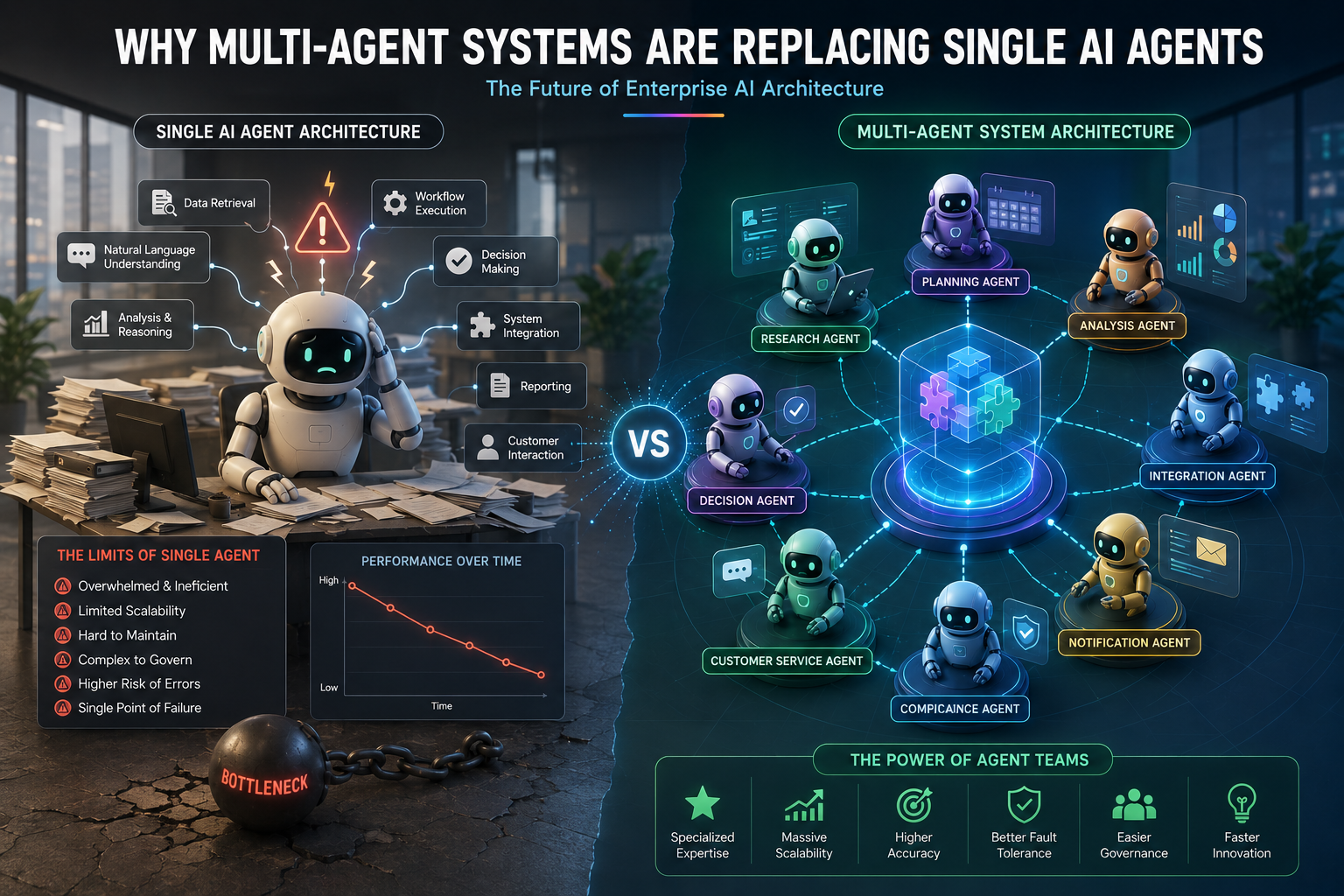
Single-Agent vs Multi-Agent Architectures
Single-Agent Architecture
In a single-agent model:
- One agent receives requests
- One agent processes information
- One agent makes decisions
- One agent executes actions
Advantages:
- Simpler initial deployment
- Lower operational complexity
- Faster proof-of-concept development
Limitations:
- Difficult to scale
- Harder to govern
- Less specialized expertise
- Increased risk of performance bottlenecks
Multi-Agent Architecture
In a multi-agent model:
- Multiple agents collaborate
- Responsibilities are distributed
- Specialized expertise is assigned
- Workloads are shared
Advantages:
- Greater scalability
- Improved accuracy
- Better fault isolation
- Enhanced governance
- Easier maintenance
Challenges:
- More orchestration requirements
- Increased communication complexity
- Additional monitoring needs
For enterprise environments, the benefits often outweigh the challenges.
Why Businesses Are Moving Toward AI Agent Teams
Organizations are discovering that multi-agent systems closely mirror how successful businesses operate.
A company does not rely on a single employee to handle:
- Finance
- Marketing
- Operations
- Sales
- Compliance
- Customer support
Instead, specialized teams collaborate to achieve organizational goals.
The same principle applies to AI.
Specialized agents can focus on individual responsibilities while coordinating through structured workflows.
This approach improves efficiency while reducing operational risk.
How Multi-Agent Systems Scale Enterprise AI
Scalability is one of the biggest drivers behind multi-agent adoption.
As AI usage grows, organizations often encounter challenges with single-agent architectures.
Performance declines.
Decision-making becomes slower.
Governance becomes more difficult.
Multi-agent systems address these challenges through workload distribution.
For example:
A customer support operation may include:
Routing AgentDetermines the nature of incoming requests.
Authentication AgentVerifies customer identity.
Knowledge AgentRetrieves relevant information.
Resolution AgentGenerates solutions.
Escalation AgentHandles complex cases.
Instead of one agent performing every task, responsibilities are distributed across multiple specialized agents.
This structure allows organizations to handle larger volumes while maintaining quality and performance.
Designing AI Agent Teams for Business Operations
One of the most exciting developments in Agentic AI is the concept of AI agent teams.
These teams function similarly to human departments.
Each agent has a specific role, expertise, and responsibility.
Consider a procurement workflow.
An AI agent team may include:
Vendor Evaluation Agent
Assesses suppliers and proposals.
Compliance Agent
Ensures regulatory requirements are met.
Budget Analysis Agent
Evaluates financial impact.
Contract Review Agent
Reviews contractual obligations.
Approval Agent
Coordinates decision-making and workflow completion.
Together, these agents perform tasks that would be difficult for a single agent to manage effectively.
The result is a more resilient and adaptable operational model.
Multi-Agent Patterns Every AI Engineer Should Know
As multi-agent architectures become more common, several design patterns are emerging.
Understanding these patterns is essential for building scalable AI systems.
1. Coordinator Pattern
A central orchestration agent manages workflow execution and delegates tasks to specialized agents. This pattern provides strong control and visibility.
Best suited for:
- Enterprise workflows
- Regulated environments
- Structured business processes
2. Specialist Pattern
Each agent focuses on a specific domain or capability. Agents collaborate when expertise is required.
Best suited for:
- Large organizations
- Complex workflows
- Knowledge-intensive operations
3. Hierarchical Pattern
Senior agents oversee groups of subordinate agents. Responsibilities are distributed across multiple levels.
Best suited for:
- Large-scale automation
- Multi-department operations
- Enterprise-wide AI ecosystems
4. Collaborative Pattern
Agents communicate directly with one another to solve problems collectively. Decision-making is decentralized.
Best suited for:
- Research tasks
- Dynamic problem-solving
- Adaptive environments
5. Reviewer Pattern
One agent performs work while another evaluates quality and compliance. This pattern improves reliability and reduces errors.
Best suited for:
- Software development
- Financial workflows
- Regulatory processes
The Role of Agent-to-Agent Communication
Multi-agent systems depend heavily on effective communication.
Agents must be able to:
- Share information
- Delegate tasks
- Exchange results
- Coordinate activities
- Resolve dependencies
Without structured communication, collaboration becomes difficult.
This is why Agent-to-Agent (A2A) communication is emerging as a critical component of modern Agentic AI architectures.
As AI ecosystems grow, robust communication protocols will become increasingly important.
Governance and Observability in Multi-Agent Systems
As organizations deploy larger networks of agents, governance becomes essential.
Leadership teams need answers to important questions:
- Which agents participated in a workflow?
- What decisions were made?
- Which data sources were accessed?
- Why was a specific action taken?
Multi-agent environments require:
Observability
Visibility into agent interactions and behavior.
Audit Trails
Complete records of actions and decisions.
Security Controls
Authorization frameworks governing agent permissions.
Compliance Monitoring
Validation against business and regulatory policies.
Without governance, multi-agent systems can become difficult to manage at scale.
The Future of Enterprise AI Is Collaborative
The shift toward multi-agent systems reflects a broader reality about intelligence itself.
Complex problems are rarely solved by a single individual.
They are solved by teams.
The same principle is proving true in artificial intelligence.
The future of enterprise AI is not a single super-agent attempting to do everything.
It is a coordinated network of specialized agents collaborating to achieve business objectives.
These systems are:
- More scalable
- More resilient
- More adaptable
- Easier to govern
- Better aligned with real-world business operations
As organizations continue investing in Agentic AI, multi-agent architectures are likely to become the dominant design model.
Conclusion
The early wave of Agentic AI focused on what a single intelligent agent could accomplish. The next wave is focused on what teams of specialized agents can achieve together.
Multi-agent systems provide a more scalable, flexible, and enterprise-ready approach to AI adoption. By distributing responsibilities across specialized agents, organizations can improve performance, strengthen governance, enhance reliability, and unlock more sophisticated forms of automation.
As businesses move from AI experimentation to enterprise-wide deployment, the question is no longer whether multi-agent systems will become important.
The question is how quickly organizations can adapt to a future where intelligent agent teams become a core part of everyday business operations.
Bitviraj Technology helps organizations design, deploy, and manage advanced multi-agent AI architectures that combine orchestration, governance, security, observability, and business process automation. Our solutions enable enterprises to build scalable AI ecosystems that are ready for the next generation of intelligent operations.
Case Studies
Empowering Digital
Evolution


Blogs
Empowering Digital
Evolution
BitViraj Technologies - Your Gateway to
Tomorrow's Innovations


Embark on a DigitalJourney


The next-generation digital technology company Bitviraj has the potential to empower and reinvent business in the current fast-paced market.


Our Service
- Website Development
- Application Development
- Blockchain Development
- Gaming and Metaverse