

BitViraj Technologies - Your Gateway to
Tomorrow's Innovations
Ransomware Evolution and Ransomware-as-a-Service (RaaS): Understanding the New Face of Cyber Extortion
Ransomware is no longer the noisy, smash-and-grab cybercrime it once was. A decade ago, attackers would infect a system, encrypt files within minutes, and demand payment. Today, ransomware operations have evolved into highly organized criminal enterprises that resemble legitimate businesses more than traditional hacking groups.

Ransomware Evolution and Ransomware-as-a-Service (RaaS)
Understanding the New Face of Cyber Extortion
Introduction
Ransomware is no longer the noisy, smash-and-grab cybercrime it once was. A decade ago, attackers would infect a system, encrypt files within minutes, and demand payment. Today, ransomware operations have evolved into highly organized criminal enterprises that resemble legitimate businesses more than traditional hacking groups.
Modern ransomware actors spend days, weeks, and sometimes even months inside victim environments before launching an attack. They quietly gather intelligence, steal sensitive data, disable security controls, and move laterally across networks before triggering encryption. In many cases, organizations are compromised long before they realize an attacker is present.
Adding to the challenge is the rise of Ransomware-as-a-Service (RaaS), a business model that allows cybercriminals with little technical expertise to launch sophisticated ransomware campaigns using tools and infrastructure developed by experienced threat actors.
Recent investigations have revealed attackers hiding communications within trusted enterprise platforms such as Microsoft Teams and other collaboration tools, making detection increasingly difficult. As ransomware continues to evolve, organizations must understand not only how these attacks occur but also how digital forensics helps uncover the full scope of an intrusion.
The Evolution of Ransomware
The Early Days
Traditional ransomware focused on one objective: encrypt files and demand payment for their release.
Attackers typically relied on:
- Malicious email attachments
- Drive-by downloads
- Exploit kits
- Infected software installers
The attack cycle was relatively straightforward. Malware infected a device, encrypted files, and displayed a ransom note. While disruptive, these attacks were often limited to individual endpoints or small networks.
Modern Ransomware Operations
Today's ransomware campaigns are far more sophisticated. Instead of immediately encrypting files, attackers now prioritize stealth and persistence.
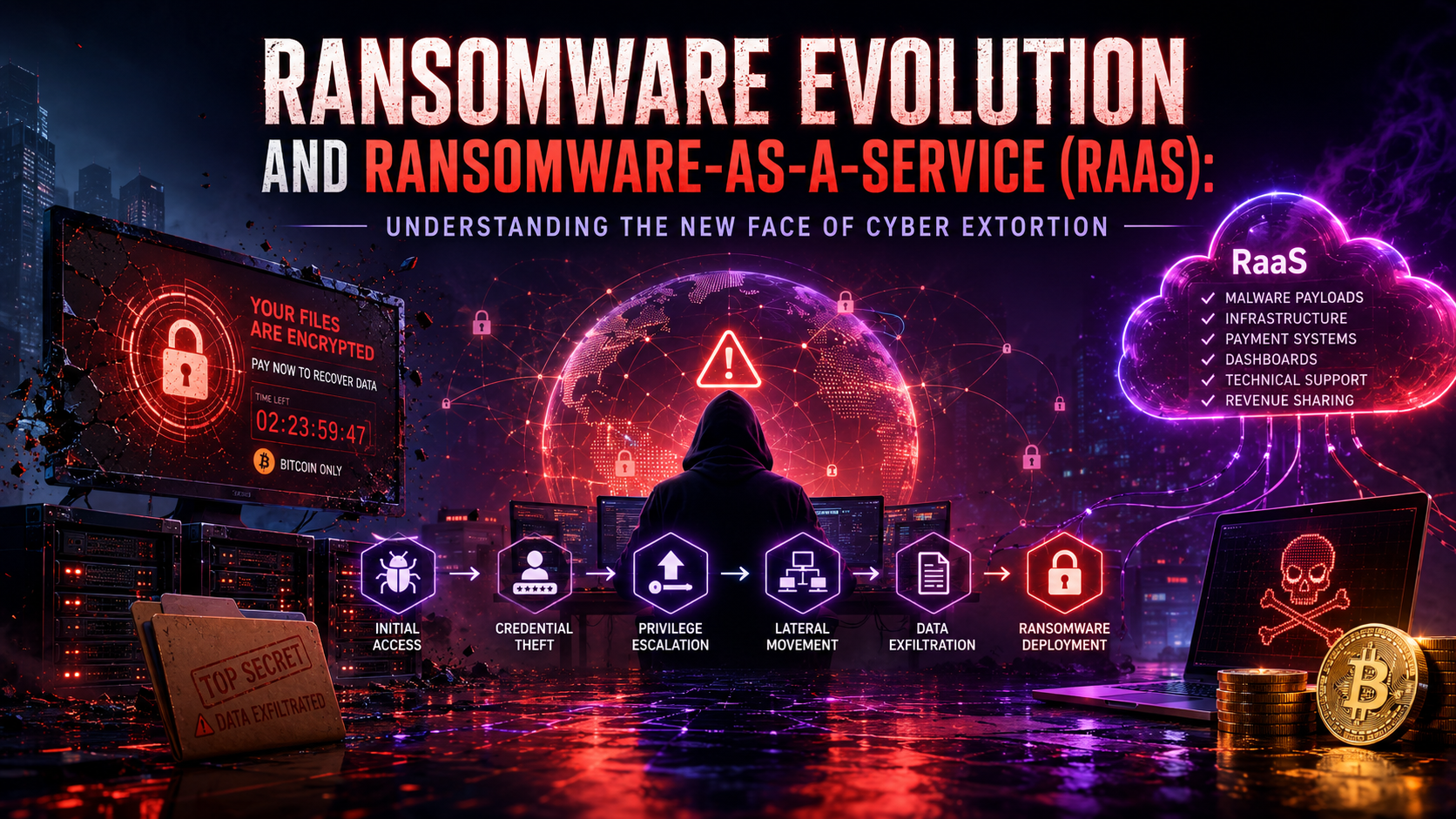
A typical attack may involve:
- Initial access
- Credential theft
- Privilege escalation
- Lateral movement
- Data exfiltration
- Security tool evasion
- Ransomware deployment
This approach maximizes both financial impact and negotiation leverage.
Double Extortion Strategy
Many ransomware groups now use a "double extortion" strategy. Victims face two threats:
- Encryption of business-critical data
- Public release of stolen information
Even organizations with strong backups may feel pressured to pay if sensitive customer, financial, or intellectual property data has been stolen.
The Rise of Ransomware-as-a-Service (RaaS)
One of the biggest reasons ransomware attacks continue to increase is the emergence of the Ransomware-as-a-Service model.
RaaS functions much like a software subscription business.
Instead of building malware from scratch, affiliates can rent ransomware platforms from experienced operators.
The service typically includes:
- Ready-made ransomware payloads
- Management dashboards
- Payment infrastructure
- Victim negotiation portals
- Technical support
- Revenue-sharing agreements
The developers create and maintain the ransomware while affiliates focus on compromising victims.
When a ransom is paid, profits are split between both parties.
This model has dramatically lowered the barrier to entry for cybercrime and enabled ransomware operations to scale globally.
Why RaaS Has Changed the Threat Landscape
The success of RaaS stems from its efficiency.
1. Lower Technical Requirements
Individuals with limited malware development skills can launch sophisticated attacks.
2. Faster Attack Deployment
Affiliates gain access to proven tools and infrastructure without investing significant time or resources.
3. Larger Criminal Ecosystem
Ransomware operators, access brokers, data thieves, and money launderers now work together as part of an interconnected cybercrime economy.
4. Continuous Innovation
Competition among ransomware groups drives rapid development of new evasion techniques and attack methods.
As a result, ransomware campaigns have become more frequent, more targeted, and more damaging.
Stealth Techniques Used by Modern Ransomware Groups
Ransomware operators increasingly prioritize stealth over speed.
Their goal is to remain undetected for as long as possible.
Living Off the Land
Rather than deploying obvious malware, attackers frequently abuse legitimate administrative tools already present in the environment.
Examples include:
- PowerShell
- Remote Desktop Protocol (RDP)
- Windows Management Instrumentation (WMI)
- PsExec
Because these tools are commonly used by system administrators, malicious activity often blends into normal operations.
Abuse of Collaboration Platforms
Recent incidents have demonstrated how attackers exploit trusted communication channels. Enterprise platforms such as Microsoft Teams, messaging systems, and collaboration tools provide opportunities to:
- Communicate internally
- Deliver malicious links
- Conduct social engineering campaigns
- Establish trusted communication paths
Because these platforms are widely used within organizations, suspicious activity can be difficult to identify.
Long Dwell Times
Modern ransomware groups often remain hidden within networks for extended periods. During this time they:
- Map infrastructure
- Identify critical systems
- Locate backups
- Collect credentials
- Exfiltrate sensitive data
The longer attackers remain undetected, the greater the potential impact of the attack.
The Digital Forensics Perspective
When a ransomware incident occurs, recovery is only one part of the response.
Organizations must understand:
- How attackers entered the environment
- What systems were affected
- Whether data was stolen
- How long the attackers remained active
- What actions were performed before encryption
Digital forensics provides the evidence needed to answer these questions.
Memory Forensics: Investigating What Disk Artifacts Miss
Many ransomware operators attempt to erase traces of their activity.
However, valuable evidence often remains in system memory.
Memory forensics allows investigators to examine:
- Running processes
- Injected malware
- Encryption routines
- Active network connections
- Credential theft activity
- In-memory command execution
Since many modern threats operate primarily in memory, analyzing RAM can reveal artifacts that never appear on disk.
Memory analysis is frequently one of the most important steps in ransomware investigations.
Lateral Movement Reconstruction
Encryption rarely begins with the first compromised system.
Attackers typically move across multiple devices before launching ransomware.
Digital forensic analysts reconstruct this movement by examining:
- Authentication logs
- Remote access activity
- Administrative tool usage
- Account behavior
- Network connections
The objective is to determine:
- Patient zero
- Attack progression
- Privilege escalation path
- Scope of compromise
Understanding lateral movement helps organizations identify every affected system and prevent reinfection.
Crypto-Wallet Tracing
Ransomware payments are often demanded in cryptocurrency.
Although cryptocurrencies provide a degree of anonymity, blockchain transactions leave permanent records.
Forensic investigators use crypto-wallet tracing to:
- Track ransom payments
- Identify related wallets
- Discover transaction patterns
- Connect criminal infrastructure
- Support law enforcement investigations
Wallet analysis has become an increasingly important component of modern ransomware investigations.
In some cases, tracing cryptocurrency movements has helped uncover relationships between multiple ransomware campaigns and threat groups.
Incident Timeline Creation
One of the most valuable outputs of a ransomware investigation is a detailed incident timeline.
A timeline helps answer critical questions such as:
- When did attackers gain access?
- When were credentials stolen?
- When was data exfiltrated?
- When was ransomware deployed?
- What actions occurred before encryption?
Analysts collect evidence from:
- Endpoint logs
- Security tools
- Authentication records
- Memory captures
- Network traffic
- System artifacts
The resulting timeline provides a complete picture of the attack lifecycle and helps organizations strengthen defenses against future incidents.
Essential Tools for Ransomware Investigations
Volatility 3
Volatility 3 is one of the industry's leading memory forensic frameworks.
Investigators use it to:
- Analyze memory dumps
- Identify malicious processes
- Detect code injection
- Recover network connections
- Examine credential theft activity
For ransomware investigations, memory analysis often reveals evidence unavailable through traditional disk-based forensics.
Velociraptor
Velociraptor is a powerful endpoint visibility and digital forensic platform.
Security teams use it to:
- Collect forensic artifacts
- Hunt threats across endpoints
- Perform rapid incident response
- Execute forensic queries at scale
Its speed and flexibility make it particularly valuable during active ransomware incidents.
KAPE
KAPE (Kroll Artifact Parser and Extractor) enables investigators to rapidly collect and process forensic evidence.
Key capabilities include:
- Evidence acquisition
- Log collection
- Registry analysis
- Timeline generation
- Artifact triage
KAPE significantly reduces investigation time by automating data collection from affected systems.
Building Ransomware Resilience
While no organization can eliminate risk entirely, several practices significantly improve resilience against ransomware attacks.
Implement Strong Access Controls
Reduce opportunities for credential abuse and privilege escalation.
Monitor Lateral Movement Activity
Detect unusual authentication and administrative behavior.
Secure Collaboration Platforms
Review access policies and monitor suspicious communications.
Maintain Offline Backups
Ensure backups cannot be encrypted alongside production systems.
Conduct Threat Hunting
Actively search for indicators of compromise before attackers deploy ransomware.
Develop Incident Response Plans
Preparation reduces response time and limits operational disruption.
Conclusion
Ransomware has evolved from simple file encryption malware into a sophisticated criminal business model powered by Ransomware-as-a-Service. Today's attackers use stealth techniques, trusted enterprise platforms, credential abuse, and prolonged dwell times to maximize damage and financial gain.
As these threats continue to grow in complexity, organizations must move beyond traditional security approaches and embrace proactive detection, forensic readiness, and rapid incident response capabilities.
Memory forensics, lateral movement reconstruction, crypto-wallet tracing, and incident timeline creation have become essential components of modern ransomware investigations. Combined with powerful tools such as Volatility 3, Velociraptor, and KAPE, these techniques provide the visibility needed to understand, contain, and recover from ransomware incidents.
About Bitviraj Technology
At Bitviraj Technology, we believe that effective cybersecurity begins with understanding how modern threats operate. By combining advanced digital forensics, threat intelligence, and incident response expertise, organizations can stay ahead of evolving ransomware campaigns and build stronger cyber resilience for the future.
Case Studies
Empowering Digital
Evolution



Blogs
Empowering Digital
Evolution
BitViraj Technologies - Your Gateway to
Tomorrow's Innovations



Embark on a DigitalJourney


The next-generation digital technology company Bitviraj has the potential to empower and reinvent business in the current fast-paced market.


Our Service
- Website Development
- Application Development
- Blockchain Development
- Gaming and Metaverse