

BitViraj Technologies - Your Gateway to
Tomorrow's Innovations
Supply Chain Attacks: The Hidden Threat Lurking in NPM, PyPI, and Open-Source Ecosystems
Modern software development is built on trust. Developers routinely install packages from repositories such as NPM and PyPI, integrate open-source libraries into applications, and rely on community-driven code to accelerate development. While this ecosystem has transformed software engineering, it has also created a dangerous new attack surface: software supply chain attacks.

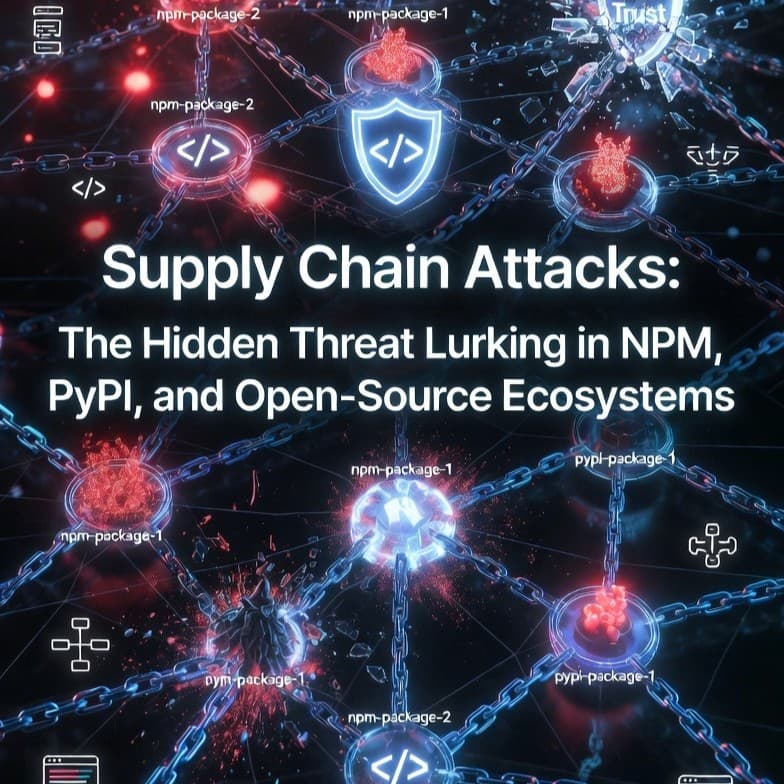
Supply Chain Attacks
The Hidden Threat Lurking in NPM, PyPI, and Open-Source Ecosystems
Introduction
Modern software development is built on trust. Developers routinely install packages from repositories such as NPM and PyPI, integrate open-source libraries into applications, and rely on community-driven code to accelerate development. While this ecosystem has transformed software engineering, it has also created a dangerous new attack surface: software supply chain attacks.
Over the last few years, attackers have increasingly targeted the software supply chain instead of directly attacking organizations. The reason is simple—compromising a widely used package can provide access to hundreds or even thousands of downstream applications.
A recent compromise involving an NPM package impacted more than 140 projects after malicious code was introduced through a post-installation payload. Incidents like these highlight a growing reality: organizations are no longer securing only their own code; they must secure the code they inherit from countless third-party dependencies.
This article explores how supply chain attacks work, how digital forensics teams investigate them, and the critical skills security professionals need to combat this emerging threat.
Understanding Software Supply Chain Attacks
A software supply chain attack occurs when threat actors compromise a trusted software component and use it as a delivery mechanism for malicious code.
Instead of targeting end users directly, attackers infiltrate:
- Open-source libraries
- Package repositories
- Build pipelines
- Dependency managers
- CI/CD systems
- Software update mechanisms
Once the compromised component is downloaded, the malicious code executes within trusted environments, often bypassing traditional security controls.
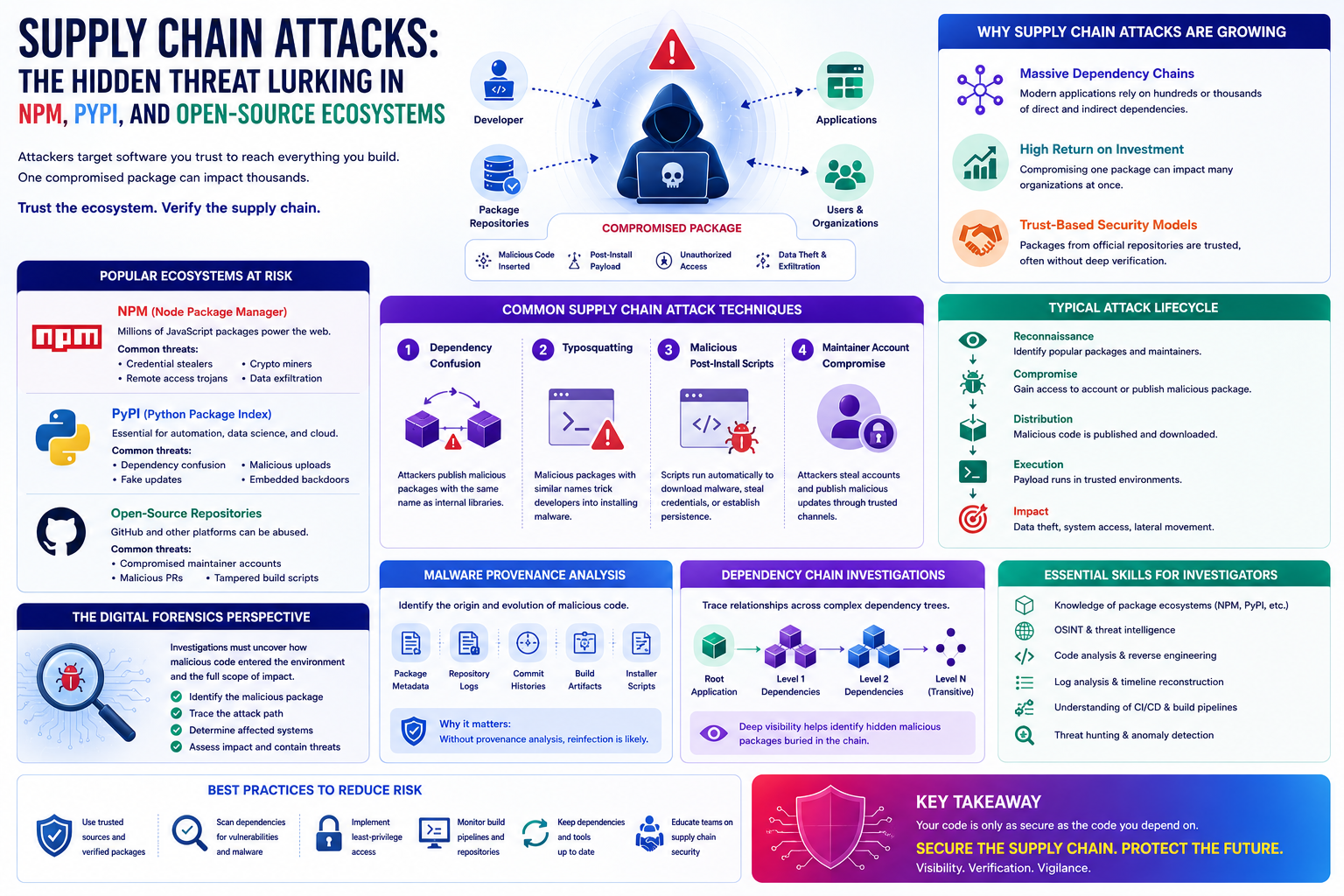
NPM (Node Package Manager)
NPM hosts millions of JavaScript packages used in web development. Attackers often publish typosquatted packages or compromise legitimate maintainers to distribute malware.
Examples include:
- Credential stealers
- Cryptocurrency miners
- Remote access trojans
- Data exfiltration scripts
PyPI (Python Package Index)
Python's popularity in automation, data science, and cloud environments makes PyPI a valuable target.
Common attack techniques include:
- Dependency confusion
- Malicious package uploads
- Fake updates
- Embedded backdoors
Open-Source Repositories
GitHub and other open-source platforms can become attack vectors when:
- Maintainer accounts are compromised
- Malicious pull requests are merged
- Build scripts are altered
- Release artifacts are tampered with
Why Supply Chain Attacks Are Growing Rapidly
Several factors contribute to the rise of supply chain compromises.
1. Massive Dependency Chains
Modern applications often contain hundreds or thousands of indirect dependencies. A developer may install one package, but that package may rely on dozens of additional libraries. This creates a complex web of trust relationships that are difficult to monitor.
2. High Return on Investment for Attackers
Compromising a single package can provide access to numerous organizations simultaneously. Instead of attacking 100 companies individually, an attacker compromises one trusted dependency and reaches all 100 through software distribution.
3. Trust-Based Security Models
Organizations generally trust packages from official repositories. This trust can lead to reduced scrutiny during installation, allowing malicious code to execute unnoticed.
Common Supply Chain Attack Techniques
1. Dependency Confusion
Attackers publish malicious packages with names matching internal company libraries. When package managers mistakenly download the public package instead of the private one, malicious code executes automatically.
2. Typosquatting
Attackers create packages with names similar to popular libraries.
Examples include:
- request → requset
- flask → flsak
- lodash → loadash
Developers who mistype package names unknowingly install malware.
3. Malicious Post-Install Scripts
Many package managers support post-install execution. Attackers abuse this feature to download malware, steal credentials, modify system settings, and establish persistence. These scripts often run automatically without user awareness.
4. Maintainer Account Compromise
Threat actors steal developer credentials and publish malicious updates through legitimate package accounts. Because the package appears trustworthy, organizations install updates without suspicion.
The Digital Forensics Perspective
When a supply chain compromise occurs, incident response teams face a unique challenge.
The investigation must determine not only what malware executed but also how it entered the environment in the first place.
This is where software supply chain forensics becomes critical.
Malware Provenance Analysis
Malware provenance analysis focuses on identifying the origin and evolution of malicious code.
Investigators attempt to answer questions such as:
- Which package introduced the malware?
- When was the package modified?
- Who published the malicious version?
- Which systems installed it?
Key evidence sources include:
- Package metadata
- Repository logs
- Commit histories
- Build artifacts
- Installer scripts
By reconstructing the malware's lifecycle, investigators can determine the scope and impact of the compromise.
Why It Matters: Without provenance analysis, organizations may remove the malware but fail to identify the compromised source, allowing reinfection during future deployments.
Dependency Chain Investigations
One of the most challenging aspects of supply chain forensics is tracing dependency relationships.
A malicious package may not be installed directly. Instead, it may arrive through multiple layers of dependencies.
Forensic analysts map:
- Direct dependencies
- Transitive dependencies
- Package versions
- Installation timelines
The objective is to identify the exact dependency path that introduced malicious code into the environment.
Application → Package A → Package B → Malicious Package C
Understanding this chain helps security teams:
- Assess exposure
- Identify affected systems
- Prevent future compromises
SBOM Forensics: The New Security Requirement
A Software Bill of Materials (SBOM) functions like an ingredient list for software.
It documents:
- Components
- Libraries
- Versions
- Dependencies
- Suppliers
During incident investigations, SBOMs help analysts quickly determine whether affected systems contain vulnerable or malicious packages.
Benefits of SBOM Forensics:
- Faster Incident Response – Security teams can immediately identify impacted assets.
- Improved Visibility – Organizations gain insight into all third-party components in use.
- Compliance Support – Many regulatory frameworks increasingly require software transparency and component tracking.
- Threat Hunting – Analysts can proactively search environments for known malicious dependencies.
As software ecosystems become more complex, SBOMs are rapidly becoming a foundational element of cybersecurity programs.
Essential Skills for Supply Chain Security Professionals
The increasing sophistication of software supply chain attacks requires specialized skills and tools.
YARA
YARA is one of the most powerful tools for malware detection and classification.
Security teams use YARA rules to:
- Detect malicious packages
- Identify suspicious scripts
- Classify malware families
- Scan repositories and artifacts
Forensic investigators often create custom YARA signatures to identify malicious code across large environments.
Sigstore
Sigstore is transforming software trust and package verification.
It enables developers and organizations to:
- Sign software artifacts
- Verify package authenticity
- Prevent tampering
- Improve supply chain integrity
By implementing cryptographic verification, organizations can significantly reduce the risk of installing modified or malicious packages.
Dependency Auditing
Dependency auditing has become a critical cybersecurity skill.
Security professionals must routinely:
- Review package inventories
- Monitor vulnerability disclosures
- Detect abandoned libraries
- Identify suspicious maintainers
- Evaluate dependency risks
Regular auditing helps organizations detect threats before they become incidents.
Best Practices for Defending Against Supply Chain Attacks
Organizations can reduce risk by adopting several proactive security measures.
Maintain an Accurate SBOM
Track every software component and dependency used across environments.
Verify Package Signatures
Use trusted signing mechanisms such as Sigstore whenever possible.
Implement Dependency Scanning
Continuously scan dependencies for vulnerabilities and suspicious behavior.
Restrict Package Sources
Allow package installations only from approved repositories.
Monitor Build Pipelines
Secure CI/CD environments against unauthorized modifications.
Enforce Least Privilege
Limit package installation permissions and repository access.
Review Third-Party Dependencies Regularly
Remove unused libraries and outdated packages to minimize exposure.
Conclusion
Software supply chain attacks have evolved from a niche threat into one of the most significant cybersecurity challenges facing organizations today. As developers increasingly rely on NPM, PyPI, and open-source ecosystems, attackers are exploiting the trust relationships that underpin modern software development.
For defenders, success requires more than traditional malware analysis. It demands expertise in malware provenance analysis, dependency chain investigations, and SBOM forensics. Equally important is mastering modern security tools such as YARA, Sigstore, and dependency auditing frameworks.
Organizations that invest in software supply chain visibility today will be far better prepared to detect, investigate, and mitigate the next generation of attacks. In an era where software is assembled from thousands of interconnected components, understanding the supply chain is no longer optional—it is a fundamental requirement for cybersecurity resilience.
About Bitviraj Technology
At Bitviraj Technology, we help organizations strengthen their cybersecurity posture through advanced threat detection, digital forensics, incident response, and software supply chain security assessments. As cyber threats continue to evolve, our experts work closely with businesses to secure critical systems, protect digital assets, and build resilient security programs for the future.
Case Studies
Empowering Digital
Evolution



Blogs
Empowering Digital
Evolution
BitViraj Technologies - Your Gateway to
Tomorrow's Innovations



Embark on a DigitalJourney


The next-generation digital technology company Bitviraj has the potential to empower and reinvent business in the current fast-paced market.


Our Service
- Website Development
- Application Development
- Blockchain Development
- Gaming and Metaverse