


BitViraj Technologies - Your Gateway to
Tomorrow's Innovations
Real Quantum Advantage
What Problems Can Quantum Computers Solve Today?
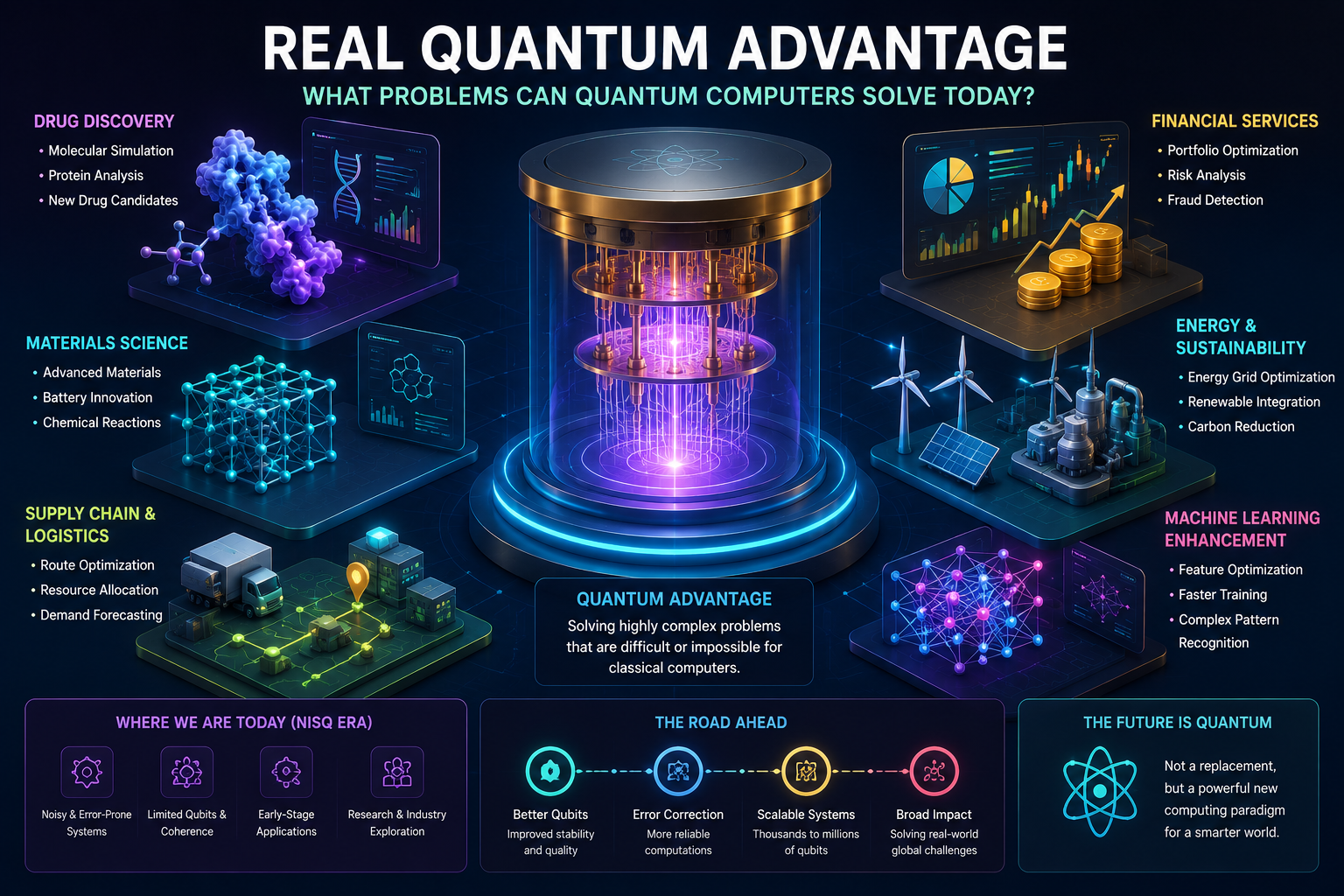
Real Quantum Advantage:
What Problems Can Quantum Computers Solve Today?
Introduction
For years, quantum computing has been surrounded by a mixture of excitement, hype, and skepticism. Headlines have promised revolutionary breakthroughs, while critics have argued that practical applications remain decades away. Somewhere between these two perspectives lies the question that business leaders, technology professionals, and curious readers continue to ask:
Can quantum computers actually solve useful problems today, or are they still experimental?
The answer is more nuanced than many people realize.
Quantum computing has not yet reached the stage where it can replace classical computers or solve every complex problem thrown at it. However, it has also moved well beyond the realm of pure scientific research. Around the world, organizations in industries such as pharmaceuticals, finance, logistics, energy, and manufacturing are already exploring real-world applications using today's quantum systems.
The debate is no longer about whether quantum computing works. The real discussion is about understanding where quantum computers can provide value today, where they cannot, and what "quantum advantage" truly means.
Understanding Quantum Advantage
Before discussing practical applications, it's important to clarify a term that is often misunderstood: quantum advantage.
Quantum advantage occurs when a quantum computer performs a specific task more efficiently than a classical computer. This does not necessarily mean solving every problem faster or replacing existing computing infrastructure.
Instead, quantum advantage is highly problem-specific.
Just as a graphics processing unit (GPU) is better than a traditional CPU for certain workloads, quantum computers excel at particular types of calculations while remaining unsuitable for others.
In other words, quantum advantage is not about building a better general-purpose computer. It is about creating a specialized tool for solving specialized problems.
This distinction is often lost in mainstream discussions about quantum technology.
The Myth of Quantum Supremacy
One of the biggest misconceptions surrounding quantum computing stems from the term "quantum supremacy."
Several years ago, the phrase gained widespread attention when researchers demonstrated that a quantum processor could perform a highly specialized calculation faster than a classical supercomputer.
While this achievement was scientifically significant, it led many people to believe that quantum computers had suddenly surpassed classical systems across the board.
That was never the case.
Quantum supremacy simply demonstrated that a quantum machine could outperform classical hardware for a carefully selected task.
It did not mean that quantum computers could immediately improve internet searches, replace data centers, or revolutionize every industry overnight.
Today, researchers increasingly prefer terms such as "quantum advantage" and "practical quantum advantage" because they better reflect the current reality of the technology.
Where Quantum Computing Stands Today
The current generation of quantum computers belongs to what researchers call the Noisy Intermediate-Scale Quantum (NISQ) era.
These machines possess enough qubits to perform meaningful experiments but still face significant limitations.
Challenges include:
- High error rates
- Limited qubit coherence times
- Noise from environmental interference
- Restricted computational depth
- Scaling difficulties
As a result, today's quantum systems cannot yet execute the large, fault-tolerant algorithms envisioned for the future.
However, they are already capable of contributing to specific research and optimization tasks.
This is where much of today's industrial activity is focused.
Real-World Use Cases Emerging Today
Despite their limitations, quantum computers are beginning to demonstrate value in several sectors.
Drug Discovery and Pharmaceutical Research
One of the most promising applications of quantum computing involves molecular simulation. Traditional computers struggle to accurately model complex molecular interactions because the computational requirements grow exponentially as molecules become more sophisticated. Quantum computers are naturally suited to representing quantum systems, making them attractive tools for pharmaceutical research.
Drug developers are investigating how quantum algorithms can help:
- Understand protein interactions
- Simulate chemical reactions
- Discover new therapeutic compounds
- Reduce research and development timelines
While fully quantum-designed medicines are still years away, early research collaborations are already showing encouraging results.
Materials Science and Chemistry
Many of the world's technological challenges depend on discovering better materials. From next-generation batteries and solar panels to superconductors and semiconductors, innovation often begins at the molecular level. Quantum computers have the potential to simulate material properties with greater accuracy than classical methods.
Researchers are exploring applications such as:
- Battery chemistry optimization
- Hydrogen fuel production
- Carbon capture materials
- Advanced manufacturing materials
Even small improvements in these areas could have enormous economic and environmental impacts.
Supply Chain and Logistics Optimization
Modern supply chains involve thousands of interconnected variables. Businesses must continuously determine delivery routes, warehouse allocation, inventory management, transportation schedules, and resource utilization. Many of these problems fall into a category known as combinatorial optimization.
Quantum-inspired algorithms and early quantum optimization techniques are already being tested to improve operational efficiency in logistics and transportation networks. While not yet transformative, these experiments are producing valuable insights for future deployment.
Financial Services and Risk Analysis
Financial institutions have shown strong interest in quantum computing due to the complexity of market behavior and portfolio management.
Potential applications include:
- Portfolio optimization
- Risk modeling
- Fraud detection
- Derivatives pricing
- Market simulation
Several banks and investment firms are already conducting pilot programs to explore how quantum computing might improve decision-making processes.
Energy and Sustainability
Energy companies are increasingly evaluating quantum computing for optimization and simulation tasks.
Potential applications include:
- Smart grid optimization
- Renewable energy forecasting
- Power distribution management
- Carbon reduction strategies
- Advanced battery development
As energy systems become more complex and decentralized, optimization challenges continue to grow. Quantum computing may offer new approaches to solving these large-scale problems.
Artificial Intelligence and Machine Learning
The relationship between quantum computing and AI is one of the hottest topics in technology today. Many people assume quantum computers will immediately make AI dramatically more powerful. The reality is more complicated.
Researchers are investigating areas such as:
- Quantum machine learning
- Data classification
- Optimization algorithms
- Feature selection
- Model training efficiency
Although practical quantum AI remains in its early stages, the intersection of these two technologies continues to attract significant investment and research attention.
What Quantum Computers Cannot Do Yet
Amid the excitement, it is important to recognize the limitations of current systems.
Today's quantum computers cannot:
Replace Classical Computers
Your laptop, smartphone, cloud server, and enterprise software systems are not about to become obsolete. Classical computers remain far superior for everyday computing tasks.
Break Modern Encryption at Scale
While future fault-tolerant quantum computers could threaten some cryptographic systems, today's machines are nowhere near capable of breaking widely used encryption standards.
Solve Every Complex Problem
Quantum computing is not a universal solution. Many tasks gain little or no benefit from quantum processing. In some cases, classical systems will always remain the more practical choice.
Why Quantum Error Correction Changes Everything
One reason practical quantum advantage remains limited today is that current systems are still prone to errors.
This is why Quantum Error Correction (QEC) has become the industry's biggest focus.
Error correction aims to create reliable logical qubits from multiple physical qubits, allowing quantum systems to perform longer and more accurate computations.
Once fault-tolerant quantum computers become available, many of the applications currently being tested in pilot programs could scale into commercially valuable solutions.
For many experts, Quantum Error Correction represents the bridge between experimental quantum computing and practical quantum advantage.
The Reality of Quantum Computing in 2026
The biggest mistake people make when evaluating quantum computing is viewing it as either a complete success or a complete failure.
The reality lies somewhere in between.
Quantum computers are not yet ready to replace classical systems, nor have they delivered the world-changing breakthroughs often portrayed in popular media.
At the same time, they are already producing valuable research outcomes, driving innovation across industries, and helping organizations prepare for the next era of computing.
Practical quantum advantage is emerging gradually rather than arriving in a single dramatic moment.
Looking Ahead
The coming years will likely determine whether quantum computing fulfills its enormous promise.
As hardware improves, error correction advances, and logical qubits become more reliable, quantum systems will move beyond experimental demonstrations toward meaningful business applications.
The organizations investing today are not necessarily expecting immediate returns.
Instead, they recognize that understanding quantum technology early may provide a significant competitive advantage when large-scale quantum computing becomes a reality.
The question is no longer whether quantum computing matters.
The question is how quickly practical quantum advantage will arrive—and which industries will benefit first.
Final Thoughts
Quantum computing remains one of the most exciting and misunderstood technologies of our time.
Despite ongoing challenges, real-world applications are beginning to emerge in areas such as drug discovery, materials science, logistics, finance, and energy. While today's systems have limitations, they are providing valuable insights into problems that may eventually be solved more effectively through quantum approaches.
The road to widespread quantum adoption is still under construction, but the foundations are already being laid.
For businesses, researchers, and technology leaders, now is the time to separate hype from reality and focus on where genuine quantum advantage is starting to take shape.
About Bitviraj Technology
Bitviraj Technology is committed to exploring the technologies shaping the future of innovation. Through expert insights on artificial intelligence, cybersecurity, cloud computing, quantum technologies, and digital transformation, we help businesses stay informed in an increasingly technology-driven world.
Case Studies
Empowering Digital
Evolution



Blogs
Empowering Digital
Evolution
BitViraj Technologies - Your Gateway to
Tomorrow's Innovations



Embark on a DigitalJourney


The next-generation digital technology company Bitviraj has the potential to empower and reinvent business in the current fast-paced market.


Our Service
- Website Development
- Application Development
- Blockchain Development
- Gaming and Metaverse