


BitViraj Technologies - Your Gateway to
Tomorrow's Innovations
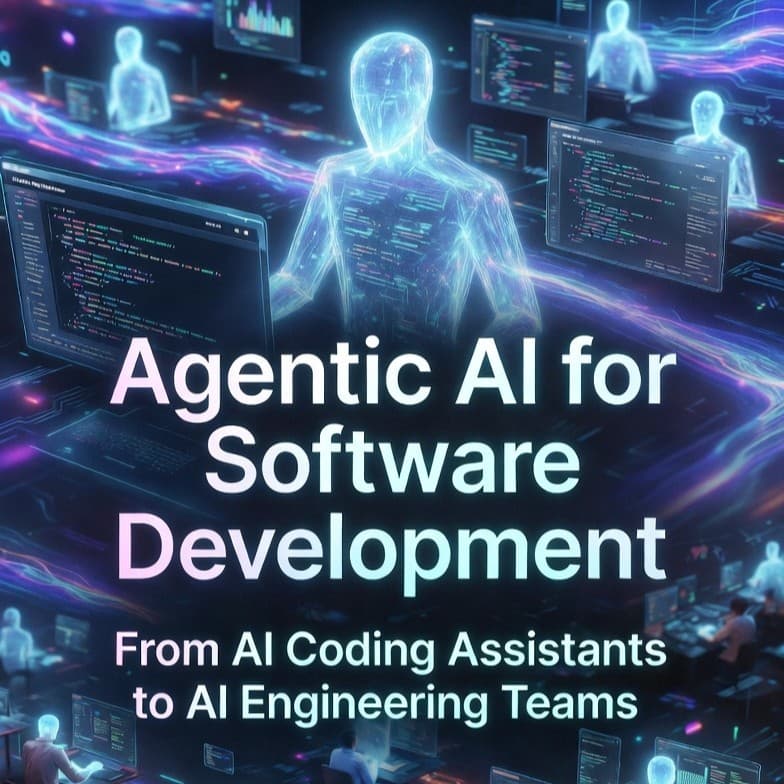
Agentic AI for Software Development
How Autonomous Coding Agents Are Reshaping Engineering Teams
Agentic AI for Software Development:
How Autonomous Coding Agents Are Reshaping Engineering Teams
From AI Coding Assistants to AI Engineering Teams
The software industry has always been shaped by automation.
From compilers and integrated development environments to cloud platforms and DevOps pipelines, every major technological shift has enabled developers to build more software with greater efficiency.
Artificial intelligence is now driving the next transformation.
Over the last few years, developers have become familiar with AI-powered coding assistants that can generate code snippets, explain functions, suggest improvements, and accelerate development tasks. These tools have already demonstrated significant productivity benefits.
However, the industry is now entering a new phase.
The future of software development is not just about AI assisting developers. It is about AI agents actively participating in the software development lifecycle.
These autonomous systems can understand requirements, write code, generate tests, review pull requests, debug issues, update documentation, and collaborate with other AI agents to complete complex engineering tasks.
This evolution is known as Agentic AI, and it has the potential to fundamentally change how software is designed, developed, tested, and maintained.
The most forward-thinking organizations are no longer asking whether AI will become part of software engineering. They are exploring how AI agents can become productive members of engineering teams.
What Is Agentic AI in Software Development?
Traditional AI coding assistants operate reactively.
A developer writes a prompt.
The AI generates a response.
The interaction ends.
Agentic AI takes a different approach.
Instead of responding to individual requests, AI agents can:
- Understand goals
- Plan tasks
- Execute actions
- Access development tools
- Monitor outcomes
- Adapt based on feedback
- Collaborate with other agents
In a software engineering environment, an AI agent can move beyond code generation and participate in entire workflows.
For example, an agent might receive a request to build a new feature.
It can then:
- Analyze requirements
- Create implementation plans
- Generate code
- Write unit tests
- Validate outputs
- Submit changes for review
- Update documentation
All with minimal human intervention.
The focus shifts from AI as a coding tool to AI as an active contributor to software delivery.
Why Software Development Is a Natural Fit for Agentic AI
Software engineering is uniquely suited for AI-driven automation.
Most development work already involves:
- Structured workflows
- Digital assets
- Defined objectives
- Tool integrations
- Measurable outcomes
These characteristics make development environments ideal for autonomous agents.
Unlike many business processes that depend heavily on human judgment and physical-world interactions, software development occurs almost entirely within digital ecosystems.
AI agents can interact directly with:
- Source code repositories
- Project management platforms
- CI/CD pipelines
- Testing frameworks
- Documentation systems
- Cloud infrastructure
This allows them to participate in engineering processes in ways that were previously impossible.
The Rise of Autonomous Coding Agents
One of the most exciting developments in Agentic AI is the emergence of autonomous coding agents.
Unlike traditional code-completion tools, autonomous coding agents can manage complete engineering tasks.
Imagine assigning a development ticket to an AI agent.
The agent could:
- Analyze requirements
- Review existing code
- Identify dependencies
- Generate implementation logic
- Create tests
- Verify functionality
- Prepare documentation
- Submit a pull request
The developer's role shifts from writing every line of code to supervising, validating, and refining AI-generated outputs.
This does not eliminate developers.
Instead, it allows them to focus on architecture, strategy, product design, and complex problem-solving.
Multi-Agent Coding Workflows
Perhaps the most transformative aspect of Agentic AI is the emergence of multi-agent software engineering workflows.
Rather than relying on a single AI system, organizations are beginning to deploy teams of specialized agents.
Each agent is responsible for a specific area of expertise.
For example:
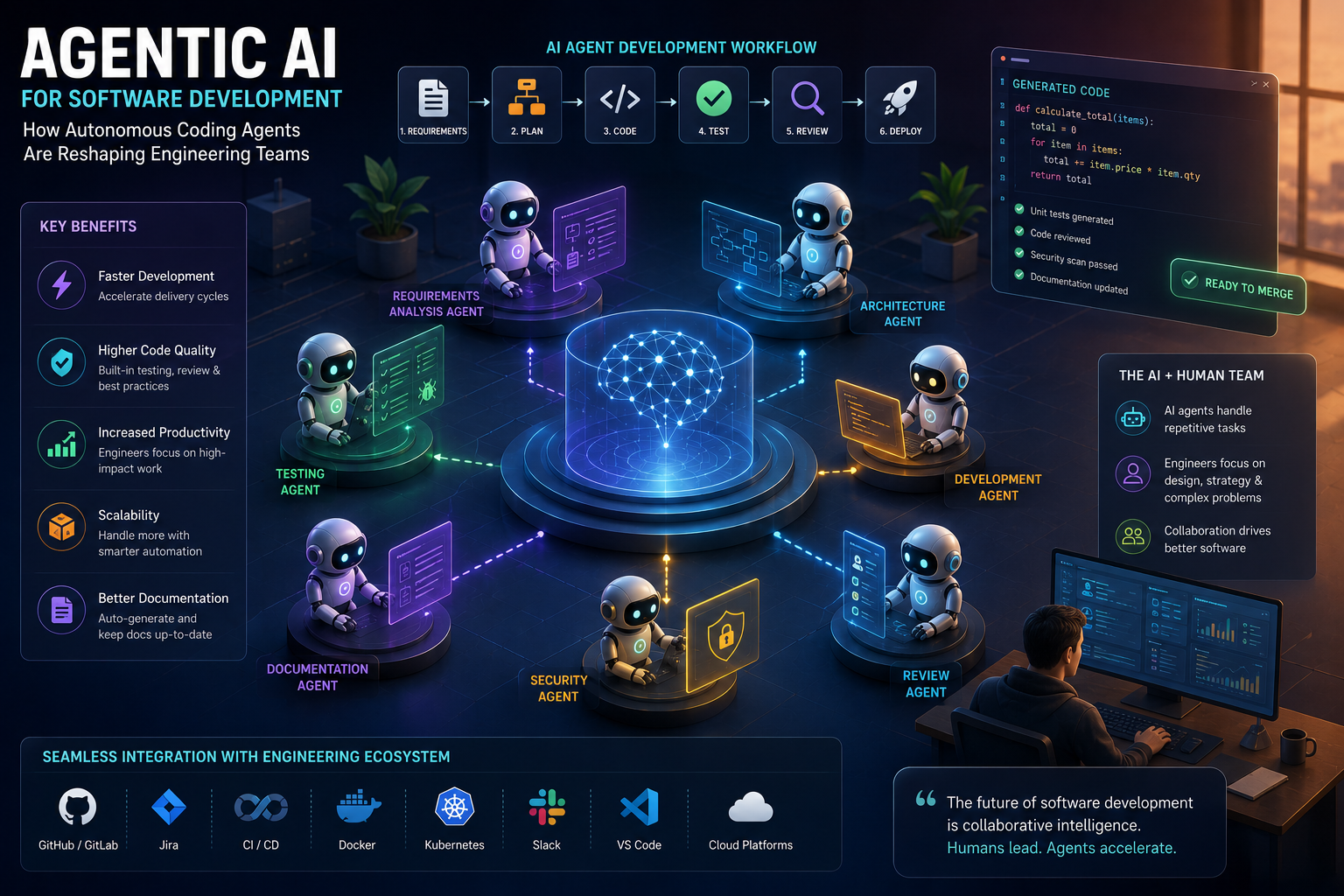
Requirements Analysis Agent – Interprets user stories and business requirements.
Architecture Agent – Designs system structures and implementation approaches.
Development Agent – Writes application code.
Testing Agent – Creates and executes automated tests.
Security Agent – Scans code for vulnerabilities and compliance risks.
Documentation Agent – Generates technical documentation and release notes.
Review Agent – Performs code reviews and quality assessments.
Together, these agents function similarly to a human engineering team.
Each contributes specialized capabilities while collaborating toward a shared objective.
How AI Engineering Teams May Operate in 2026
The concept of an AI engineering team may sound futuristic today, but many organizations are already moving in this direction.
A typical software development workflow in 2026 may look very different from today's processes.
Consider a new feature request.
A project manager submits requirements into the development platform.
An orchestration agent coordinates the workflow.
Specialized agents then:
- Analyze requirements
- Break work into tasks
- Design architecture
- Generate implementation plans
- Write code
- Run tests
- Review outputs
- Prepare deployment packages
Human engineers remain involved throughout the process, providing oversight, approvals, and strategic direction.
However, much of the repetitive implementation work becomes automated.
The result is faster delivery cycles and increased engineering productivity.
The Future of AI Pair Programming
AI pair programming has already become a familiar concept.
Many developers now work alongside AI assistants that provide real-time coding suggestions.
The next stage will be significantly more advanced.
Instead of acting as a passive assistant, AI will become an active collaborator.
Future pair programming experiences may include AI agents that:
- Proactively identify bugs
- Recommend architectural improvements
- Monitor code quality
- Generate alternative implementations
- Detect performance bottlenecks
- Suggest security enhancements
Developers will engage in ongoing collaboration rather than isolated prompt-response interactions.
The relationship will increasingly resemble working with a highly skilled engineering partner.
Benefits of Agentic AI in Software Engineering
Organizations adopting Agentic AI can unlock several strategic advantages.
Faster Development Cycles
AI agents can perform development tasks continuously, reducing delivery timelines and accelerating innovation.
Improved Code Quality
Specialized agents can enforce coding standards, generate comprehensive tests, and identify defects early in the development process.
Greater Engineering Productivity
Developers spend less time on repetitive tasks and more time solving meaningful business problems.
Enhanced Scalability
Engineering teams can handle larger workloads without proportional increases in staffing requirements.
Better Documentation
Documentation is often neglected because of time constraints. AI agents can automatically generate and maintain technical documentation throughout the development lifecycle.
Challenges Organizations Must Address
Despite its potential, Agentic AI is not without challenges.
Successful adoption requires thoughtful planning and governance.
Code Reliability
AI-generated code must be validated to ensure accuracy, maintainability, and performance.
Security Risks
Autonomous agents with access to repositories, infrastructure, and production environments require strong authorization controls.
Governance and Accountability
Organizations must establish clear oversight mechanisms for AI-generated outputs. Questions around ownership, responsibility, and approval processes remain critical.
Observability
Businesses need visibility into how agents make decisions, what changes they introduce, and how they interact with development systems. Without observability, debugging and governance become difficult.
Human Oversight
While AI agents can automate many tasks, strategic decision-making and architectural judgment still require human expertise. The goal is augmentation, not replacement.
The Evolving Role of Software Developers
One of the biggest misconceptions surrounding AI in software development is the belief that developers will become obsolete.
History suggests otherwise.
Every major advancement in development tools has increased the impact of skilled engineers rather than eliminating them.
The role of developers is evolving.
Future engineers will spend less time writing routine code and more time:
- Designing systems
- Defining requirements
- Reviewing AI-generated outputs
- Managing agent workflows
- Solving complex business challenges
- Ensuring security and compliance
The most successful developers will be those who learn how to collaborate effectively with AI agents.
Why Agentic AI Represents a Fundamental Shift
The software industry is moving beyond simple AI assistance.
We are entering an era where autonomous agents can contribute meaningfully across the entire software development lifecycle.
This shift is comparable to the rise of cloud computing, DevOps, or agile methodologies.
Organizations that embrace Agentic AI early will gain significant advantages in speed, productivity, and innovation.
Those that ignore the trend risk falling behind competitors that can deliver software faster and more efficiently.
The future of software engineering will not be defined by humans or AI working independently.
It will be defined by intelligent collaboration between both.
Conclusion
Agentic AI is transforming software development from a human-centered activity supported by tools into a collaborative ecosystem where humans and autonomous agents work together to build better software.
From autonomous coding agents and multi-agent development workflows to AI engineering teams and advanced pair programming experiences, the possibilities are expanding rapidly. While challenges around security, governance, and reliability remain important, the potential benefits are too significant to ignore.
The future of software engineering is not about replacing developers. It is about empowering them with intelligent agents capable of accelerating innovation, improving quality, and reducing operational complexity.
Organizations that begin preparing for this future today will be best positioned to lead tomorrow's digital economy.
Bitviraj Technology helps businesses leverage Agentic AI, autonomous development workflows, intelligent automation, and AI-powered engineering solutions to accelerate software delivery while maintaining security, governance, and quality. Our expertise enables organizations to build the next generation of software development ecosystems with confidence.
Case Studies
Empowering Digital
Evolution



Blogs
Empowering Digital
Evolution
BitViraj Technologies - Your Gateway to
Tomorrow's Innovations



Embark on a DigitalJourney


The next-generation digital technology company Bitviraj has the potential to empower and reinvent business in the current fast-paced market.


Our Service
- Website Development
- Application Development
- Blockchain Development
- Gaming and Metaverse