

BitViraj Technologies - Your Gateway to
Tomorrow's Innovations
Post-Quantum Cryptography: Are We Ready for Q-Day?
For decades, modern cybersecurity has relied on a simple assumption: certain mathematical problems are so difficult that even the world's most powerful computers would need thousands—or even millions—of years to solve them. That assumption has protected everything from online banking and e-commerce transactions to government communications, healthcare records, and cloud infrastructure.
Post-Quantum Cryptography
Are We Ready for Q-Day?
Introduction
For decades, modern cybersecurity has relied on a simple assumption: certain mathematical problems are so difficult that even the world's most powerful computers would need thousands—or even millions—of years to solve them.
That assumption has protected everything from online banking and e-commerce transactions to government communications, healthcare records, and cloud infrastructure.
But what happens when a new type of computer emerges that can solve those problems dramatically faster?
This is the question driving one of the most important cybersecurity conversations of our time.
As quantum computing advances, governments, enterprises, and security experts around the world are preparing for a future event often referred to as Q-Day—the moment when quantum computers become powerful enough to break widely used public-key cryptographic systems.
While Q-Day has not arrived yet, the preparations are already underway.
Organizations that wait until quantum computers become a threat may find themselves years behind in securing their data.
So what exactly is Q-Day, why are cybersecurity experts concerned, and how can businesses prepare?
Let's take a closer look.
What Is Q-Day?
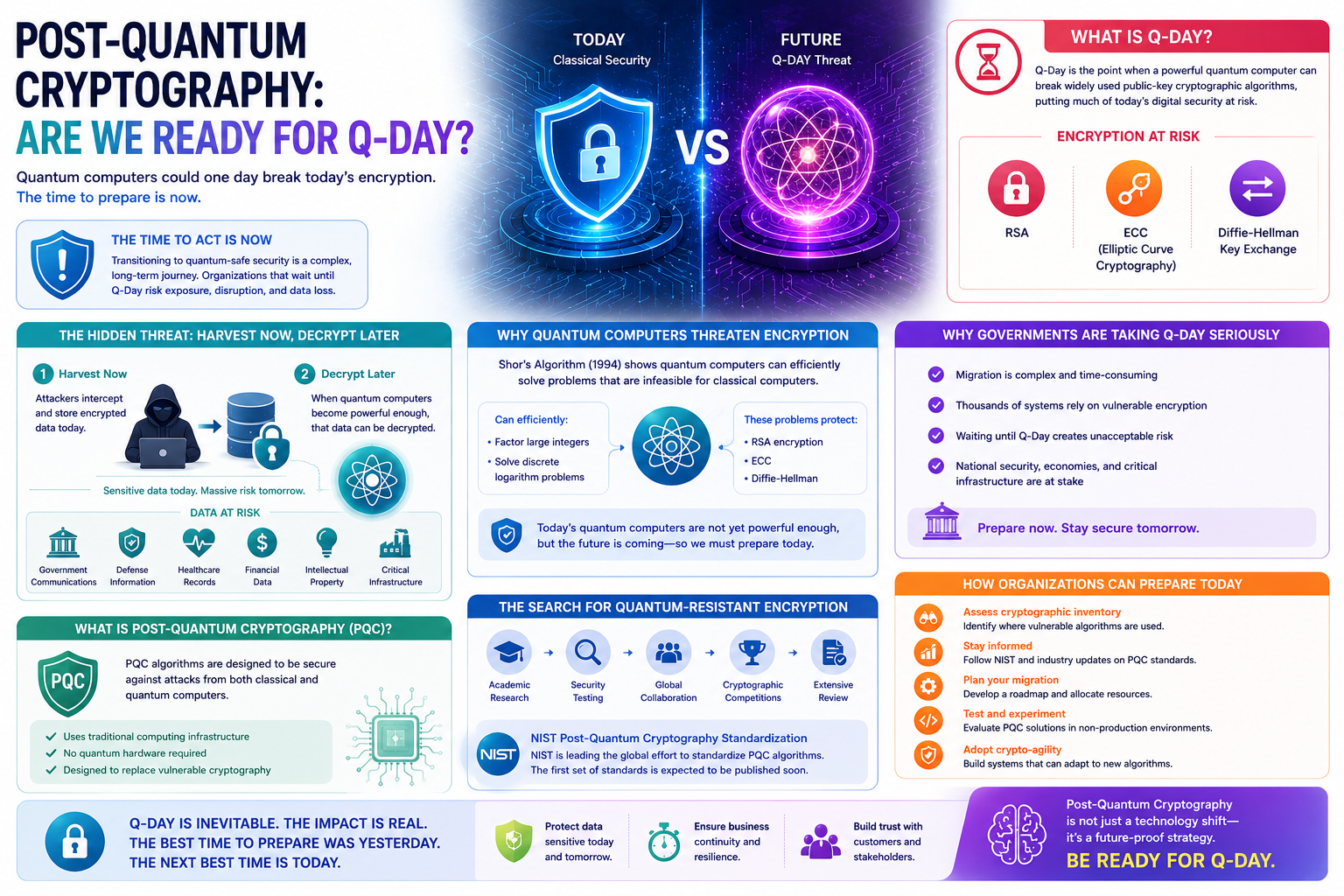
Q-Day is a term used to describe the point at which a sufficiently powerful quantum computer can break cryptographic algorithms that currently secure much of the internet and the digital economy.
Today's security infrastructure relies heavily on encryption methods such as:
- RSA
- Elliptic Curve Cryptography (ECC)
- Diffie-Hellman key exchange
These systems are considered secure because classical computers cannot efficiently solve the mathematical problems on which they are based.
For example, RSA encryption depends on the difficulty of factoring extremely large numbers.
With conventional computing technology, factoring these numbers would take an impractical amount of time.
Quantum computers, however, could change the equation.
A future fault-tolerant quantum computer running advanced algorithms may be capable of solving these problems much faster than classical machines.
When that capability becomes practical at scale, many of today's encryption systems could become vulnerable.
That moment is what cybersecurity professionals call Q-Day.
Why Quantum Computers Threaten Current Encryption
The concern stems largely from a quantum algorithm developed by mathematician and computer scientist Peter Shor in 1994.
Known as Shor's Algorithm, it demonstrated that a sufficiently powerful quantum computer could efficiently solve certain mathematical problems that are extremely difficult for classical systems.
Most importantly, it could:
- Factor large integers
- Solve discrete logarithm problems
These are the foundational problems behind many of today's public-key cryptographic systems.
If large-scale fault-tolerant quantum computers become available, encryption methods currently trusted by governments, banks, corporations, and internet users could potentially be broken.
It is important to emphasize that today's quantum computers cannot yet perform these attacks.
However, experts believe the transition to quantum-safe security must begin long before the threat becomes operational.
The Hidden Threat: Harvest Now, Decrypt Later
One of the biggest reasons organizations are accelerating their migration efforts is a strategy known as Harvest Now, Decrypt Later (HNDL).
The concept is surprisingly simple.
An attacker intercepts and stores encrypted data today, even if they cannot currently read it.
Years later, when more powerful quantum computers become available, that same data could potentially be decrypted.
This creates a serious risk for information that remains sensitive over long periods.
Examples include:
- Government communications
- Defense information
- Healthcare records
- Financial data
- Intellectual property
- Trade secrets
- Critical infrastructure information
Even if Q-Day arrives ten years from now, data stolen today could still be valuable.
This is why many cybersecurity experts view the threat as a present-day challenge rather than a future problem.
Why Governments Are Taking Q-Day Seriously
Governments around the world are investing heavily in quantum preparedness.
National cybersecurity agencies increasingly recognize that transitioning cryptographic infrastructure is a complex process that can take years.
Large organizations often operate thousands of systems, applications, databases, and communication networks that rely on encryption.
Replacing cryptographic standards across such environments cannot happen overnight.
Many governments are therefore encouraging organizations to begin planning and migration efforts well before large-scale quantum computers become available.
The goal is straightforward:
Prepare before the threat arrives rather than react after it appears.
What Is Post-Quantum Cryptography?
Post-Quantum Cryptography (PQC) refers to cryptographic algorithms designed to remain secure against attacks from both classical and quantum computers.
Unlike quantum cryptography, which relies on quantum mechanics for security, post-quantum cryptography uses traditional computing infrastructure while employing mathematical problems believed to resist quantum attacks.
This distinction is important.
Organizations do not need quantum computers to implement post-quantum cryptography.
Most PQC solutions can run on existing hardware, making migration more practical.
The challenge lies in identifying algorithms that are secure, efficient, and suitable for widespread deployment.
The Search for Quantum-Resistant Encryption
For years, cryptographers worldwide have been working to develop and evaluate algorithms capable of withstanding future quantum attacks.
The process has involved:
- Academic research
- Security testing
- International collaboration
- Cryptographic competitions
- Extensive peer review
The objective has been to create encryption standards that can protect digital systems long after quantum computers become powerful enough to threaten existing methods.
This effort has led to some of the most significant developments in modern cybersecurity.
NIST's Role in the Post-Quantum Transition
One of the most influential organizations in this effort has been the National Institute of Standards and Technology (NIST).
NIST launched a multi-year initiative to evaluate and standardize quantum-resistant cryptographic algorithms.
The process involved researchers from around the world proposing, testing, and challenging candidate algorithms under intense scrutiny.
The objective was not simply to find algorithms that work, but to identify solutions capable of becoming global security standards.
This initiative is widely regarded as one of the most important cryptographic projects of the modern era.
NIST-Approved Quantum-Resistant Algorithms
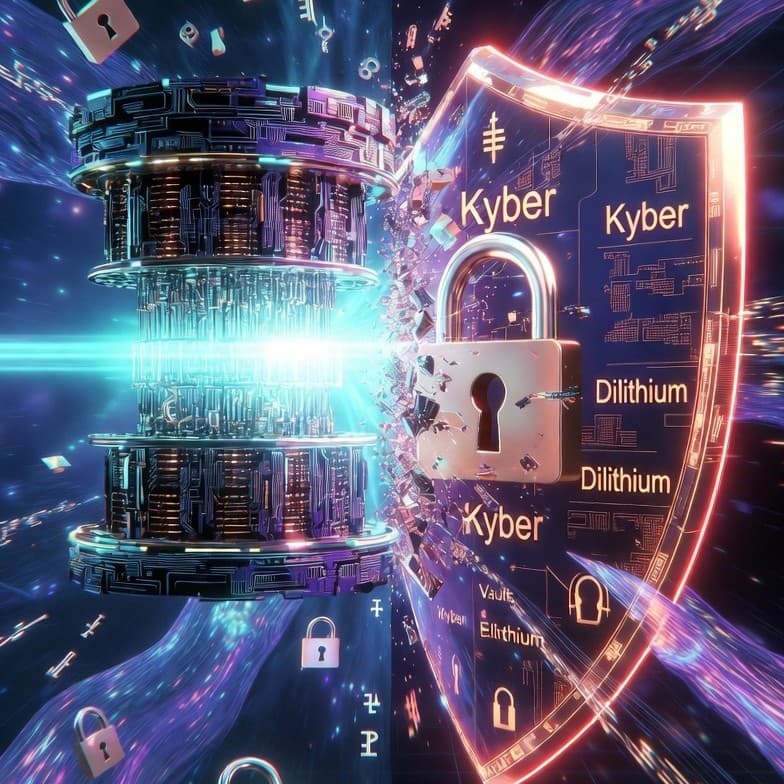
CRYSTALS-Kyber
CRYSTALS-Kyber is designed for secure key establishment and encryption. It is considered one of the primary replacements for current public-key encryption systems.
Its advantages include:
- Strong security properties
- Efficient performance
- Practical implementation across a wide range of devices
Many organizations view Kyber as a cornerstone of future quantum-safe communications.
CRYSTALS-Dilithium
CRYSTALS-Dilithium focuses on digital signatures. Digital signatures are essential for software updates, secure communications, identity verification, and document authentication.
Dilithium has become one of the leading candidates for replacing current signature schemes that may eventually become vulnerable to quantum attacks.
SPHINCS+
SPHINCS+ provides an alternative approach to quantum-resistant digital signatures. Although it may require larger signatures than some competing methods, it offers additional diversity within the post-quantum cryptographic ecosystem.
Many security experts consider algorithm diversity an important safeguard against unforeseen vulnerabilities.
Industries Most Affected by Q-Day
Virtually every sector that depends on digital security will be impacted by the transition.
However, some industries face greater urgency than others.
Financial Services
Banks, payment systems, and investment firms rely heavily on cryptographic security. Long-term data confidentiality is critical.
Healthcare
Medical records often remain sensitive for decades. Harvest-now-decrypt-later attacks represent a serious concern.
Government and Defense
National security communications require protection far beyond current technology cycles.
Critical Infrastructure
Power grids, transportation systems, telecommunications networks, and industrial control systems increasingly depend on secure digital communications.
Technology and Cloud Providers
Large-scale cloud environments support billions of users and countless encrypted transactions daily. The migration challenge is substantial.
Common Misconceptions About Q-Day
As interest in quantum computing grows, several misconceptions continue to circulate.
"Quantum Computers Will Break Everything Overnight"
The transition is unlikely to happen suddenly. Q-Day will probably be preceded by years of progress in quantum hardware, error correction, and fault-tolerant computing. Organizations will have opportunities to prepare.
"Post-Quantum Cryptography Requires Quantum Computers"
It doesn't. Most PQC solutions run on traditional computing infrastructure.
"The Threat Is Decades Away"
No one knows exactly when Q-Day will occur. However, the harvest-now-decrypt-later threat means organizations cannot afford to ignore the issue simply because large-scale quantum computers are not yet available.
What Organizations Should Be Doing Today
Preparation begins with visibility.
Organizations should identify:
- Where cryptography is being used
- Which systems depend on vulnerable algorithms
- How sensitive data is stored and transmitted
- Which assets require long-term protection
Many experts recommend adopting a strategy known as crypto-agility.
Crypto-agility allows systems to transition more easily between cryptographic standards as new threats and technologies emerge.
The organizations that begin planning now will likely face fewer disruptions later.
Are We Ready for Q-Day?
The honest answer is: not entirely.
The cybersecurity community has made remarkable progress in developing quantum-resistant algorithms and preparing for the future. Governments, standards organizations, technology providers, and enterprises are actively working toward a quantum-safe ecosystem.
Yet much work remains.
Migrating global digital infrastructure is one of the largest cybersecurity transitions ever attempted. It will require coordination across industries, governments, software vendors, hardware manufacturers, and cloud providers.
The good news is that the industry is no longer asking whether Q-Day will matter.
The focus has shifted to ensuring that when it arrives, the world is ready.
Final Thoughts
Quantum computing has the potential to reshape industries, accelerate scientific discovery, and solve problems beyond the reach of classical computers. At the same time, it introduces new cybersecurity challenges that cannot be ignored.
Q-Day may still be years away, but the preparation window is already open. The rise of harvest-now-decrypt-later threats and the development of quantum-resistant encryption standards have made post-quantum cryptography one of the most important technology initiatives of the decade.
For organizations that depend on digital trust—and that includes virtually every modern business—the question is no longer whether to prepare for the quantum era.
The question is how quickly they can begin.
About Bitviraj Technology
Bitviraj Technology explores the technologies shaping the future of digital innovation, including artificial intelligence, cybersecurity, cloud computing, quantum technologies, and emerging technology trends. Our mission is to help businesses and technology professionals stay informed, secure, and ready for the next wave of technological transformation.
Case Studies
Empowering Digital
Evolution



Blogs
Empowering Digital
Evolution
BitViraj Technologies - Your Gateway to
Tomorrow's Innovations



Embark on a DigitalJourney


The next-generation digital technology company Bitviraj has the potential to empower and reinvent business in the current fast-paced market.


Our Service
- Website Development
- Application Development
- Blockchain Development
- Gaming and Metaverse