



BitViraj Technologies - Your Gateway to
Tomorrow's Innovations
AI-Powered Digital Forensics
Automating Cyber Investigations
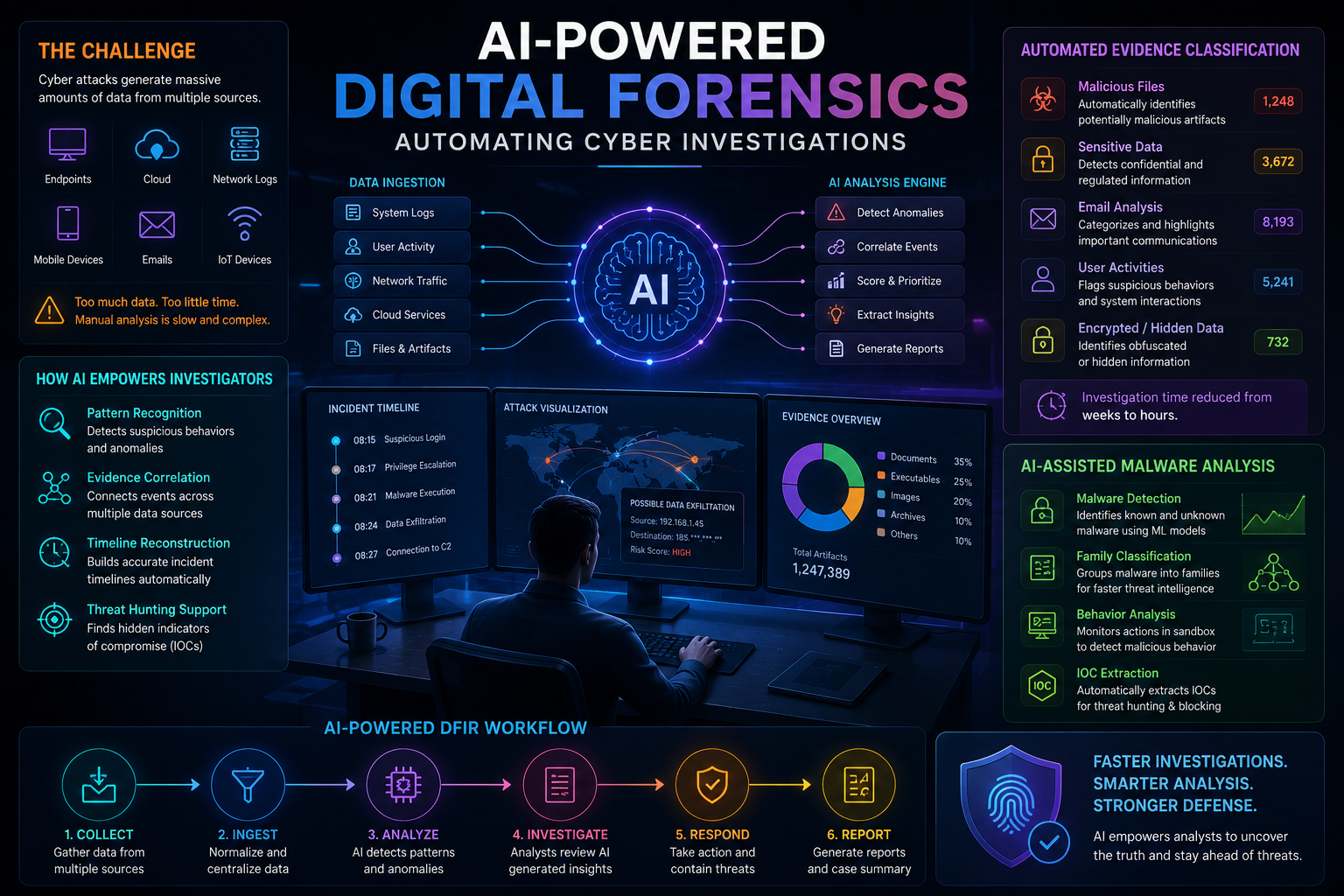
AI-Powered Digital Forensics:
Automating Cyber Investigations
Introduction
Cybercrime is evolving at an unprecedented pace. From sophisticated ransomware campaigns to advanced persistent threats (APTs), modern attacks generate massive amounts of digital evidence that investigators must analyze under tight deadlines. Traditional digital forensic methods, while effective, often struggle to keep up with the sheer volume and complexity of today's cyber incidents.
This is where Artificial Intelligence (AI) is transforming the field of Digital Forensics and Incident Response (DFIR). By automating repetitive tasks, accelerating evidence analysis, and uncovering hidden patterns, AI is helping forensic investigators work faster, more accurately, and at a scale that was previously impossible.
In this article, we'll explore how AI is reshaping digital forensics, its role in evidence classification and malware analysis, and what the future of AI-powered DFIR workflows looks like.
The Growing Challenges in Digital Forensics
Modern investigations involve analyzing data from multiple sources, including:
Computers & Servers
Mobile Devices
Cloud Environments
Network Traffic Logs
IoT Devices
Email Communications
Security Monitoring Systems
A single cybersecurity incident can generate terabytes of data. Manually reviewing every file, log entry, and system artifact can take days or even weeks. Delays in investigations can increase business losses, prolong system downtime, and allow attackers to cover their tracks.
Organizations need smarter approaches that reduce investigation time without compromising accuracy. AI is emerging as one of the most valuable tools to address this challenge.
How AI Assists Forensic Investigators
AI does not replace forensic experts; it enhances their capabilities.
Machine learning algorithms can rapidly process large datasets and identify patterns that might be difficult for human analysts to detect. Instead of spending countless hours sorting through data, investigators can focus on interpreting findings and making strategic decisions.
Key Areas Where AI Supports Investigations
1. Pattern Recognition
AI can identify suspicious behaviors across systems, such as unusual login activities, privilege escalation attempts, data exfiltration patterns, and abnormal file modifications. These indicators often help investigators pinpoint the timeline and scope of an attack more quickly.
2. Correlation of Evidence
Cyber incidents leave traces across multiple platforms. AI can correlate evidence from endpoint logs, firewall records, email systems, cloud services, and SIEM platforms. This creates a unified view of the incident, reducing manual effort and improving accuracy.
3. Timeline Reconstruction
Building an accurate timeline is a crucial forensic task. AI-powered systems can automatically sequence events based on timestamps, user activities, and system interactions, helping investigators understand exactly what happened and when.
4. Threat Hunting Support
AI continuously analyzes historical and real-time data to identify indicators of compromise (IOCs) that may otherwise go unnoticed.
Automated Evidence Classification
One of the most time-consuming stages of digital forensics is evidence categorization. Investigators often need to review thousands or even millions of files.
AI-powered evidence classification significantly accelerates this process.
What Is Automated Evidence Classification?
Automated evidence classification uses machine learning models to sort and categorize digital artifacts based on their content, metadata, and behavioral characteristics.
Examples include:
- Identifying potentially malicious files
- Detecting sensitive documents
- Categorizing email communications
- Flagging suspicious user activities
- Recognizing encrypted or hidden data
Faster Investigations
Instead of manually examining every artifact, investigators can focus on high-priority evidence identified by AI systems.
Reduced Human Error
Large datasets increase the likelihood of overlooked evidence. AI helps ensure consistency across investigations.
Improved Prioritization
Critical evidence can be automatically ranked based on risk level and relevance.
Scalability
AI systems can analyze millions of files in significantly less time than traditional methods.
For organizations dealing with large-scale incidents, automated classification can reduce investigation timelines from weeks to hours.
AI-Assisted Malware Analysis
Malware analysis is another area where AI is making a substantial impact.
Traditional malware analysis often requires extensive reverse engineering and manual examination. As malware variants continue to multiply, analysts face increasing challenges in identifying threats quickly.
AI introduces automation into several stages of malware analysis.
Malware Detection
Machine learning models can identify malicious code based on behavioral patterns, execution characteristics, network activity, and code structures. Even previously unseen malware variants can sometimes be detected through anomaly-based analysis.
Malware Family Classification
AI can automatically group malware samples into families by analyzing similarities in behavior and code characteristics. This helps investigators understand attacker tactics, identify known threat actors, and apply existing remediation strategies.
Dynamic Behavior Analysis
AI-powered sandboxes monitor how malware behaves in controlled environments. The system can automatically identify registry modifications, process injections, network communications, persistence mechanisms, and credential theft attempts.
Accelerated Threat Intelligence
AI can compare malware indicators against vast threat intelligence databases, helping organizations quickly determine whether a threat is part of a known attack campaign.
Benefits of AI in DFIR Operations
Faster Incident Response
Rapid analysis enables security teams to contain threats before they spread further.
Enhanced Accuracy
AI can identify correlations and anomalies that may be difficult for humans to detect manually.
Cost Efficiency
Automation reduces the number of labor-intensive tasks, allowing forensic teams to focus on higher-value activities.
Improved Decision-Making
Investigators gain actionable insights faster, enabling more informed response strategies.
Better Resource Utilization
AI handles repetitive tasks while human experts focus on complex analysis and legal considerations.
Challenges and Limitations
Despite its advantages, AI is not a perfect solution.
Organizations should be aware of several challenges:
False Positives
AI systems may occasionally flag legitimate activities as suspicious.
Training Data Quality
Machine learning models are only as effective as the data used to train them.
Explainability Issues
Some AI models operate as "black boxes," making it difficult to understand how specific conclusions were reached.
Legal and Compliance Concerns
Forensic evidence must often meet strict legal standards. Investigators must ensure AI-assisted findings remain transparent and defensible.
Because of these factors, AI should be viewed as a support tool rather than a replacement for skilled forensic professionals.
The Future of DFIR Workflows
The future of Digital Forensics and Incident Response will likely be defined by deeper integration between AI, automation, and human expertise.
Several trends are already emerging:
Autonomous Investigation Assistants
AI-powered assistants will guide analysts through investigations, recommend next steps, and automatically gather relevant evidence.
Predictive Forensics
Future systems may identify attack patterns before major incidents occur, enabling proactive defense measures.
Intelligent Case Management
AI will help prioritize cases, allocate resources, and automate documentation processes.
Continuous Monitoring and Investigation
Instead of reacting after incidents occur, organizations will maintain continuous forensic visibility across endpoints, networks, and cloud environments.
Integration with Security Operations Centers (SOCs)
AI-driven forensic platforms will become tightly integrated with detection and response systems, creating faster and more coordinated incident response workflows.
Conclusion
Artificial Intelligence is rapidly transforming digital forensics from a largely manual discipline into a highly automated and intelligence-driven process. By assisting investigators with evidence classification, malware analysis, pattern recognition, and incident correlation, AI significantly improves the speed and effectiveness of cyber investigations.
However, successful digital forensics will continue to rely on a balance between advanced technology and human expertise. While AI can process enormous volumes of data and uncover hidden insights, experienced investigators remain essential for interpreting evidence, validating findings, and making critical decisions.
As cyber threats continue to grow in sophistication, organizations that embrace AI-powered DFIR capabilities will be better positioned to investigate incidents, reduce response times, and strengthen their overall cybersecurity posture.
At Bitviraj Technology, we believe that the future of cybersecurity lies in combining intelligent automation with expert-driven security practices to build resilient and proactive digital defense strategies.
Case Studies
Empowering Digital
Evolution



Blogs
Empowering Digital
Evolution
BitViraj Technologies - Your Gateway to
Tomorrow's Innovations




Embark on a DigitalJourney


The next-generation digital technology company Bitviraj has the potential to empower and reinvent business in the current fast-paced market.


Our Service
- Website Development
- Application Development
- Blockchain Development
- Gaming and Metaverse