


BitViraj Technologies - Your Gateway to
Tomorrow's Innovations
AI Agent Security and Authorization
Protecting Autonomous Systems in the Age of Agentic AI
AI Agent Security and Authorization:
Protecting Autonomous Systems in the Age of Agentic AI
Why Security Has Become the Defining Challenge of Enterprise AI
For years, organizations focused on making artificial intelligence smarter.
Today, the conversation has shifted.
The question is no longer whether AI can generate content, answer questions, or automate workflows. Modern AI agents can already do these things with remarkable effectiveness. The real challenge now is determining how to deploy autonomous AI safely inside enterprise environments.
As organizations embrace Agentic AI, security has emerged as one of the fastest-growing concerns among technology leaders. CIOs, CISOs, compliance teams, and boards of directors are increasingly asking a critical question:
Can we trust AI agents with access to our business systems, sensitive data, and operational processes?
The concern is valid.
Unlike traditional software applications, AI agents can make decisions, access resources, execute actions, and interact with multiple systems with minimal human intervention. While this autonomy creates enormous business value, it also introduces entirely new security risks.
A compromised AI agent is no longer just a software issue—it can become a business risk, a compliance risk, and a reputational risk.
As enterprises move from experimentation to large-scale deployment, security and authorization must become foundational pillars of every Agentic AI strategy.
The Expanding Attack Surface of Agentic AI
Traditional enterprise applications typically operate within clearly defined boundaries.
AI agents are different.
To perform useful work, they often require access to:
- Business applications
- Customer databases
- Internal knowledge repositories
- APIs
- Cloud platforms
- Communication systems
- Third-party tools
Modern agents are designed to interact with multiple environments simultaneously.
An AI-powered customer support agent may retrieve customer information from a CRM platform, access company policies from a knowledge base, generate responses using a language model, and update support tickets in real time.
Every connection introduces another potential security exposure.
The more capable an agent becomes, the larger its attack surface grows.
This reality is forcing organizations to rethink how security should be designed for autonomous systems.
Why Traditional Security Models Are No Longer Enough
Most enterprise security frameworks were built around human users and conventional software applications.
AI agents do not fit neatly into either category.
Unlike traditional applications, agents can dynamically determine actions based on context.
Unlike employees, agents can perform thousands of operations every hour without fatigue.
This creates a unique challenge.
Organizations must answer questions such as:
- What systems should an AI agent access?
- What actions should it be allowed to perform?
- How should permissions be enforced?
- How can unauthorized behavior be detected?
- What happens if an agent is manipulated?
Traditional authentication mechanisms alone cannot answer these questions.
A new security model is required—one designed specifically for autonomous AI systems.
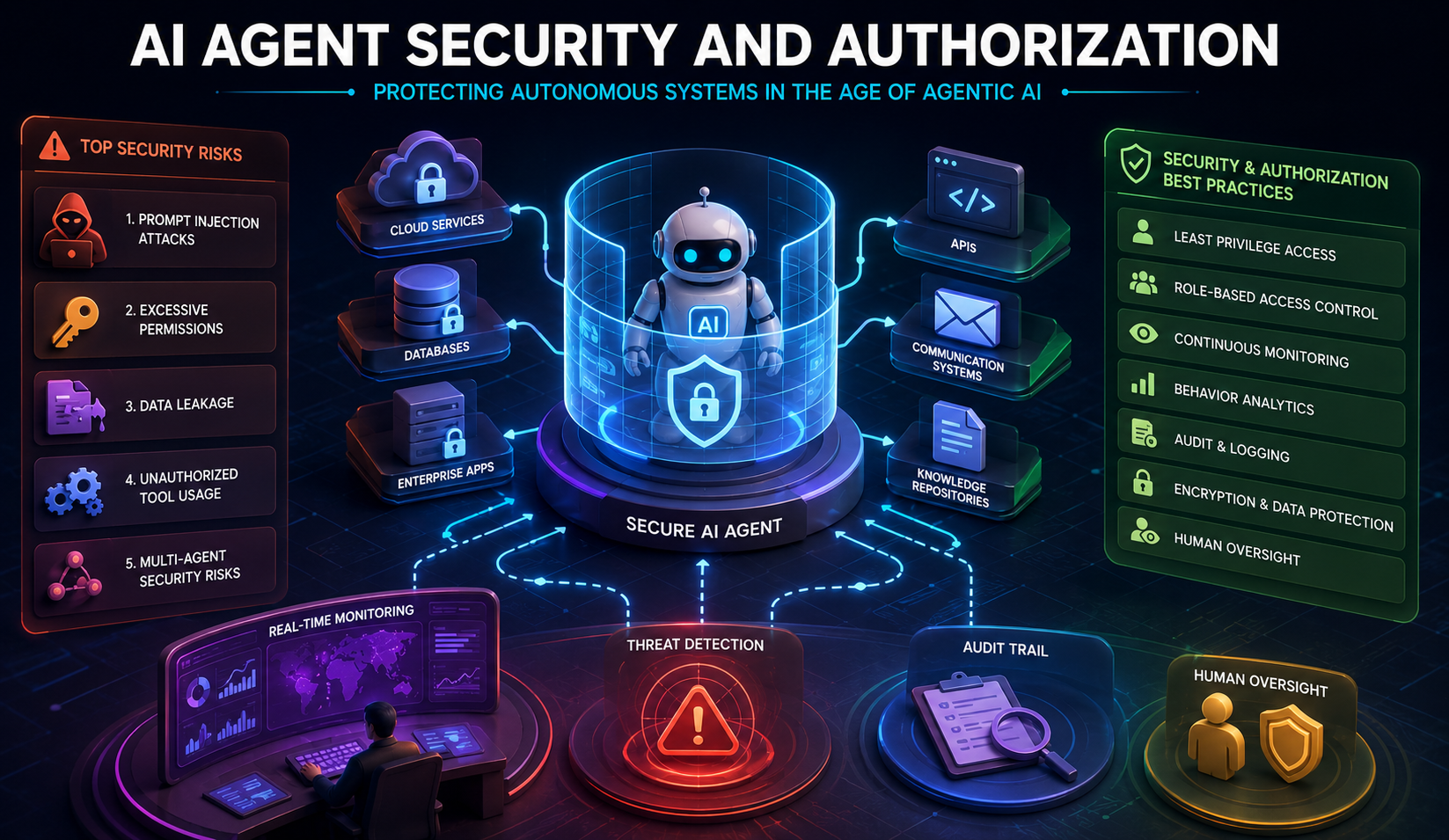
The Biggest Security Risks in Agentic AI
Before implementing safeguards, organizations must understand the most significant threats facing AI agents.
1. Prompt Injection Attacks
Prompt injection has quickly become one of the most discussed risks in Agentic AI.
In a prompt injection attack, malicious instructions are embedded within content that an AI agent processes.
For example:
An agent may be instructed to analyze emails, documents, web pages, or customer messages.
An attacker can hide commands inside that content designed to manipulate the agent's behavior.
Instead of performing its intended task, the agent may:
- Ignore established rules
- Reveal sensitive information
- Execute unauthorized actions
- Access restricted resources
Prompt injection effectively targets the decision-making process of the AI itself.
This makes it fundamentally different from traditional cybersecurity attacks.
2. Excessive Permissions
Many organizations unintentionally give AI agents broader access than necessary.
This often occurs during development when convenience takes priority over security.
For example, an agent that only needs read access to customer records may be granted administrative privileges across an entire system.
If the agent is compromised or behaves unexpectedly, the consequences become far more severe.
Excessive permissions remain one of the most common security weaknesses in enterprise AI deployments.
3. Data Leakage
AI agents frequently interact with sensitive business information.
Examples include:
- Customer records
- Financial data
- Employee information
- Intellectual property
- Strategic documents
Without appropriate controls, agents may expose confidential information through generated outputs, external integrations, or unintended interactions.
Data leakage risks increase significantly when agents access multiple systems simultaneously.
4. Unauthorized Tool Usage
Modern AI agents often connect to external tools and services.
These tools may include:
- Databases
- APIs
- Email platforms
- Workflow systems
- File repositories
If authorization controls are weak, agents may execute actions beyond their intended responsibilities.
Unauthorized tool usage can lead to operational disruptions, security incidents, and compliance violations.
5. Multi-Agent Security Risks
As organizations deploy multiple collaborating agents, security challenges become even more complex.
One compromised agent can potentially influence others within a workflow.
This creates opportunities for:
- False information propagation
- Unauthorized task execution
- Workflow manipulation
- Cascading failures
Security must therefore be designed for entire agent ecosystems rather than individual agents alone.
Understanding AI Agent Authorization
Authentication answers one question:
Who are you?
Authorization answers a different question:
What are you allowed to do?
For AI agents, authorization is arguably more important than authentication.
An authenticated agent with excessive permissions remains a security risk.
Effective authorization frameworks establish clear boundaries around agent behavior.
These frameworks define:
- Accessible systems
- Approved actions
- Data permissions
- Operational limits
- Escalation requirements
Authorization transforms AI agents from unrestricted actors into controlled participants within enterprise environments.
Building an AI Agent Authorization Framework
Organizations deploying Agentic AI should establish a dedicated authorization strategy rather than relying solely on traditional access management models.
Principle of Least Privilege
Every AI agent should receive only the permissions required to perform its assigned responsibilities.
If an agent only needs to read data, it should not have modification privileges.
If it only performs analysis, it should not be authorized to execute transactions.
Limiting permissions significantly reduces risk.
Role-Based Access Controls
Organizations should define standardized roles for AI agents.
Examples include:
- Research Agent
- Customer Support Agent
- Finance Agent
- Operations Agent
- Compliance Agent
Each role should have predefined permissions aligned with business requirements.
This approach improves consistency and simplifies governance.
Action-Level Authorization
Access controls should extend beyond system permissions.
Organizations should define which specific actions an agent can perform.
For example:
An HR agent may:
- View employee records
- Schedule interviews
- Generate reports
But it may not:
- Modify payroll data
- Approve compensation changes
- Access executive personnel files
Granular authorization provides stronger protection against misuse.
Human Approval Gates
Certain actions should require explicit human authorization.
Examples include:
- Large financial transactions
- Contract approvals
- Customer compensation decisions
- Regulatory submissions
Human oversight creates an additional layer of protection for high-risk operations.
Securing MCP-Based AI Agents
As organizations adopt AI agent ecosystems, the Model Context Protocol (MCP) is becoming increasingly important.
MCP enables AI agents to connect with external tools, applications, databases, and services through a standardized framework.
While MCP improves interoperability, it also creates new security considerations.
Organizations implementing MCP-based architectures should focus on:
- Tool Validation: Agents should only connect to approved and verified tools.
- Context Isolation: Sensitive information should remain separated across environments when appropriate.
- Permission Enforcement: Each MCP-connected resource should enforce its own authorization policies.
- Request Verification: Every request between agents and connected systems should be authenticated and validated.
- Activity Monitoring: Organizations should continuously monitor MCP interactions for anomalies and unauthorized behavior.
The security model must extend beyond the AI model itself and encompass every connected component.
Preventing Prompt Injection in Autonomous Agents
Prompt injection attacks are rapidly becoming one of the most significant challenges in Agentic AI security.
While no defense is perfect, organizations can significantly reduce risk through layered protections.
Separate Instructions from Data
Agents should clearly distinguish operational instructions from external content.
External information should never automatically override system-level directives.
Limit High-Risk Actions
Agents should not be able to perform sensitive operations solely based on external prompts.
Additional verification mechanisms should be required.
Validate Inputs
Organizations should inspect incoming content for suspicious patterns and potentially malicious instructions.
Input validation remains a critical defense mechanism.
Implement Human Oversight
High-impact decisions should include human review processes whenever appropriate.
Human oversight remains one of the most effective safeguards against manipulation.
Continuously Test Agent Behavior
Security teams should actively evaluate agents through adversarial testing and simulated attack scenarios.
Testing helps identify vulnerabilities before attackers do.
Why Monitoring and Auditability Matter
Security does not end after deployment.
Organizations must continuously monitor AI agents in production environments.
Effective monitoring should provide visibility into:
- Decisions made
- Actions executed
- Data accessed
- Tools utilized
- Policy violations
- Security anomalies
Comprehensive audit trails help organizations answer critical questions:
- What happened?
- Why did it happen?
- Which systems were affected?
- Was the action authorized?
Without monitoring and auditability, organizations cannot effectively manage AI-related risks.
The Future of AI Security
The next generation of enterprise AI will involve thousands of autonomous agents operating across business functions.
These agents will:
- Access enterprise systems
- Collaborate with one another
- Execute transactions
- Support strategic decisions
As autonomy increases, security will become a defining factor in successful AI adoption.
The organizations that thrive will not necessarily be those deploying the most AI.
They will be the organizations that build secure, governed, and trustworthy AI ecosystems.
Security will evolve from a technical requirement into a competitive advantage.
Conclusion
Agentic AI is creating unprecedented opportunities for automation, productivity, and innovation. However, autonomy without security introduces significant risks that organizations cannot afford to ignore.
From prompt injection attacks and excessive permissions to data leakage and unauthorized actions, AI agents require a new approach to security and authorization.
The future of enterprise AI depends on more than intelligence. It depends on trust.
By implementing robust authorization frameworks, enforcing least-privilege access, securing MCP integrations, monitoring agent behavior, and maintaining strong governance practices, organizations can confidently scale AI adoption while protecting their most valuable assets.
Bitviraj Technology helps enterprises design, deploy, and secure AI agent ecosystems with enterprise-grade security, authorization controls, observability, and governance. Our solutions enable organizations to unlock the full potential of Agentic AI while maintaining the highest standards of security, compliance, and operational trust.
Case Studies
Empowering Digital
Evolution



Blogs
Empowering Digital
Evolution
BitViraj Technologies - Your Gateway to
Tomorrow's Innovations



Embark on a DigitalJourney


The next-generation digital technology company Bitviraj has the potential to empower and reinvent business in the current fast-paced market.


Our Service
- Website Development
- Application Development
- Blockchain Development
- Gaming and Metaverse