

BitViraj Technologies - Your Gateway to
Tomorrow's Innovations
How Quantum Computing Could Revolutionize Drug Discovery
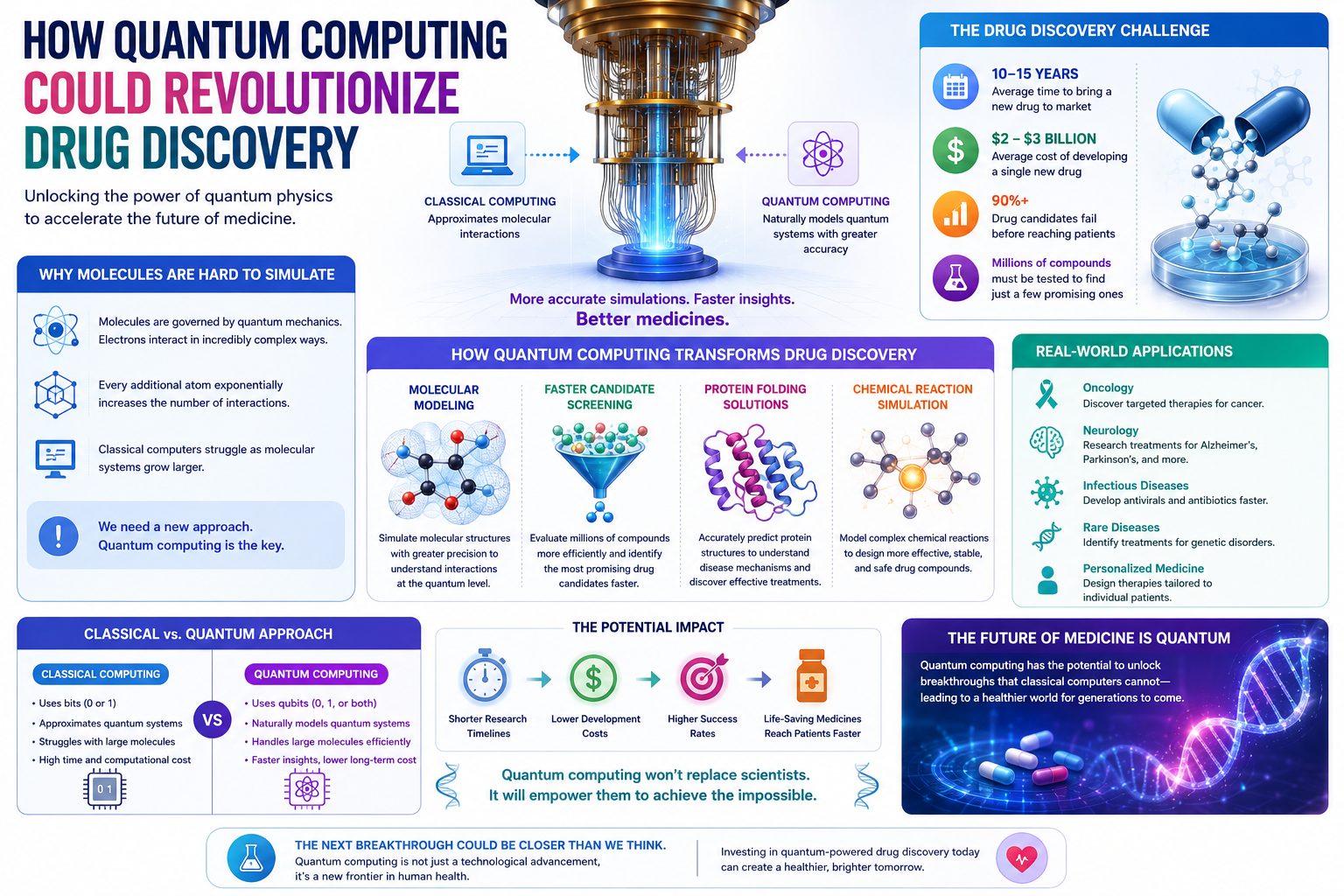
Developing a new medicine is one of the most difficult, expensive, and time-consuming challenges in modern science. On average, bringing a new drug from the laboratory to the market can take more than a decade and cost billions of dollars. Even after years of research and testing, most drug candidates never make it to pharmacy shelves. Scientists must analyze countless molecular interactions, predict biological responses, and identify promising compounds among millions of possibilities.

How Quantum Computing Could Revolutionize Drug Discovery
By Bitviraj Technology
Introduction
Developing a new medicine is one of the most difficult, expensive, and time-consuming challenges in modern science.
On average, bringing a new drug from the laboratory to the market can take more than a decade and cost billions of dollars. Even after years of research and testing, most drug candidates never make it to pharmacy shelves. Scientists must analyze countless molecular interactions, predict biological responses, and identify promising compounds among millions of possibilities.
Despite advances in artificial intelligence, supercomputing, and biotechnology, drug discovery remains a complex puzzle.
This is where quantum computing enters the conversation.
For years, quantum computing was viewed as a futuristic technology with theoretical potential but few practical applications. Today, however, researchers increasingly believe that healthcare and pharmaceuticals may become among the first industries to benefit from large-scale quantum computing.
Why?
Because the fundamental challenge of drug discovery is, at its core, a quantum problem.
Molecules, atoms, and chemical reactions all behave according to the laws of quantum mechanics. Traditional computers can approximate these behaviors, but they often struggle as molecular complexity increases. Quantum computers, on the other hand, are designed to operate using the same principles that govern the natural world.
This unique capability could fundamentally change how medicines are discovered, developed, and delivered.
The Drug Discovery Challenge
Before understanding the role of quantum computing, it's important to appreciate why drug development is so difficult.
A single disease may involve thousands of biological interactions occurring simultaneously inside the human body.
Researchers must answer questions such as:
- Which molecules can target a disease effectively?
- How will a drug interact with proteins?
- What side effects might occur?
- How stable is the compound?
- Can it be manufactured efficiently?
Every answer requires extensive experimentation and computational analysis.
Traditional computers help scientists model these interactions, but as molecular systems grow larger, calculations become exponentially more difficult.
In many cases, researchers must rely on approximations because exact simulations would require unrealistic amounts of computing power.
This limitation slows innovation and increases development costs.
Why Molecules Are So Difficult to Simulate
Molecules may appear simple on paper, but their behavior is extraordinarily complex.
Electrons move around atomic nuclei according to quantum mechanical principles. The interactions between these particles determine:
- Chemical properties
- Molecular stability
- Drug effectiveness
- Biological activity
The problem is that every additional atom dramatically increases the number of possible interactions that must be analyzed.
Even the world's most powerful supercomputers struggle to simulate larger molecules with complete accuracy.
Scientists often describe this as one of the greatest computational challenges in chemistry.
Quantum computers offer a fundamentally different approach.
Instead of approximating quantum systems, they can represent and model them more naturally.
Why Quantum Computing Is Different
Classical computers process information using bits that exist as either 0 or 1.
Quantum computers use qubits, which can exist in multiple states simultaneously through a phenomenon called superposition.
Combined with quantum entanglement, this allows quantum systems to process certain types of information far more efficiently than traditional computers.
When applied to chemistry and pharmaceutical research, quantum computers could potentially simulate molecular interactions at a level of detail that is currently impossible.
This capability has generated enormous interest across the healthcare industry.
The Promise of Molecular Modeling
One of the most exciting applications of quantum computing is molecular modeling.
Molecular modeling involves creating digital representations of molecules and predicting how they behave under different conditions.
Today, pharmaceutical companies spend years conducting simulations and laboratory experiments to identify promising drug candidates.
Quantum computing could dramatically improve this process.
More Accurate Simulations
Researchers could model molecular structures with greater precision than current computational methods allow.
This would help scientists:
- Understand chemical reactions
- Predict molecular behavior
- Identify promising compounds faster
- Reduce costly trial-and-error experiments
The result could be a more efficient drug development pipeline.
Faster Candidate Screening
Modern drug discovery often involves screening millions of compounds to identify a handful worth testing.
Quantum algorithms may eventually accelerate this process by evaluating molecular interactions more efficiently.
Instead of testing vast numbers of possibilities blindly, researchers could focus on candidates with the highest probability of success.
Solving the Protein Folding Puzzle
Another area where quantum computing could have a significant impact is protein folding.
Proteins are essential biological molecules that perform countless functions within the human body.
A protein's function depends heavily on its three-dimensional shape.
Determining how proteins fold is incredibly challenging because each protein can adopt an enormous number of possible configurations.
Understanding protein folding is critical for:
- Drug design
- Disease research
- Genetic disorders
- Cancer treatment
- Neurodegenerative diseases
Why Protein Folding Matters
Many diseases occur when proteins fold incorrectly.
Conditions such as:
- Alzheimer's disease
- Parkinson's disease
- Huntington's disease
have been linked to abnormal protein behavior.
The ability to accurately model protein folding could help researchers understand these diseases more effectively and develop targeted treatments.
Quantum Computing's Potential Role
Quantum computers may eventually simulate protein dynamics at a level beyond the reach of classical systems.
Although significant challenges remain, researchers believe quantum simulation could provide deeper insights into how proteins interact, fold, and malfunction.
This could accelerate the development of therapies for some of the world's most difficult medical conditions.
Quantum Computing and Precision Medicine
Healthcare is increasingly moving toward personalized treatment strategies.
Rather than prescribing the same treatment to every patient, researchers aim to develop therapies tailored to individual biological characteristics.
Quantum computing could contribute by helping scientists analyze:
- Genetic variations
- Molecular interactions
- Drug responses
- Personalized treatment pathways
By improving our understanding of biological complexity, quantum systems may support more precise and effective medical interventions.
Real Partnerships Between Pharma and Quantum Companies
The pharmaceutical industry's interest in quantum computing is no longer theoretical.
Several major healthcare organizations have already formed partnerships with quantum technology providers.
These collaborations focus on exploring how quantum systems might accelerate research and improve drug discovery workflows.
Roche and Quantum Computing Research
Healthcare companies have investigated quantum approaches to molecular simulation and computational chemistry as part of broader innovation initiatives. The goal is to identify areas where quantum algorithms may eventually outperform classical methods.
AstraZeneca and Quantum Collaborations
Global pharmaceutical organizations have partnered with quantum computing researchers to explore applications in chemistry, drug design, and biological modeling. These partnerships reflect growing confidence that quantum technologies could become valuable research tools.
Biogen and Quantum Research Initiatives
Researchers are examining how quantum simulation may contribute to understanding neurological diseases and complex biological systems. Although commercial applications remain in development, the interest from leading pharmaceutical organizations continues to grow.
Quantum Technology Providers
Several quantum companies are actively collaborating with pharmaceutical researchers, including organizations working on molecular simulation, computational chemistry, optimization problems, and drug candidate discovery. These partnerships represent an important step toward practical applications.
Current Limitations and Challenges
Despite the excitement, it is important to remain realistic.
Quantum computing has not yet revolutionized drug discovery.
Several challenges still need to be overcome.
Hardware Limitations
Today's quantum computers remain relatively small and prone to errors. Researchers continue working toward fault-tolerant systems capable of handling larger and more complex simulations.
Quantum Error Correction
Reliable quantum computations require sophisticated error correction techniques. Significant progress has been made, but large-scale fault-tolerant quantum computing remains under development.
Integration with Existing Workflows
Pharmaceutical companies have invested heavily in classical computing infrastructure. Future quantum systems will likely complement rather than replace existing technologies. Hybrid approaches combining AI, high-performance computing, and quantum computing are expected to become increasingly important.
Why Many Experts Remain Optimistic
Despite current limitations, few application areas generate as much excitement as drug discovery.
The reason is simple:
The value proposition is enormous.
Imagine reducing drug development timelines by years.
Imagine identifying promising compounds faster and more accurately.
Imagine accelerating treatments for cancer, rare diseases, Alzheimer's, or antibiotic-resistant infections.
Even modest improvements could save billions of dollars and improve millions of lives.
This potential explains why governments, pharmaceutical companies, and technology firms continue investing heavily in quantum research.
What Could Happen Between 2026 and 2030?
Over the next several years, researchers are expected to focus on demonstrating practical quantum advantages in chemistry and molecular science.
Potential milestones include:
- Improved molecular simulations
- More advanced protein modeling
- Enhanced computational chemistry workflows
- Hybrid quantum-classical drug discovery platforms
- Stronger collaboration between pharmaceutical and quantum companies
While fully quantum-designed drugs may still be years away, meaningful progress is likely during this period.
The Bigger Picture
Quantum computing is often discussed in terms of faster calculations or more powerful computers.
However, its true significance may lie in its ability to solve problems that have remained beyond the reach of traditional computing methods.
Drug discovery is one of those problems.
The pharmaceutical industry faces enormous computational challenges that directly impact human health. By enabling more accurate molecular simulations and deeper insights into biological systems, quantum computing could transform how medicines are developed.
The technology is not yet mature enough to deliver all of its promises.
But for researchers seeking new ways to fight disease, accelerate innovation, and improve patient outcomes, quantum computing represents one of the most exciting frontiers in modern science.
Final Thoughts
The future of drug discovery may not be defined by larger laboratories or faster traditional computers. It may be shaped by machines that operate according to the same quantum principles that govern the molecules scientists are trying to understand.
Quantum computing offers the possibility of simulating complex biological systems with unprecedented accuracy, potentially transforming molecular modeling, protein research, and pharmaceutical development.
Although significant challenges remain, the growing collaboration between quantum technology companies and pharmaceutical organizations suggests that the journey has already begun.
The next breakthrough medicine may not come from a laboratory alone.
It may come from a quantum computer.
About Bitviraj Technology
Bitviraj Technology explores the technologies driving the future of innovation, including artificial intelligence, cybersecurity, cloud computing, quantum technologies, and digital transformation. Our mission is to help businesses and technology professionals understand the breakthroughs shaping tomorrow's world.
Case Studies
Empowering Digital
Evolution



Blogs
Empowering Digital
Evolution
BitViraj Technologies - Your Gateway to
Tomorrow's Innovations




Embark on a DigitalJourney


The next-generation digital technology company Bitviraj has the potential to empower and reinvent business in the current fast-paced market.


Our Service
- Website Development
- Application Development
- Blockchain Development
- Gaming and Metaverse