



BitViraj Technologies - Your Gateway to
Tomorrow's Innovations
Blockchain Forensics
Tracking Cybercriminals Through Cryptocurrency
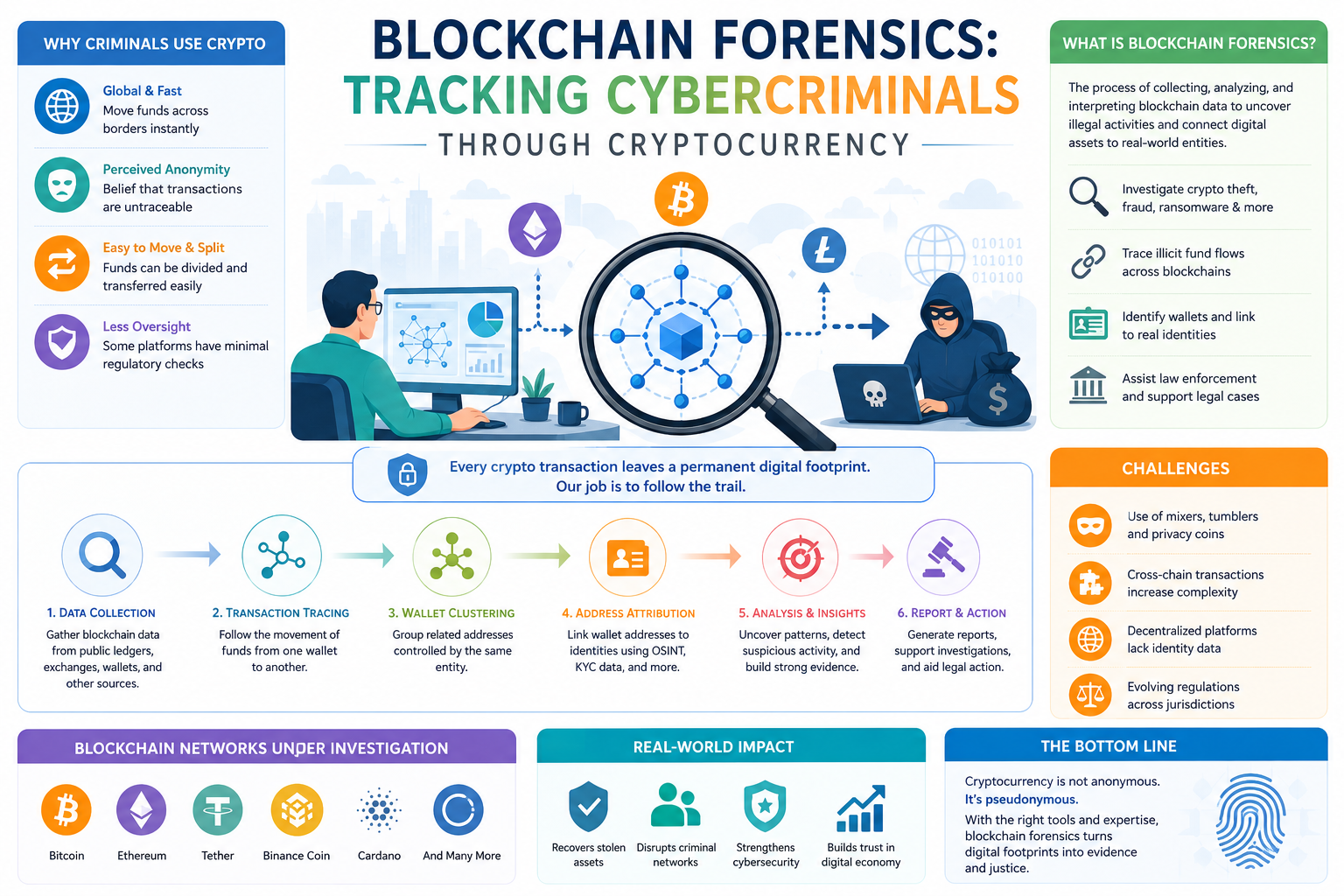
Blockchain Forensics:
Tracking Cybercriminals Through Cryptocurrency
Introduction
Cryptocurrency has transformed the global financial landscape by enabling fast, borderless, and decentralized transactions. While digital currencies such as Bitcoin, Ethereum, and other blockchain-based assets have created new opportunities for innovation, they have also attracted cybercriminals seeking alternative methods to move and hide illicit funds.
From ransomware attacks and phishing campaigns to darknet marketplaces and fraud schemes, cryptocurrency has become a common component of modern cybercrime. However, contrary to popular belief, cryptocurrency transactions are not entirely anonymous. Every transaction recorded on a blockchain leaves a permanent digital footprint.
This is where blockchain forensics plays a critical role. By analyzing blockchain transactions and tracing the flow of digital assets, investigators can uncover criminal networks, identify suspicious activity, and assist law enforcement agencies in bringing cybercriminals to justice.
In this article, we explore the fundamentals of blockchain forensics, how investigators track cryptocurrency transactions, the challenges involved, and why this discipline has become an essential part of modern cybersecurity investigations.
Understanding Blockchain and Cryptocurrency Transactions
Before exploring blockchain forensics, it is important to understand how blockchain technology works.
A blockchain is a distributed ledger that records transactions across a decentralized network of computers. Each transaction is stored in a block, which is linked to previous blocks, creating an immutable chain of records.
Key characteristics of blockchain transactions include:
- Transparency
- Immutability
- Decentralization
- Public accessibility (for most blockchains)
Every cryptocurrency transaction contains information such as:
- Sender wallet address
- Recipient wallet address
- Transaction amount
- Timestamp
- Transaction hash
Although wallet addresses do not directly reveal personal identities, all transaction records remain permanently visible on the blockchain. This transparency creates opportunities for forensic investigators to trace financial activity.
What Is Blockchain Forensics?
Blockchain forensics is the process of collecting, analyzing, and interpreting blockchain data to investigate cryptocurrency-related activities.
The primary objective is to connect blockchain transactions to real-world entities, individuals, organizations, or criminal operations.
Blockchain forensic investigations typically focus on:
- Cryptocurrency theft
- Ransomware payments
- Fraud investigations
- Money laundering activities
- Terrorism financing investigations
- Insider threats
- Asset recovery efforts
Unlike traditional financial investigations that rely heavily on banking records, blockchain investigations utilize publicly available transaction data combined with intelligence from multiple external sources.
Why Cybercriminals Use Cryptocurrency
Cybercriminals are increasingly adopting cryptocurrencies for several reasons.
Fast Cross-Border Transactions
Cryptocurrency allows funds to move globally without relying on traditional banking systems.
Reduced Regulatory Oversight
Some cryptocurrency platforms operate with limited compliance requirements, making them attractive to criminals.
Perceived Anonymity
Many individuals mistakenly believe cryptocurrency transactions cannot be traced.
Ease of Distribution
Digital assets can be quickly divided, transferred, and exchanged across multiple wallets.
However, the transparency of blockchain networks often works against cybercriminals. Every movement of funds creates a trail that investigators can follow.
How Blockchain Forensics Tracks Cryptocurrency Activity
Blockchain forensic investigations involve a combination of data analytics, cybersecurity expertise, and investigative techniques.
Transaction Tracing
The most fundamental technique is tracing the movement of cryptocurrency from one wallet address to another.
Investigators analyze:
- Transaction histories
- Fund flows
- Wallet relationships
- Transaction timing patterns
By following the path of funds, investigators can often identify where stolen or illicit cryptocurrency has been transferred.
Wallet Clustering
Cybercriminals frequently control multiple wallet addresses.
Blockchain forensic tools use behavioral analysis and transaction patterns to group related wallet addresses into clusters that likely belong to the same individual or organization.
Wallet clustering helps investigators build a broader picture of criminal networks.
Address Attribution
One of the most important goals of blockchain forensics is linking wallet addresses to real-world identities.
Investigators use:
- Exchange records
- Open-source intelligence (OSINT)
- Dark web monitoring
- Social media analysis
- KYC (Know Your Customer) data
When a suspect transfers cryptocurrency through a regulated exchange, investigators may obtain records that connect blockchain activity to an individual.
Following the Money Trail
Just as traditional investigators follow bank transfers, blockchain analysts track cryptocurrency as it moves through:
- Exchanges
- Payment processors
- Mixing services
- DeFi platforms
- Cross-chain bridges
Even when criminals attempt to obscure transactions, traces often remain visible across the blockchain ecosystem.
Blockchain Forensics in Ransomware Investigations
Ransomware has become one of the most common cyber threats worldwide.
Attackers typically demand payment in cryptocurrency because they believe it offers anonymity and quick access to funds.
Blockchain forensics has become a valuable tool in ransomware response.
Investigators can:
- Trace ransom payments
- Identify connected wallets
- Monitor movement of stolen funds
- Detect cash-out attempts
- Link attacks to known threat groups
In some cases, authorities have successfully recovered portions of ransomware payments after tracking cryptocurrency transactions through the blockchain.
This capability has significantly improved the effectiveness of cybercrime investigations.
Investigating Cryptocurrency Money Laundering
Money laundering remains one of the biggest challenges in the cryptocurrency ecosystem.
Criminals often attempt to hide transaction origins through techniques such as:
Mixing Services
Cryptocurrency mixers combine funds from multiple users to make transaction tracing more difficult.
Chain Hopping
Attackers move funds between different cryptocurrencies to obscure transaction histories.
Layering Transactions
Funds are transferred repeatedly across numerous wallets to create complexity.
Decentralized Finance Platforms
Some criminals use decentralized exchanges and lending protocols to complicate investigations.
Despite these tactics, advanced blockchain analytics platforms can often reconstruct transaction flows and identify suspicious patterns.
Tools Used in Blockchain Forensics
Modern blockchain investigations rely on specialized analytics platforms.
These solutions help investigators:
- Visualize transaction networks
- Identify wallet relationships
- Detect suspicious activities
- Monitor high-risk addresses
- Generate investigative reports
Many platforms use machine learning and graph analysis to uncover hidden connections within large transaction datasets.
Combined with threat intelligence and cybersecurity expertise, these tools significantly enhance investigative capabilities.
Challenges in Blockchain Investigations
While blockchain transparency provides valuable evidence, investigators still face several challenges.
Privacy-Focused Cryptocurrencies
Certain cryptocurrencies are specifically designed to enhance user privacy and reduce transaction visibility. These networks can complicate forensic investigations.
Cross-Chain Transactions
Criminals increasingly move assets across multiple blockchain networks, requiring investigators to analyze data from various ecosystems.
Rapid Technological Evolution
The cryptocurrency landscape evolves quickly, introducing new technologies and techniques that investigators must continuously learn.
Global Jurisdiction Issues
Cryptocurrency transactions often cross international borders, creating legal and regulatory complexities. Successful investigations frequently require cooperation between law enforcement agencies, exchanges, and cybersecurity experts across multiple countries.
The Future of Blockchain Forensics
As cryptocurrency adoption continues to grow, blockchain forensics will become increasingly important.
Several trends are shaping the future of the field:
AI-Powered Blockchain Analytics
Artificial intelligence is helping investigators analyze massive transaction datasets more efficiently and identify suspicious patterns faster.
Real-Time Transaction Monitoring
Organizations are adopting systems capable of detecting risky cryptocurrency activity as it occurs.
Enhanced Regulatory Compliance
Governments worldwide are introducing stricter regulations for cryptocurrency exchanges and service providers.
Integration with Cyber Threat Intelligence
Blockchain analytics is becoming a key component of broader cybersecurity investigations, allowing analysts to connect financial activity with cyberattack campaigns.
Improved Asset Recovery
Advanced tracing techniques are increasing the likelihood of recovering stolen cryptocurrency and disrupting criminal operations.
Why Blockchain Forensics Matters for Organizations
Businesses are becoming increasingly exposed to cryptocurrency-related risks.
Whether facing ransomware attacks, fraud attempts, insider threats, or regulatory compliance requirements, organizations need the ability to investigate digital asset transactions effectively.
Blockchain forensics provides:
- Greater visibility into cryptocurrency activity
- Faster incident response capabilities
- Improved fraud detection
- Better regulatory compliance
- Stronger cybercrime investigations
Organizations that develop blockchain investigation capabilities are better positioned to manage emerging threats in the digital economy.
Conclusion
The misconception that cryptocurrency transactions are completely anonymous has been repeatedly disproven. While cybercriminals continue to leverage digital assets for illegal activities, the transparent nature of blockchain technology often leaves behind valuable evidence.
Blockchain forensics has emerged as a powerful discipline that enables investigators to trace cryptocurrency transactions, uncover criminal networks, support ransomware investigations, and assist in recovering stolen assets. By combining blockchain analytics, cybersecurity expertise, and investigative intelligence, organizations and law enforcement agencies can effectively track illicit financial activity across the digital ecosystem.
As cyber threats continue to evolve, blockchain forensics will play an increasingly important role in strengthening cybersecurity operations and protecting organizations from financial and reputational harm.
At Bitviraj Technology, we recognize that the future of cyber investigations extends beyond traditional digital evidence. As cryptocurrency adoption grows, blockchain forensic capabilities will become essential for detecting, investigating, and mitigating modern cyber threats in an increasingly decentralized world.
Case Studies
Empowering Digital
Evolution



Blogs
Empowering Digital
Evolution
BitViraj Technologies - Your Gateway to
Tomorrow's Innovations



Embark on a DigitalJourney


The next-generation digital technology company Bitviraj has the potential to empower and reinvent business in the current fast-paced market.


Our Service
- Website Development
- Application Development
- Blockchain Development
- Gaming and Metaverse