

BitViraj Technologies - Your Gateway to
Tomorrow's Innovations
AI-Powered DAOs: Can Communities Govern Themselves?
The internet has transformed the way we communicate, work, and build businesses. Now, it's reshaping something even more fundamental—how organizations make decisions. Imagine a company with no CEO, no boardroom meetings, and no centralized authority. Instead, every important decision is made collectively by the community, supported by transparent rules and intelligent automation.

AI-Powered DAOs
Can Communities Govern Themselves?
Introduction
The internet has transformed the way we communicate, work, and build businesses. Now, it's reshaping something even more fundamental—how organizations make decisions. Imagine a company with no CEO, no boardroom meetings, and no centralized authority. Instead, every important decision is made collectively by the community, supported by transparent rules and intelligent automation.
This isn't science fiction. It's the promise of AI-powered Decentralized Autonomous Organizations (DAOs).
As blockchain technology matures and artificial intelligence becomes more capable, these two innovations are beginning to intersect. Together, they're creating a new model of digital governance that could redefine how online communities, startups, investment groups, and even social organizations operate.
But can communities truly govern themselves? And what role should AI play in those decisions?
Let's explore.
Understanding DAOs: More Than Just Blockchain Buzzwords
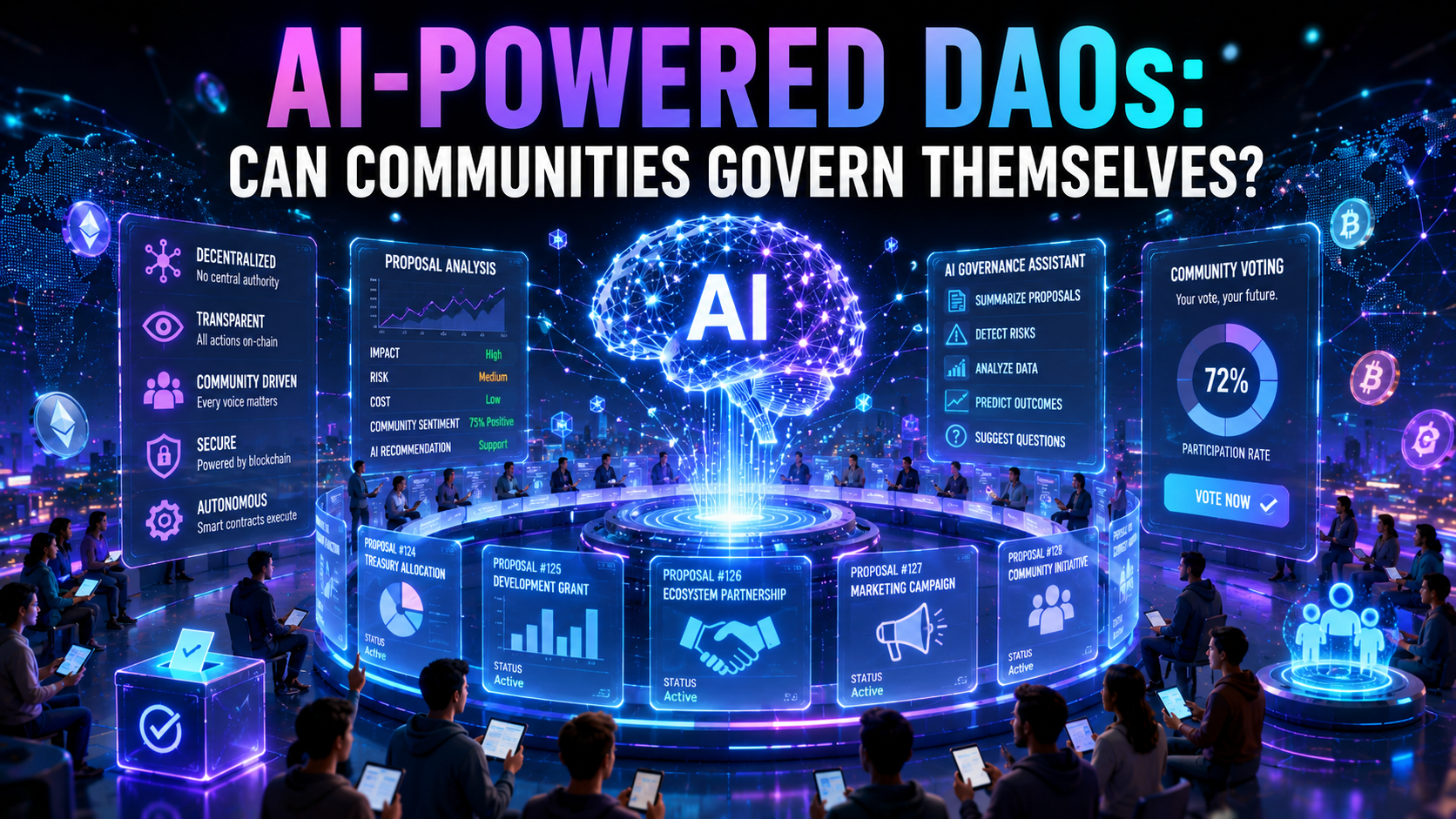
A Decentralized Autonomous Organization, commonly known as a DAO, is an organization governed by code rather than traditional management structures.
Instead of executives making decisions behind closed doors, members vote on proposals. These voting rights are often linked to governance tokens, giving participants a direct voice in how the organization evolves.
Every decision, transaction, and proposal is recorded on the blockchain, making the entire process transparent and difficult to manipulate.
This model offers several advantages:
- Greater transparency
- Community-driven decision making
- Reduced bureaucracy
- Global participation
- Automated execution through smart contracts
However, DAOs also face significant challenges.
Large communities generate hundreds of proposals. Members often lack the time or expertise to evaluate every decision. Participation rates can decline over time, leading to governance fatigue.
This is where artificial intelligence enters the conversation.
How AI Is Changing DAO Governance
Artificial intelligence doesn't replace community members—it helps them make better decisions.
Instead of manually reviewing lengthy governance proposals, AI systems can summarize documents, identify risks, analyze financial impacts, and even predict possible outcomes based on historical data.
Imagine receiving a governance proposal that spans 40 pages.
Rather than expecting thousands of members to read every word, an AI assistant could provide:
- A concise summary
- Key benefits
- Potential risks
- Financial implications
- Previous similar decisions
- Recommended questions before voting
This dramatically improves participation without removing human control.
Smarter Decision-Making Through Data
One of AI's biggest strengths is its ability to process enormous amounts of information.
For DAOs managing millions of dollars in treasury funds, AI can analyze:
- Market trends
- Community sentiment
- Token performance
- Treasury health
- Risk exposure
- Historical governance outcomes
Instead of relying on emotions or speculation, members receive data-driven insights before casting their votes.
The final decision still belongs to the community—but it's an informed decision.
AI Can Automate Routine Governance
Not every decision requires thousands of token holders to vote.
Many operational tasks are repetitive:
- Treasury reporting
- Budget tracking
- Proposal categorization
- Community moderation
- Fraud detection
- Member onboarding
AI can automate these responsibilities, allowing the community to focus on strategic decisions instead of administrative work.
This creates a healthier governance model where people spend less time on routine tasks and more time shaping the organization's future.
Personalized Governance at Scale
One challenge DAOs face is information overload.
Some members are interested in technical upgrades.
Others care about marketing.
Some focus on treasury management.
AI can personalize governance dashboards based on each member's interests.
For example:
- A developer may receive technical improvement proposals first.
- An investor may see treasury and financial updates.
- A community moderator may receive proposals involving member engagement.
This personalized experience makes governance far more accessible.
The Risks of AI in Decentralized Governance
While AI offers exciting possibilities, it also introduces new concerns.
Communities must avoid treating AI as an unquestionable authority.
After all, AI systems learn from historical data, and historical data often contains biases.
If an AI recommendation engine consistently favors one type of proposal, it could unintentionally influence voting behavior.
Transparency becomes essential.
DAO members should understand:
- Why AI made a recommendation
- Which data it analyzed
- What assumptions it used
- How confident the prediction is
Explainable AI will become just as important as decentralized governance itself.
Can AI Replace Human Voting?
Probably not—and it shouldn't.
Communities are built on values, culture, and shared goals.
These are human concepts.
AI excels at analyzing facts.
Humans excel at making ethical judgments.
For example:
- Should a DAO invest in a risky but innovative startup?
- Should treasury funds support social causes?
- Should community rules prioritize security or privacy?
These questions require discussion, debate, and human perspectives.
AI should remain an advisor, not the final decision-maker.
Real-World Applications Already Emerging
Several blockchain ecosystems are already experimenting with AI-enhanced governance.
Some projects use AI-powered chatbots to answer governance questions.
Others employ machine learning to detect suspicious voting patterns.
Treasury management tools increasingly use predictive analytics to optimize fund allocation.
As these systems improve, AI may become a standard component of DAO infrastructure rather than an optional feature.
The Security Challenge
Giving AI greater influence also creates new attack surfaces.
Malicious actors could attempt to manipulate:
- Training data
- Governance recommendations
- Automated treasury actions
- Community sentiment analysis
To reduce these risks, AI systems should be:
- Open-source whenever possible
- Independently audited
- Continuously monitored
- Governed by transparent policies
Combining blockchain transparency with responsible AI development creates a stronger foundation for decentralized organizations.
The Future: Hybrid Governance
The most successful DAOs are unlikely to become fully autonomous.
Instead, they'll adopt a hybrid governance model.
In this approach:
- AI handles repetitive analysis.
- Smart contracts execute approved decisions.
- Community members debate important proposals.
- Human voters make the final call.
This balance preserves decentralization while making governance more efficient.
Rather than replacing people, AI amplifies collective intelligence.
What This Means for Businesses
The lessons from AI-powered DAOs extend beyond cryptocurrency.
Businesses are beginning to adopt decentralized decision-making for:
- Remote teams
- Open-source projects
- Global communities
- Innovation hubs
- Customer advisory groups
AI can help these organizations gather feedback, prioritize ideas, and support transparent collaboration without requiring rigid management hierarchies.
As digital workplaces evolve, decentralized governance principles may become increasingly relevant across industries.
Final Thoughts
AI-powered DAOs represent one of the most fascinating experiments at the intersection of blockchain and artificial intelligence.
They challenge long-standing assumptions about leadership, trust, and organizational structure.
Can communities govern themselves?
Yes—but only when supported by transparent systems, active participation, and responsible technology.
Artificial intelligence isn't the replacement for human judgment. It's a powerful tool that can reduce complexity, improve decision-making, and make decentralized governance practical at scale.
The future isn't about AI leading communities.
It's about communities using AI to lead themselves more effectively.
About Bitviraj Technology
At Bitviraj Technology, we explore the technologies shaping tomorrow's digital economy. From artificial intelligence and blockchain to cloud computing, cybersecurity, and enterprise software, our mission is to help businesses and innovators understand emerging trends and build future-ready solutions.
Stay connected with Bitviraj Technology for practical insights, technology guides, and expert perspectives on the innovations transforming industries worldwide.
Case Studies
Empowering Digital
Evolution



Blogs
Empowering Digital
Evolution
BitViraj Technologies - Your Gateway to
Tomorrow's Innovations


Embark on a DigitalJourney


The next-generation digital technology company Bitviraj has the potential to empower and reinvent business in the current fast-paced market.


Our Service
- Website Development
- Application Development
- Blockchain Development
- Gaming and Metaverse