

BitViraj Technologies - Your Gateway to
Tomorrow's Innovations
Why GPU Networks Are Becoming Strategic Assets
For years, discussions about artificial intelligence focused primarily on algorithms, models, and breakthroughs in machine learning. Companies competed to build smarter systems, researchers raced to create larger models, and investors poured billions into AI startups promising revolutionary capabilities. But beneath all the excitement surrounding AI lies a less visible reality. Artificial intelligence runs on infrastructure.

Why GPU Networks Are Becoming Strategic Assets
By BitViraj Technology
Introduction
For years, discussions about artificial intelligence focused primarily on algorithms, models, and breakthroughs in machine learning. Companies competed to build smarter systems, researchers raced to create larger models, and investors poured billions into AI startups promising revolutionary capabilities.
But beneath all the excitement surrounding AI lies a less visible reality.
Artificial intelligence runs on infrastructure.
And today, one particular piece of infrastructure has become more valuable than almost anything else in the technology industry:
GPU networks.
What was once considered specialized hardware for gaming and graphics has evolved into the engine powering modern artificial intelligence. From training large language models to generating images, processing videos, and running advanced simulations, GPUs have become the foundation of the AI economy.
As demand for AI continues to grow, access to GPU computing is no longer just a technical requirement.
It is becoming a strategic advantage.
The New Gold Rush of the Digital Age
Every technological revolution creates a resource that becomes critically important.
The industrial revolution required coal and steel.
The information age required semiconductors and internet infrastructure.
The AI era requires computing power.
Specifically, it requires Graphics Processing Units, or GPUs.
Unlike traditional processors designed for sequential tasks, GPUs can perform thousands of calculations simultaneously. This makes them exceptionally well-suited for training and running artificial intelligence models.
The more advanced AI becomes, the more computing power it demands.
As a result, GPUs have transformed from hardware components into strategic assets that influence innovation, competition, and even national policy.
Why AI Depends on GPUs
Modern AI systems process enormous amounts of data.
Training a large AI model involves performing trillions of mathematical operations across massive datasets. These operations must be completed quickly and efficiently.
Traditional CPUs are powerful but not optimized for this type of workload.
GPUs excel because they are designed for parallel processing.
This allows them to:
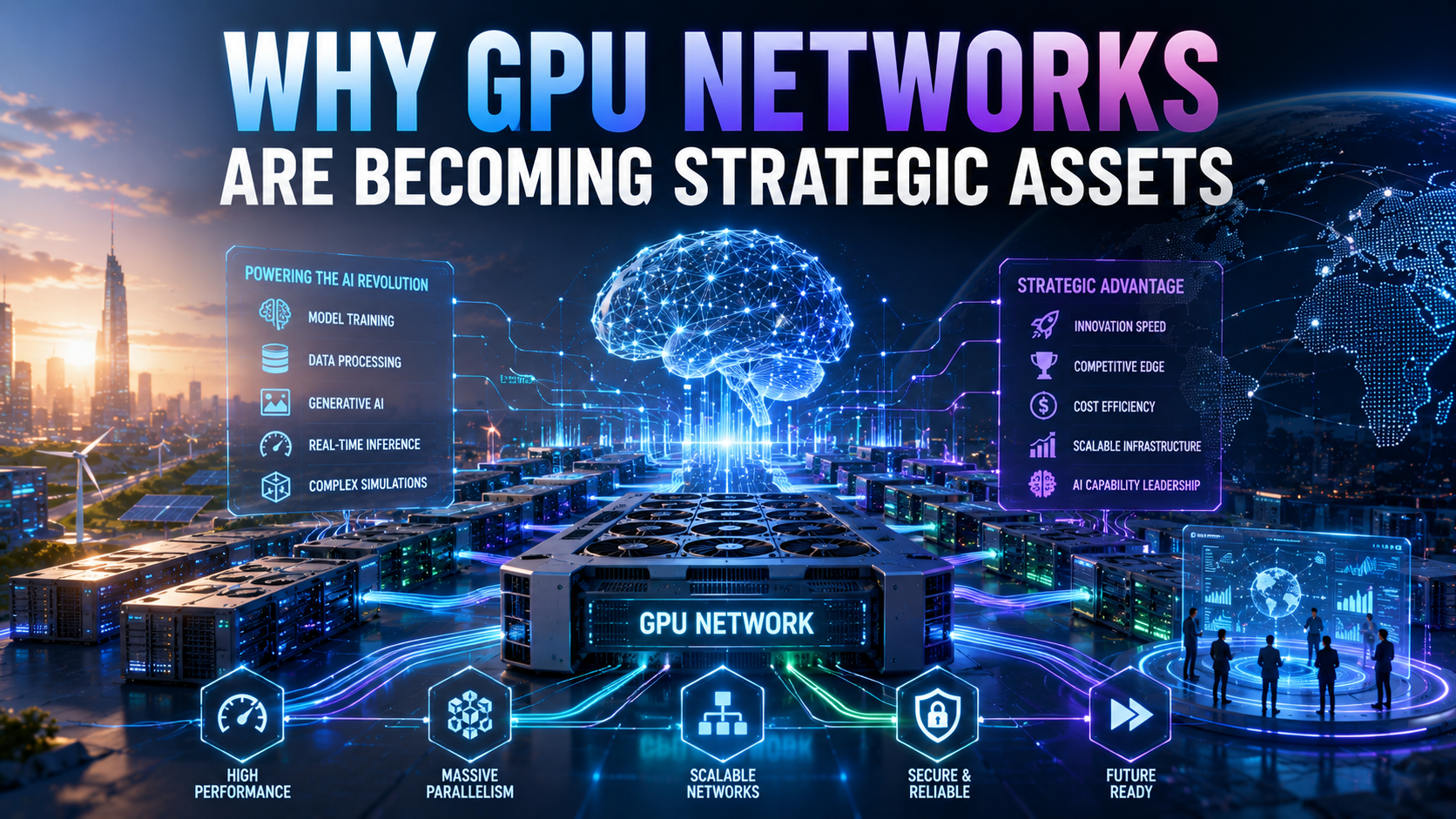
- Train machine learning models faster
- Handle large-scale data processing
- Accelerate deep learning workloads
- Support real-time AI applications
- Run complex simulations
Without GPU infrastructure, many of today's AI breakthroughs would simply not be practical.
The intelligence people interact with every day is powered by vast networks of GPUs working behind the scenes.
The Growing Demand for Compute Power
The demand for AI has expanded far beyond research laboratories.
Today, AI is being integrated into:
- Healthcare
- Finance
- Manufacturing
- Education
- Cybersecurity
- Retail
- Logistics
- Entertainment
Every industry is exploring how intelligent systems can improve operations, increase efficiency, and create new opportunities.
As adoption grows, the demand for computational resources grows alongside it.
Organizations are no longer competing solely for talent or data.
They are competing for access to compute.
This shift is creating a new kind of infrastructure race.
Why GPU Networks Matter More Than Individual GPUs
When people think about GPUs, they often imagine a single high-performance device.
In reality, modern AI development depends on GPU networks.
These networks connect thousands of GPUs together, allowing them to function as a unified computational system.
The scale is extraordinary.
Advanced AI models require:
- Massive parallel processing
- Distributed computing environments
- High-speed networking
- Sophisticated orchestration systems
A single GPU can be powerful.
A coordinated GPU network can power an entire AI ecosystem.
This is why companies increasingly focus on building and securing access to large-scale GPU infrastructure rather than simply purchasing individual hardware components.
The Strategic Importance of GPU Ownership
Historically, technology companies viewed computing infrastructure as an operational expense.
Today, it is increasingly viewed as a strategic asset.
Why?
Because access to GPU resources directly impacts:
Innovation Speed
Organizations with more compute can train models faster and experiment more frequently.
Competitive Advantage
Companies with reliable GPU access can develop products and services more efficiently.
Cost Efficiency
Owning or controlling infrastructure reduces dependence on external providers.
AI Capability
The complexity and scale of AI systems are often limited by available compute resources.
In many cases, access to GPU networks determines what is technologically possible.
The Rise of Decentralized GPU Networks
One of the most interesting developments is the emergence of decentralized GPU infrastructure.
Traditionally, large cloud providers controlled most high-performance computing resources.
However, decentralized models are beginning to gain attention.
These networks allow organizations and individuals to contribute unused GPU capacity to shared ecosystems.
The benefits can include:
- Increased accessibility
- Reduced infrastructure bottlenecks
- Greater resilience
- Lower costs
- Global distribution
While still evolving, decentralized GPU networks may play an important role in supporting future AI growth.
They represent an alternative approach to scaling computational resources beyond traditional centralized systems.
GPU Infrastructure and National Competitiveness
The strategic importance of GPU networks extends beyond private companies.
Governments around the world increasingly recognize that AI capabilities influence economic growth, technological leadership, and national security.
As a result, access to advanced computing infrastructure is becoming a geopolitical consideration.
Countries investing in AI development are simultaneously investing in:
- Semiconductor manufacturing
- Data centers
- Cloud infrastructure
- High-performance computing
- AI research ecosystems
The race for AI leadership is, in many ways, a race for computational capacity.
GPU networks sit at the center of that competition.
The Hidden Backbone of Every AI Product
Consumers often see the final product.
A chatbot.
An image generator.
A recommendation engine.
A virtual assistant.
What they rarely see is the infrastructure supporting those experiences.
Behind every AI application lies an enormous network of hardware, software, and computational resources.
GPU networks make these systems possible.
They process requests, train models, generate outputs, and enable real-time intelligence at scale.
Without GPU infrastructure, the AI products shaping today' s digital economy would not exist.
Challenges Facing GPU Infrastructure
Despite their importance, GPU networks face significant challenges.
Supply Constraints
Demand for advanced GPUs continues to exceed supply in many markets.
Energy Consumption
Large-scale AI workloads require substantial amounts of electricity.
Cost
Building and maintaining GPU infrastructure remains expensive.
Accessibility
Smaller organizations often struggle to access the same computational resources as large enterprises.
Addressing these challenges will be critical as AI adoption accelerates globally.
What the Future Looks Like
The importance of GPU networks is unlikely to decrease.
In fact, demand will probably grow as AI becomes more integrated into everyday life.
Future developments may include:
- More efficient hardware architectures
- Specialized AI accelerators
- Global decentralized compute networks
- Sustainable data center designs
- AI-driven infrastructure management
At the same time, organizations will increasingly view compute power as a strategic resource rather than a technical utility.
Just as cloud computing transformed software development, GPU networks are transforming artificial intelligence.
Final Thoughts
Artificial intelligence may be defined by algorithms, but it is powered by infrastructure.
As AI systems become larger, smarter, and more capable, access to computational resources becomes increasingly important.
GPU networks have emerged as the foundational layer supporting this transformation.
They are no longer simply pieces of hardware.
They are strategic assets that influence innovation, competitiveness, and economic growth.
Organizations that understand the value of computational infrastructure today will be better positioned to lead tomorrow's AI-driven economy.
Because in the age of artificial intelligence, the most valuable resource may not be data alone.
It may be the ability to process it.
At BitViraj Technology, we believe the future of AI depends not only on intelligent software but also on the infrastructure that powers it. As GPU networks continue to evolve, they will play a defining role in shaping the next generation of digital innovation.
Case Studies
Empowering Digital
Evolution



Blogs
Empowering Digital
Evolution
BitViraj Technologies - Your Gateway to
Tomorrow's Innovations




Embark on a DigitalJourney


The next-generation digital technology company Bitviraj has the potential to empower and reinvent business in the current fast-paced market.


Our Service
- Website Development
- Application Development
- Blockchain Development
- Gaming and Metaverse