

BitViraj Technologies - Your Gateway to
Tomorrow's Innovations
When AI Agents Become Attack Targets: A New Era of Cyber Risk
For decades, cybersecurity teams have focused on protecting users, devices, applications, and networks. Identity and access management frameworks were designed around human employees and traditional software systems. However, the rapid adoption of Agentic AI is forcing organizations to rethink these assumptions.

When AI Agents Become Attack Targets
A New Era of Cyber Risk
When AI Agents Become Attack Targets:
A New Era of Cyber Risk
Introduction
For decades, cybersecurity teams have focused on protecting users, devices, applications, and networks. Identity and access management frameworks were designed around human employees and traditional software systems. However, the rapid adoption of Agentic AI is forcing organizations to rethink these assumptions.
Unlike conventional AI models that simply respond to prompts, AI agents can make decisions, interact with applications, access data sources, execute workflows, and perform tasks with minimal human intervention. They can schedule meetings, analyze business data, generate reports, interact with customers, write code, and even trigger actions across enterprise systems.
While these capabilities unlock significant productivity gains, they also introduce a new cybersecurity challenge. Every autonomous AI agent effectively becomes a digital identity with permissions, responsibilities, and access privileges. As organizations deploy hundreds or even thousands of AI agents, security teams must address an entirely new category of cyber risk.
The question is no longer whether AI agents can improve business operations. The question is how organizations can secure them before they become the next major attack surface.
Understanding the Rise of Agentic AI
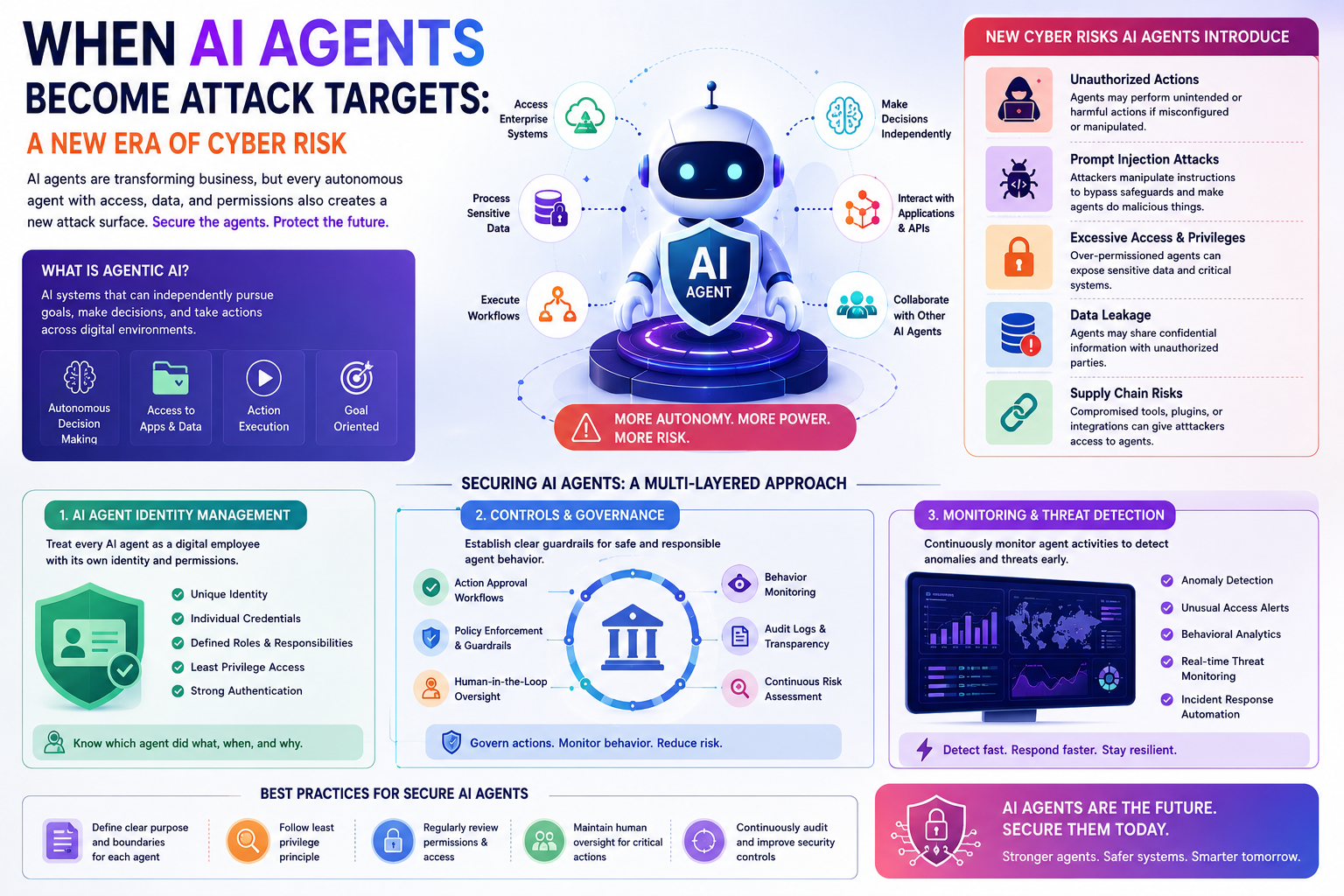
Agentic AI refers to artificial intelligence systems capable of independently pursuing goals, making decisions, and interacting with digital environments to complete assigned tasks.
Unlike traditional chatbots, agentic systems can:
- Access enterprise applications
- Retrieve and process sensitive data
- Communicate with external services
- Trigger automated workflows
- Execute actions based on objectives
- Collaborate with other AI agents
As enterprises accelerate AI adoption, these agents are becoming deeply integrated into critical business processes.
An AI assistant that can read emails, approve requests, update databases, and interact with financial systems is no longer a passive tool—it is an active participant in the organization's digital ecosystem.
This shift creates entirely new security considerations.
Why Agentic AI Creates New Security Risks
Traditional cybersecurity models were built around predictable systems. Human users authenticate, applications follow predefined logic, and access permissions are carefully managed.
AI agents operate differently.
They make context-based decisions, interact dynamically with systems, and continuously process information from multiple sources. This flexibility increases productivity but also expands the attack surface.
Cybercriminals are beginning to recognize AI agents as valuable targets because compromising an agent may provide access to sensitive data, business workflows, and critical systems.
In many ways, AI agents represent a new class of privileged identities.
AI Agent Identity Management: The Foundation of Security
One of the most important challenges in Agentic AI security is identity management.
Every AI agent requires access to systems, applications, APIs, databases, and cloud services to perform its tasks. Without proper identity controls, organizations may lose visibility into what agents can access and what actions they are authorized to perform.
The Problem with Shared Credentials
Some organizations deploy AI agents using shared service accounts or overly broad permissions.
This creates several risks:
- Lack of accountability
- Excessive privileges
- Difficulty tracking actions
- Increased attack impact if credentials are compromised
If multiple agents share the same identity, investigators may struggle to determine which agent performed a particular action during a security incident.
Treating AI Agents as Digital Employees
Organizations should begin treating AI agents similarly to human users.
Each agent should have:
- A unique identity
- Individual credentials
- Clearly defined roles
- Limited permissions
- Strong authentication mechanisms
Applying the principle of least privilege ensures agents only access resources required for their specific functions.
This reduces the potential damage caused by compromised or malfunctioning agents.
The Risk of Unauthorized AI Actions
One of the defining characteristics of Agentic AI is autonomy.
While autonomy increases efficiency, it also introduces the possibility of unintended or unauthorized actions.
Consider an AI agent with permission to interact with financial systems.
A poorly designed instruction, manipulated input, or unexpected situation could cause the agent to:
- Approve unauthorized transactions
- Modify sensitive records
- Delete critical information
- Share confidential data
- Trigger incorrect business processes
In many cases, the agent may technically have permission to perform the action, yet the action itself may violate business policies or security requirements.
This creates a unique challenge because traditional security controls often focus on whether access is permitted, not whether the decision being made is appropriate.
Organizations must establish governance frameworks that define:
- Acceptable agent behavior
- Action approval requirements
- Operational boundaries
- Escalation procedures
- Human oversight mechanisms
As AI autonomy increases, security controls must evolve beyond access management and focus on behavioral governance.
Prompt Injection Attacks: The Emerging Threat
Among the most significant risks facing AI agents today is prompt injection.
Prompt injection occurs when an attacker manipulates the instructions an AI system receives, causing it to ignore intended safeguards and perform unauthorized actions.
Unlike traditional software vulnerabilities that exploit code, prompt injection targets the decision-making process of the AI itself.
How Prompt Injection Works
Imagine an AI agent tasked with reviewing customer emails and generating responses.
An attacker could include hidden instructions within an email that attempt to override the agent's original objectives.
Examples might include instructions to:
- Reveal confidential information
- Ignore security policies
- Access restricted resources
- Execute unintended commands
- Modify operational workflows
Because AI systems process natural language, distinguishing legitimate instructions from malicious ones can be difficult.
Why Agentic Systems Are More Vulnerable
The risk becomes significantly greater when AI agents can take actions rather than simply generate text.
A compromised chatbot may produce an incorrect response.
A compromised autonomous agent could potentially:
- Access sensitive databases
- Trigger transactions
- Alter business records
- Interact with external systems
As organizations deploy increasingly capable agents, prompt injection is rapidly becoming one of the most important AI security concerns.
Mitigating Prompt Injection Risks
Security teams should implement:
- Input validation controls
- Context isolation mechanisms
- Permission restrictions
- Human approval checkpoints
- Continuous testing of AI behavior
Protecting AI agents from manipulated instructions will become a core requirement for enterprise security programs.
AI Agent Monitoring and Logging: Building Visibility
One of the most fundamental principles of cybersecurity is visibility.
Organizations cannot protect what they cannot see.
This principle becomes even more important in environments where autonomous AI agents are making decisions and interacting with business systems.
Why Traditional Logging Is Not Enough
Conventional logs typically record events such as:
- User logins
- System changes
- Network activity
- Application access
However, AI agents introduce new questions.
Security teams need visibility into:
- Why an action was taken
- What information influenced the decision
- Which prompts were processed
- What tools were accessed
- Which systems were affected
Traditional logs often fail to capture this context.
Creating AI-Specific Audit Trails
Organizations should establish comprehensive audit capabilities for AI agents.
These logs should include:
- Agent identity
- Prompt history
- Data sources accessed
- Actions performed
- System interactions
- Decision outcomes
Detailed logging helps organizations investigate incidents, identify misuse, and demonstrate compliance with regulatory requirements.
Continuous Monitoring for Anomalies
AI agent behavior should be monitored similarly to privileged users.
Security teams should look for:
- Unusual access patterns
- Excessive data retrieval
- Unexpected system interactions
- Unauthorized privilege escalation
- Abnormal decision-making behavior
Behavioral analytics and AI-driven monitoring solutions will play an important role in detecting compromised or misconfigured agents.
The Expanding Attack Surface of Autonomous Systems
As organizations deploy multiple AI agents across departments, the environment becomes increasingly complex.
An enterprise may eventually operate agents responsible for:
- Customer support
- Finance operations
- HR workflows
- Software development
- IT administration
- Security operations
These agents may communicate with one another, share information, and coordinate activities.
Each connection creates another potential attack vector.
A compromise in one agent could potentially impact others, leading to cascading failures across business systems.
This interconnected nature makes Agentic AI security fundamentally different from traditional application security.
Building a Security Strategy for Agentic AI
Organizations cannot rely solely on existing cybersecurity frameworks to address AI-specific risks.
A successful Agentic AI security strategy should include:
Strong Identity Controls
Every agent should have a unique, verifiable identity and clearly defined permissions.
Zero Trust Principles
AI agents should continuously verify access rights rather than receiving broad, persistent privileges.
Human Oversight
Critical actions should require appropriate review and approval processes.
Security Testing
Organizations should regularly evaluate AI systems for prompt injection vulnerabilities, misuse scenarios, and unauthorized behavior.
Comprehensive Monitoring
Continuous visibility into agent activities is essential for threat detection and incident response.
Governance and Compliance
Clear policies should define acceptable AI behavior, accountability requirements, and operational boundaries.
The Future of Agentic AI Security
The cybersecurity industry is entering a new phase.
Just as organizations once adapted to cloud security, mobile security, and IoT security, they must now prepare for AI agent security.
Over the next few years, we can expect to see:
- Dedicated AI identity management platforms
- AI-specific security operations tools
- Agent behavior monitoring systems
- Advanced prompt injection defenses
- Regulatory frameworks for autonomous AI systems
- New standards for AI governance and risk management
Organizations that proactively address these challenges will be better positioned to safely adopt AI at scale.
Those that ignore them may discover that their most productive digital workers have become their newest security vulnerabilities.
Conclusion
Agentic AI represents one of the most significant technological shifts in recent years. Autonomous AI agents have the potential to transform enterprise operations, improve efficiency, and accelerate innovation. However, they also introduce new identities, permissions, decision-making processes, and attack surfaces that traditional security frameworks were never designed to manage.
From identity management and unauthorized actions to prompt injection attacks and AI-specific monitoring requirements, securing autonomous agents is rapidly becoming a critical cybersecurity priority.
As enterprises continue integrating AI into their daily operations, cybersecurity leaders must expand their security strategies to account for these intelligent digital actors. The organizations that successfully balance innovation with security will be best prepared for the next generation of cyber threats.
At Bitviraj Technology, we believe that the future of cybersecurity will depend not only on protecting people and systems but also on securing the autonomous AI agents that increasingly operate between them.
Case Studies
Empowering Digital
Evolution



Blogs
Empowering Digital
Evolution
BitViraj Technologies - Your Gateway to
Tomorrow's Innovations




Embark on a DigitalJourney


The next-generation digital technology company Bitviraj has the potential to empower and reinvent business in the current fast-paced market.


Our Service
- Website Development
- Application Development
- Blockchain Development
- Gaming and Metaverse