


BitViraj Technologies - Your Gateway to
Tomorrow's Innovations
Edge AI
Bringing Intelligence Closer to Users
Introduction
Artificial Intelligence (AI) has become a driving force behind digital transformation. From virtual assistants and recommendation engines to predictive analytics and automation, AI is changing how businesses operate and how people interact with technology. Traditionally, most AI applications have relied on cloud computing, where data is sent to remote servers for processing before results are returned to users.
While this model has worked well for many use cases, it also comes with challenges such as latency, bandwidth limitations, privacy concerns, and dependence on internet connectivity. As businesses demand faster and more responsive AI-powered experiences, a new approach is gaining momentum—Edge AI.
Instead of sending every piece of data to the cloud, Edge AI brings intelligence directly to the devices that generate the data. Whether it's a smartphone, a security camera, a medical device, or an autonomous vehicle, these systems can now process information locally and make decisions in real time.
At Bitviraj Technology, we believe Edge AI is one of the most significant advancements in modern computing. It is reshaping industries by making artificial intelligence faster, smarter, and more accessible than ever before.
In this article, we'll explore what Edge AI is, why it matters, and how it's transforming the way businesses and users experience intelligent technology.
What Is Edge AI?
Edge AI refers to the deployment of artificial intelligence algorithms directly on edge devices rather than relying entirely on centralized cloud servers.
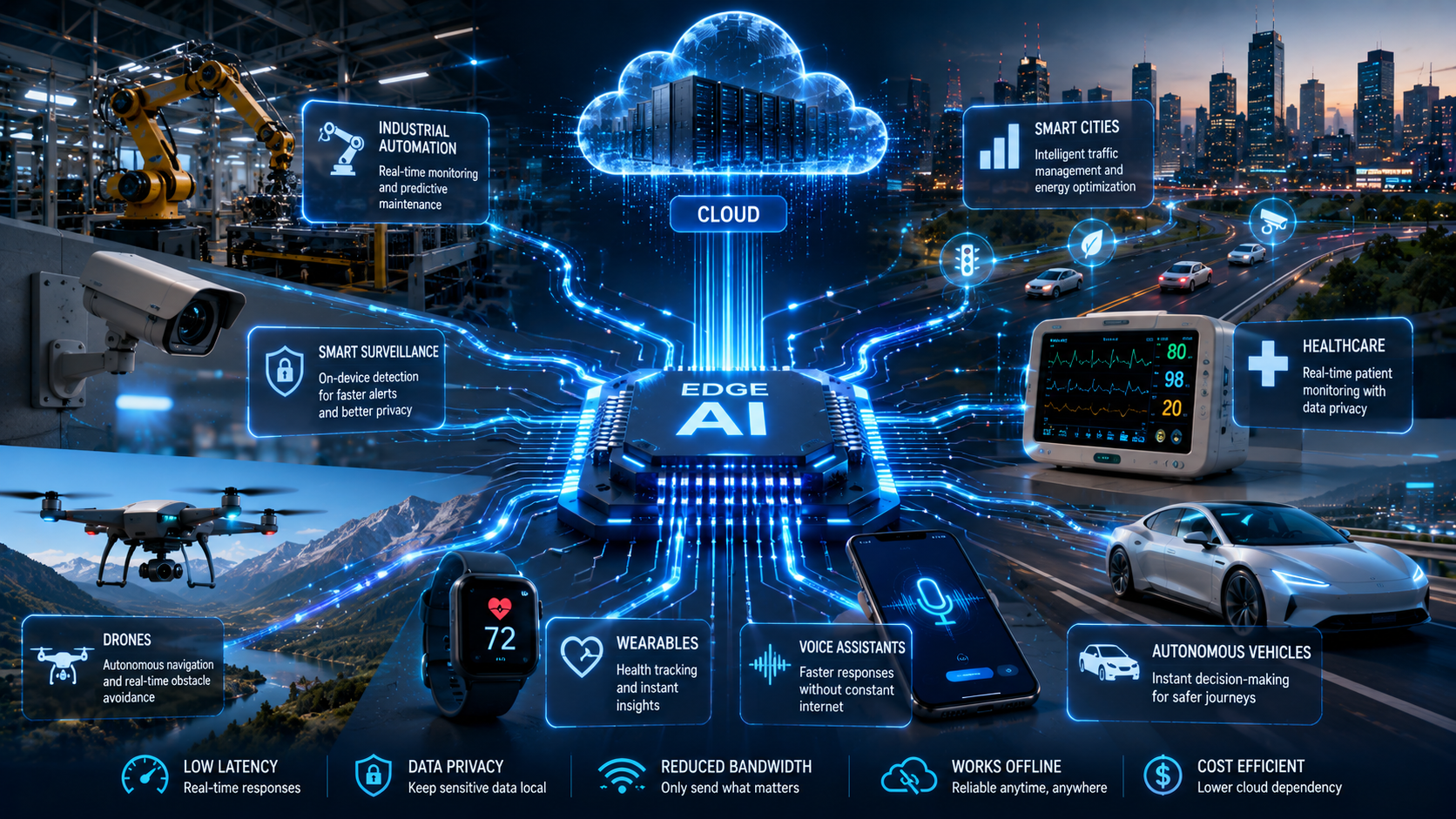
An edge device is any hardware that collects or processes data near its source. Examples include:
- Smartphones
- Smart cameras
- Industrial sensors
- Wearable devices
- Drones
- Autonomous vehicles
- Smart home devices
- Medical equipment
Instead of transmitting all data to a distant data center, these devices analyze information locally using AI models.
Only essential information may be sent to the cloud for storage, reporting, or further analysis.
This approach enables immediate decision-making while reducing dependence on constant internet connectivity.
Why Traditional Cloud AI Has Limitations
Cloud-based AI has powered many technological innovations, but it isn't always the ideal solution.
Imagine a self-driving car detecting a pedestrian crossing the road.
Waiting even a second for cloud processing could have serious consequences.
Similarly, a factory monitoring machine failures or a hospital using AI-assisted medical devices cannot afford communication delays.
Cloud AI also faces other challenges, including:
- Network latency
- High bandwidth consumption
- Privacy concerns
- Internet dependency
- Increased operational costs
These limitations have accelerated the adoption of Edge AI across multiple industries.
How Edge AI Works
Edge AI combines machine learning models with edge computing infrastructure.
The process typically works like this:
- A device collects data using sensors or cameras.
- AI software processes the information locally.
- The device makes an immediate decision.
- Only selected information is transmitted to the cloud if necessary.
For example, a smart security camera can identify suspicious activity in real time without uploading continuous video footage.
Instead, it sends only alerts or relevant video clips, reducing bandwidth while improving response times.
Key Benefits of Edge AI
1. Real-Time Decision Making
Perhaps the biggest advantage of Edge AI is speed. Because processing happens directly on the device, there is almost no delay between collecting data and generating insights.
This is essential for applications like:
- Autonomous vehicles
- Industrial automation
- Healthcare monitoring
- Robotics
- Smart manufacturing
When every millisecond matters, Edge AI delivers results much faster than cloud-based systems.
2. Reduced Latency
Latency refers to the time required for data to travel between a device and a remote server. In cloud environments, even fast internet connections introduce delays.
Edge AI eliminates much of this communication by keeping processing local. The result is a smoother, more responsive user experience. Whether unlocking a smartphone using facial recognition or translating speech instantly, users benefit from immediate AI responses.
3. Improved Privacy and Security
Privacy has become a major concern for both consumers and businesses. Many AI applications process sensitive information, including medical records, personal photos, financial transactions, voice recordings, and surveillance footage.
Edge AI keeps much of this data on the local device. Instead of transmitting sensitive information across the internet, only essential insights leave the device. This significantly reduces exposure to cyber threats while helping organizations comply with privacy regulations.
4. Lower Bandwidth Usage
Modern devices generate enormous amounts of data. A single surveillance camera, for example, can record hundreds of gigabytes of video every day. Uploading all that data to the cloud is expensive and inefficient.
Edge AI processes the information locally and transmits only relevant events. This dramatically reduces network traffic while lowering cloud storage costs.
5. Reliable Performance Without Constant Internet Access
Many locations still experience unreliable internet connectivity. Factories, construction sites, farms, ships, and remote healthcare facilities often operate in areas with limited network coverage.
Edge AI allows intelligent systems to continue functioning even when internet access is unavailable. Once connectivity returns, important information can be synchronized with cloud systems. This reliability makes Edge AI particularly valuable in remote environments.
Industries Transforming Through Edge AI
Healthcare
Hospitals and healthcare providers increasingly use Edge AI for real-time patient monitoring. Medical devices can instantly analyze heart rates, oxygen levels, or other vital signs without waiting for cloud processing. Doctors receive faster alerts during emergencies, potentially improving patient outcomes.
Manufacturing
Modern factories depend on predictive maintenance and quality control. Edge AI monitors equipment continuously, identifying unusual patterns before machinery fails. Manufacturers reduce downtime while improving operational efficiency.
Retail
Retailers use Edge AI to enhance customer experiences. Smart cameras analyze customer movement, optimize store layouts, and monitor inventory without sending continuous video streams to centralized servers. Self-checkout systems also benefit from faster local processing.
Transportation
Autonomous vehicles represent one of the most demanding applications of Edge AI. Cars must identify road signs, detect obstacles, recognize pedestrians, and make driving decisions within milliseconds. Local AI processing makes this possible. Even advanced driver-assistance systems rely heavily on Edge AI technologies.
Smart Cities
Cities are becoming increasingly connected through intelligent infrastructure. Traffic cameras, environmental sensors, parking systems, and public safety devices all generate valuable information. Edge AI processes this data locally, enabling smarter traffic management, faster emergency responses, improved energy efficiency, and better public safety.
Edge AI and the Internet of Things (IoT)
The rapid expansion of IoT has created billions of connected devices worldwide.
Each device produces continuous streams of data.
Sending every sensor reading to the cloud would overwhelm networks and increase operational costs.
Edge AI solves this challenge by allowing IoT devices to analyze information where it is generated.
Only meaningful insights are shared with central systems.
This combination of IoT and Edge AI creates intelligent ecosystems capable of making decisions independently.
Challenges of Edge AI
Despite its many advantages, Edge AI also presents several challenges.
Limited Hardware Resources
Edge devices generally have less computing power than cloud servers. Developers must optimize AI models to run efficiently on smaller processors.
Device Management
Organizations may need to manage thousands of AI-enabled devices. Updating software, deploying new models, and maintaining security across distributed environments requires careful planning.
Security Risks
Although Edge AI improves privacy, physical devices can still become targets for cyberattacks. Businesses must implement strong encryption, authentication, and regular software updates.
Development Complexity
Designing AI applications that work efficiently across both cloud and edge environments requires specialized expertise. Organizations often need experienced technology partners to build scalable Edge AI solutions.
The Future of Edge AI
The future of Edge AI looks incredibly promising.
Several emerging technologies are accelerating its growth, including:
- 5G connectivity
- Advanced AI chips
- Tiny machine learning (TinyML)
- Smart robotics
- Autonomous transportation
- Augmented Reality (AR)
- Virtual Reality (VR)
As AI models become smaller and hardware becomes more powerful, intelligent devices will perform increasingly complex tasks without relying on remote cloud servers.
Businesses that embrace Edge AI today will be better positioned to deliver faster services, improve customer experiences, and create innovative products.
Why Businesses Should Start Exploring Edge AI
Organizations don't need to replace cloud computing entirely.
Instead, the future lies in combining cloud and edge technologies.
Cloud platforms remain ideal for large-scale data storage, AI model training, and centralized management.
Edge AI complements these capabilities by handling real-time decision-making close to users.
This hybrid approach offers:
- Faster performance
- Greater reliability
- Enhanced security
- Lower operational costs
- Better customer experiences
Businesses that strategically adopt Edge AI can unlock new opportunities while building more responsive digital ecosystems.
Final Thoughts
Artificial Intelligence is no longer confined to powerful cloud servers. With Edge AI, intelligence is moving closer to where data is created and where decisions need to be made. This shift is enabling real-time responses, stronger privacy, reduced bandwidth usage, and more reliable performance across industries.
From healthcare and manufacturing to retail, transportation, and smart cities, Edge AI is redefining how organizations use technology to solve real-world problems. As connected devices continue to grow in number and capability, processing data locally will become an essential part of delivering faster and more intelligent digital experiences.
At Bitviraj Technology, we help businesses stay ahead of technological change by building scalable, future-ready solutions powered by AI, cloud computing, and edge technologies. Whether you're developing intelligent IoT devices, modernizing enterprise infrastructure, or exploring next-generation automation, Edge AI offers exciting possibilities for innovation.
The future of AI isn't just smarter—it's closer, faster, and more connected than ever before.
Case Studies
Empowering Digital
Evolution



Blogs
Empowering Digital
Evolution
BitViraj Technologies - Your Gateway to
Tomorrow's Innovations



Embark on a DigitalJourney


The next-generation digital technology company Bitviraj has the potential to empower and reinvent business in the current fast-paced market.


Our Service
- Website Development
- Application Development
- Blockchain Development
- Gaming and Metaverse